
The Great AI Gifting Showdown: Which Model Should You Trust for Christmas Shopping?
First published on the previous version of Spring Prompt. Results describe the benchmarks and models as they were on that date, and may differ from the current results.
It’s that time of year again. You’re out and about, the clock is ticking, and you still haven't found the perfect gift for your partner, your roommate, or that difficult-to-shop-for in-law. Naturally, many of us are turning to AI chatbots to brainstorm ideas.
But not all AIs are created equal when it comes to the nuances of gift-giving. Does ChatGPT understand "thoughtfulness"? Can Claude actually predict what your brother wants, or just what he needs?
We ran a rigorous test using Spring Prompt to find out exactly which AI model deserves to be your personal shopping assistant this holiday season. Here is the data-backed verdict.
This experiment was also recorded as a video on YouTube - you can view that here.
The Experiment Setup
To get a scientific answer to a subjective question, we set up a comprehensive test environment.
- The Task: We fed the AI models 121 specific "Test Cases." Each case included a recipient profile (relationship, budget, likes/dislikes) and a history of previous gifts.
- The Goal: The AI had to generate a specific gift recommendation.
- The Judges: We didn't just eyeball the results. We used a dual-evaluation system:
- LLM-as-a-Judge (Gemini 3 Pro): An AI judge scored the recommendations based on key gifting metrics like "Happiness," "Thoughtfulness," and "Value Asymmetry" (giving more value than the item costs).
- The "Would I Buy This" Classifier: A custom-trained classifier modeled on human preferences to predict if a human shopper would actually pull the trigger on the suggestion.
The Contenders
We pitted the heavy hitters (Frontier Models) against some faster, lightweight options to see if "smarter" really means better for shopping.
- Google: Gemini 3 Pro Preview
- Anthropic: Claude Opus 4.5
- OpenAI: GPT-5.2
- xAI: Grok 4.1 Fast
- Mistral: Mistral Small 3.2 24B
- Meta: Llama 4 Maverick
The Results: Who Won Christmas?
After running over 700 simulations, the data revealed a clear hierarchy.
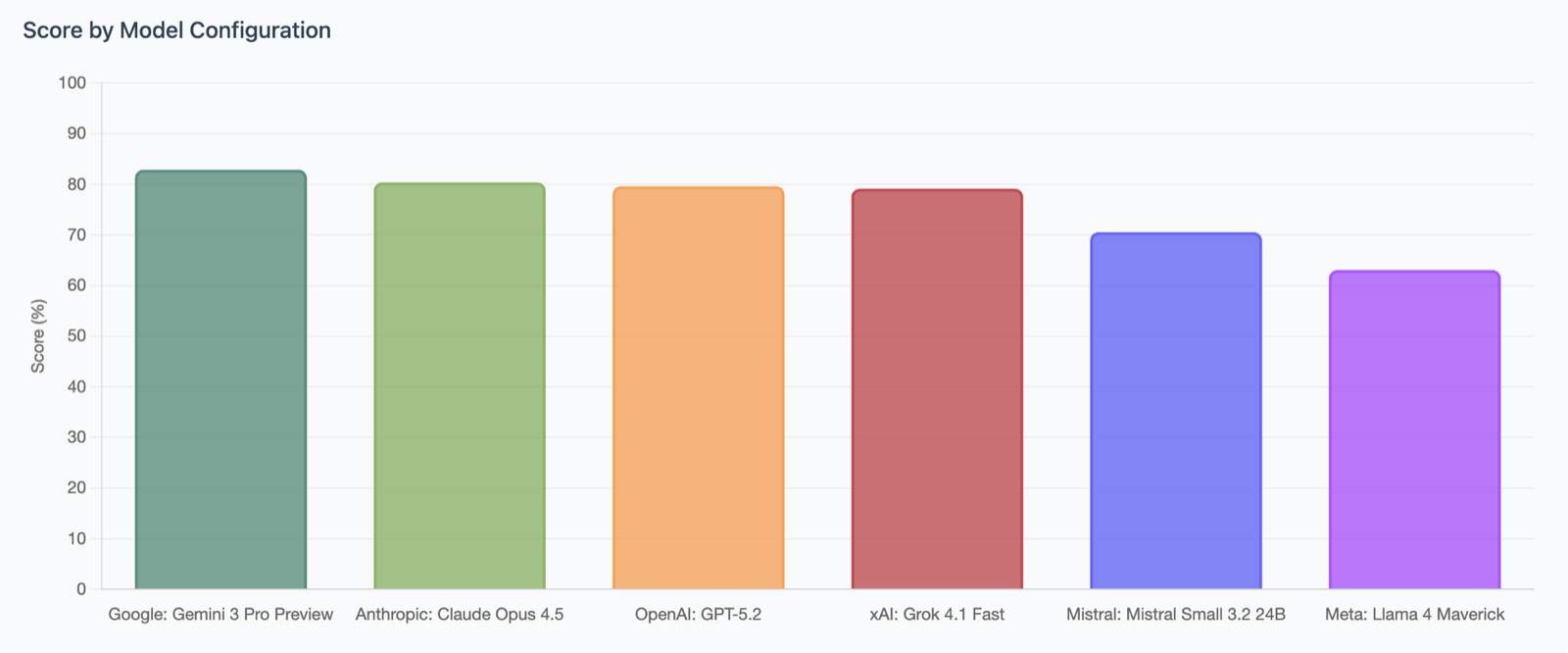
1. The Winner: Google Gemini 3 Pro Preview (Score: 82.9%)
Gemini took the crown with the highest average score. It excelled at understanding the "Slight Stretch" trait—finding gifts that a recipient would love but wouldn't necessarily buy for themselves. It consistently navigated complex constraints (like avoiding friction) better than the rest.
2. The Runner Up: Anthropic Claude Opus 4.5 (Score: 80.4%)
Claude came in a strong second. It performed exceptionally well on "Value Asymmetry" and "Recipient Happiness," though it fell just slightly behind Gemini in the overall aggregate score.
3. The Efficient Contender: GPT-5.2 (Score: 79.6%)
OpenAI’s model took third place. While it didn't top the charts, it offered a very competitive performance with significantly lower latency and cost compared to the winner (more on that below).
The Surprise Performance: Grok 4.1 Fast (Score: 79.1%)
Despite being a "Fast" model, Grok punched well above its weight class, landing virtually tied with GPT-5.2. If you need speed without sacrificing much quality, this was the standout.
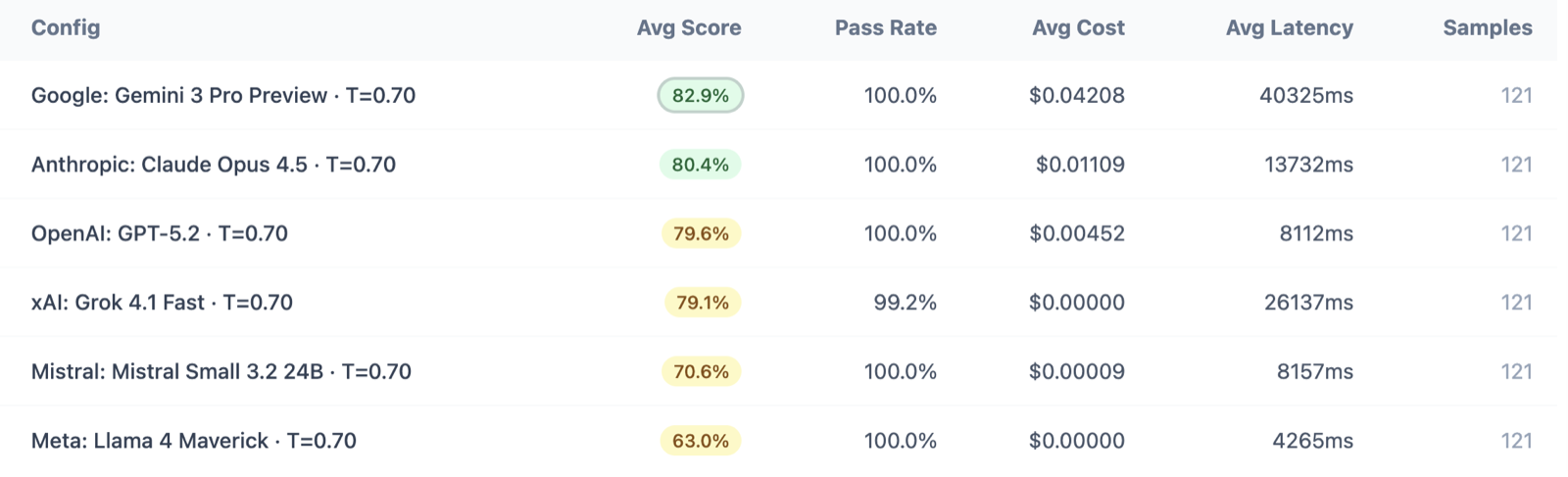
The Disappointments: Mistral & Llama
- Mistral Small (70.6%) struggled to keep up with the creative demands of gifting.
- Llama 4 Maverick (63.0%) came in last. It failed significant logic tests. For example, in a test case where the user explicitly stated "No items requiring special fuel" for a camping enthusiast, Llama recommended a stove that required special fuel. It ignored negative constraints, which is a major red flag for reliable shopping assistance.
Deep Dive: Where Do AI Models Struggle?
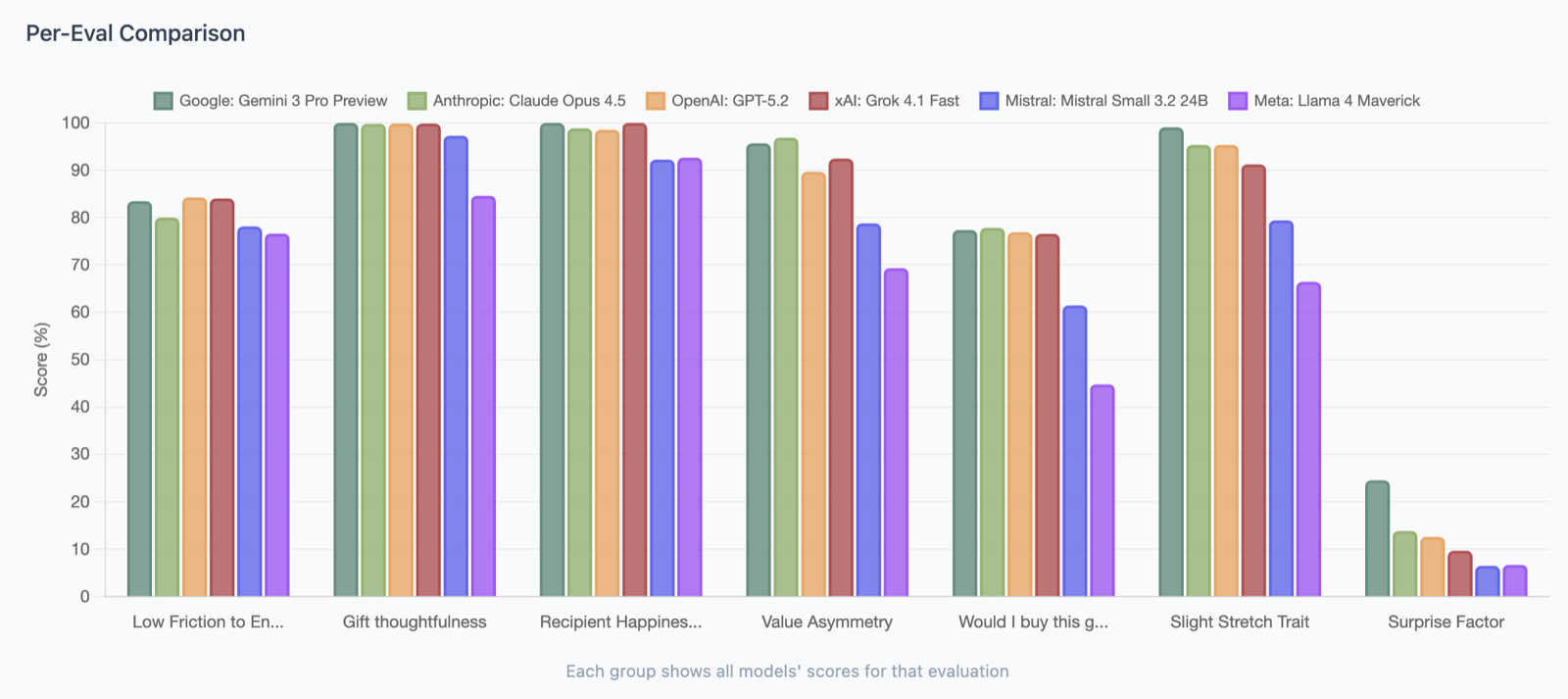
Looking at the Per-Eval Comparison chart, we found some fascinating trends about how AI thinks about gifts:
- The "Surprise" Problem: Across the board, AI is terrible at surprising you. Even Gemini only scored ~25% on the "Surprise Factor" metric. The models are biased toward "safe" and "relevant" rather than "shocking" or "novel."
- High Happiness: Almost all the top models scored near-perfectly on predicted "Recipient Happiness" and "Gift Thoughtfulness." If you use a Frontier model, you likely won't buy a bad gift.
- Human Preference: On the "Would I buy this gift?" classifier, the top four models all hovered around 77% accuracy. This suggests a plateau in how well current AI can mimic the gut feeling of a human shopper.
The Cost of Thoughtfulness
While Gemini 3 Pro won on quality, it lost on efficiency.
| Model | Avg Score | Avg Cost (per run) | Avg Latency (Wait time) |
| Gemini 3 Pro | 82.9% | $0.042 | ~40 seconds |
| Claude Opus 4.5 | 80.4% | $0.011 | ~13 seconds |
| GPT-5.2 | 79.6% | $0.004 | ~8 seconds |
Gemini is the "luxury" shopper. It costs 10x more than GPT-5.2 and takes nearly a minute to "think" about the gift. It engages in deep reasoning to ensure it hits the mark. Meanwhile, GPT-5.2 and Grok are the "express" shoppers—cheap, fast, and almost as good.
The Verdict
So, which AI should you use?
- For the absolute best gift: Use Gemini 3 Pro. If you are stuck on a really important gift for a spouse or close family member, the extra "reasoning" capabilities and high thoughtfulness score make it worth the wait.
- For quick brainstorming: Use GPT-5.2 or Grok. They are significantly faster and cheaper, and their recommendations are nearly indistinguishable from the top tier for casual gifting.
- Avoid: Llama 4 Maverick. Unless you want to buy a camping stove for someone who explicitly said they don't want a camping stove.
Happy Shopping!
Ready to run your own AI experiments or LLM optimisations? Whether you're building a gifting bot, testing customer support replies, or just curious which model handles your specific data best, Spring Prompt makes it easy to set up rigorous evaluations in minutes. We are currently opening up access to our beta—head over to Spring Prompt and sign up for the waitlist to start benchmarking the models that matter to you.