Confirm Action

Are you sure you want to proceed?

ARC Prize Foundation · ARC-AGI-3 (2026)

Verified results through 2026-07-24

ARC-AGI-3 benchmark: scores, methodology, and results

ARC-AGI-3 is an interactive reasoning benchmark. A system must explore unfamiliar game-like environments, infer their rules, pursue a goal, and act efficiently without being given task instructions.

Current published leader
Claude Opus 5 · High
Top score
30.16%
Primary metric
RHAE · 0–100
Evaluation subject
model configuration in ARC's evaluation loop

ARC Prize verified · semi-private

All verified ARC-AGI-3 model scores

26 configurations · 12 model families

This page includes every scored entry on ARC Prize's official verified ARC-AGI-3 track reviewed through 30 July 2026. Entries marked N/A and separate community/custom-harness results are not mixed into this table. Scores are RHAE percentages, not question-answer accuracy.

Best verified score by model family

Each mark shows the strongest published configuration for one model family on ARC's official verified track. Labels contain the exact RHAE score.

  1. Claude Opus 5 30.16%
  2. GPT-5.6 Sol 7.78%
  3. Claude Opus 4.8 1.50%
  4. GPT-5.6 Terra 0.80%
  5. Anthropic Opus 4.6 0.50%
  6. GPT-5.5 0.43%
  7. Gemini 3.1 Pro Preview 0.40%
  8. Grok 4.5 0.30%
  9. GPT-5.4 0.20%
  10. GPT-5.6 Luna 0.18%
  11. Opus 4.7 0.18%
  12. Grok 4.20 0.10%
0.0 15.1 30.2

RHAE · 0–100

Official verified semi-private track only; entries with no ARC-AGI-3 score are omitted. Community/custom-harness track ↗

How to interpret the result

What does this mean?

The headline number is useful only when you read it as a result from one evaluated system under one protocol. Here is the practical reading.

1. Read the percentage correctly

30.16% is a semi-private RHAE score. It combines progress with action efficiency relative to humans; it is not the percentage of questions answered correctly. ARC Prize reported Claude Opus 5 at High reasoning as the verified leader on 24 July 2026.

2. Attach the setup to the score

The 30.16% row means Claude Opus 5 at High reasoning inside ARC's official verified setup. Change state management, tools, budget, sampling, or scoring protocol and you have a materially different result—not an update to the same number.

3. Compare only like with like

The published rows share ARC's verified protocol, but they are not equal-compute experiments: reasoning effort and provider internals can differ. Treat the table as a verified leaderboard, then inspect the setup before drawing a model-level conclusion.

Best takeaway: use a benchmark score as evidence about a deployment recipe under stated constraints—not as a context-free property of the model.

Ask what the evaluation held constant and what it allowed to vary before treating two ARC-AGI-3 results as comparable.

Every row comes from RHAE · semi-private.

#ModelConfigurationVerified score
1 Claude Opus 5Leader High 30.16%24 Jul 2026
2 GPT-5.6 Sol Max 7.78%9 Jul 2026
3 GPT-5.6 Sol Extra High 6.99%9 Jul 2026
4 GPT-5.6 Sol High 2.15%9 Jul 2026
5 Claude Opus 4.8 High 1.50%1 Jun 2026
6 GPT-5.6 Sol Medium 1.07%9 Jul 2026
7 GPT-5.6 Terra Max 0.80%9 Jul 2026
8 GPT-5.6 Terra Extra High 0.65%9 Jul 2026
9 Anthropic Opus 4.6 Max 0.50%17 Dec 2025
10 GPT-5.6 Terra High 0.49%9 Jul 2026
11 GPT-5.5 High 0.43%23 Apr 2026
12 Gemini 3.1 Pro (Preview) Preview 0.40%5 Mar 2026
13 GPT-5.6 Sol Low 0.33%9 Jul 2026
14 Grok 4.5 High 0.30%16 Jul 2026
15 Grok 4.5 Low 0.30%16 Jul 2026
16 Grok 4.5 Medium 0.30%16 Jul 2026
17 GPT-5.4 High 0.20%5 Mar 2026
18 GPT-5.6 Luna Max 0.18%9 Jul 2026
19 Opus 4.7 High 0.18%16 Apr 2026
20 GPT-5.6 Luna Low 0.17%9 Jul 2026
21 GPT-5.6 Luna Medium 0.17%9 Jul 2026
22 GPT-5.6 Luna High 0.10%9 Jul 2026
23 Grok 4.20 Beta Reasoning 0.10%5 Mar 2026
24 GPT-5.6 Terra Medium 0.08%9 Jul 2026
25 GPT-5.6 Luna Extra High 0.02%9 Jul 2026
Show the remaining 1 configurations
#ModelConfigurationVerified score
26 GPT-5.6 Terra Low 0.01%9 Jul 2026

Showing the top 25 of 26 published configurations.

How these setups compareShared protocol, reported differences, and explicit unknowns Open contract
Comparison track
ARC Prize official verified leaderboard, using its semi-private environment set and RHAE scoring.
Harness and prompts
No domain-specific external harness; ARC reports the same benchmark prompt and evaluation policy across providers.
What varies
Model family and stated reasoning effort. Provider internals are not controlled or fully disclosed by ARC.
Tools
No model-facing external tools. Provider-side implementation details remain a black box.
Budget
ARC action policy is shared; exact per-result token, runtime, and compute budgets are not published on the cited result pages.
Comparison limit
Comparable as official leaderboard entries, but not as equal-compute experiments.

What ARC-AGI-3 tests

ARC-AGI-3 evaluates an agent in unfamiliar, interactive environments. The system must explore, infer how an environment works, pursue a goal, and adapt its actions from feedback rather than answer a static question once.

That makes it useful evidence about interactive reasoning, but it also makes the evaluation setup part of the thing being measured.
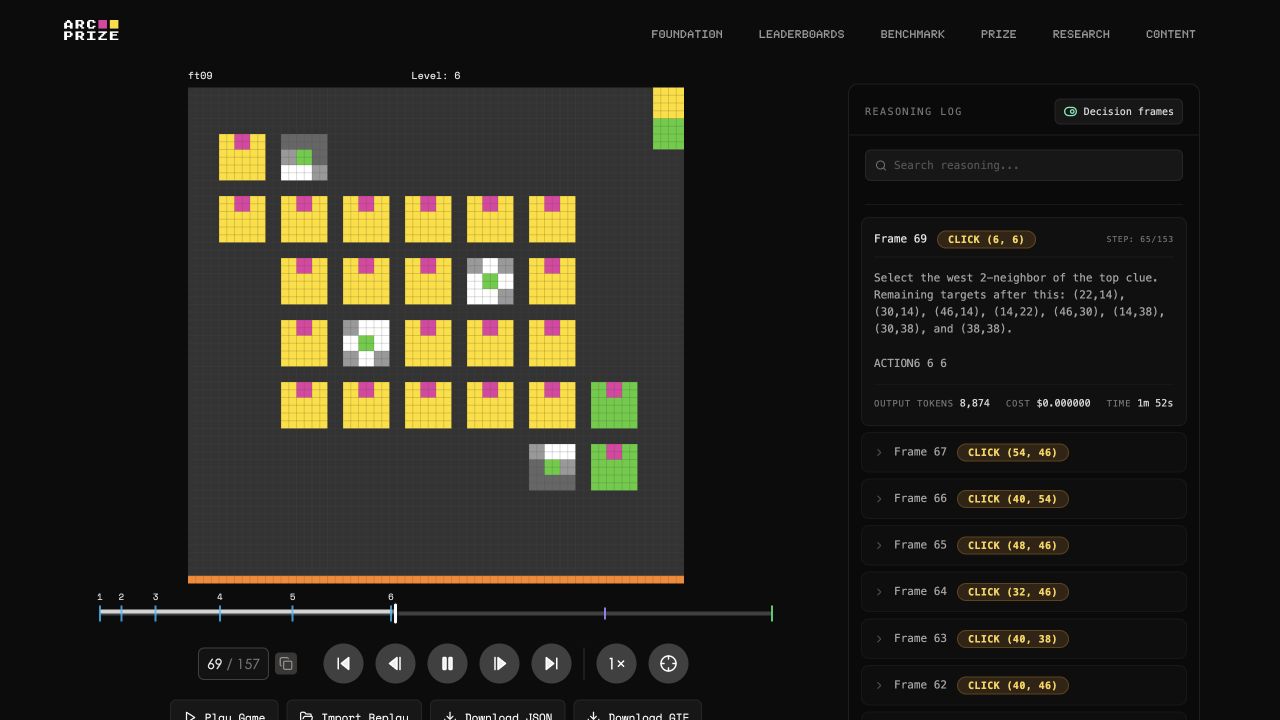
ARC Prize replay viewer showing GPT-5.6 Sol playing the ft09 ARC-AGI-3 environment
A frame from ARC Prize's public ft09 replay for GPT-5.6 Sol at Max reasoning. The replay makes the benchmark's multi-turn environment, actions, and carried reasoning visible. Open the interactive ARC Prize replay ↗

How the score works

The primary method is Relative Human Action Efficiency (RHAE). Completion matters, and efficient completion matters: an evaluated system is compared with first-attempt human action baselines, then level and game results are aggregated onto a 0-100 scale.

A higher score is better, but a score is only interpretable alongside the exact environment set, scoring version, action policy, and budget used to produce it.

What a reported result actually measures

An ARC-AGI-3 result is a system result. It reflects the model plus the agent loop, prompts, state representation, tool access, action budget, retries, and scoring implementation. Calling it a bare model score hides variables that may materially change performance.

The useful comparison question is therefore: what did the evaluation hold constant, and what did it allow each system to vary?

Comparability policy

Why harness and state-management results stay separate

ARC describes its verified leaderboard as a no-domain-specific-harness comparison: evaluated systems receive the same ARC prompt and policy, while community harness research is reported separately. The technical report notes that useful harness improvements and progress on the official AGI-oriented leaderboard are evidence about different evaluation setups.

Springprompt therefore does not merge provider-managed state, custom memory, additional tools, or other agent-loop changes into the verified rows on this page. Those results can still be useful, but they should appear as a separate setup only after a canonical source and complete evaluation contract are available.

How Springprompt will compare results

Springprompt will display a result only with a complete evaluation contract and a reviewed source snapshot. Results produced under materially different harnesses, tools, budgets, sampling policies, or scoring protocols will be shown as distinct setups rather than merged into one model number.

The table contains all 26 scored entries on ARC's official verified ARC-AGI-3 track reviewed through 30 July 2026. They share ARC's official verified protocol, while each model family and reasoning variant remains a distinct configuration. Rows with no ARC-AGI-3 result and the separate community/custom-harness track are excluded rather than presented as comparable scores.

Official ARC resources 10 links · show

Go deeper

Turn benchmark evidence into a model decision

Browse Spring Prompt’s task-level model evidence, compare the published configurations above, or join the product waitlist to build an evaluation around your own workflow.

Sources and provenance

Spring Prompt stores a reviewed, content-addressed evidence manifest for every citation. The linked official source remains canonical.

  1. 1.ARC Prize 2026 competition overview ↗ARC Prize Foundation · what-it-tests · retrieved 2026-07-30 · evidence 5054a50b2715
  2. 2.ARC-AGI-3 scoring methodology ↗ARC Prize Foundation · scoring · retrieved 2026-07-30 · evidence 9d9c0e1f82f1
  3. 3.ARC-AGI-3 technical report ↗ARC Prize Foundation · what-it-tests · retrieved 2026-07-30 · evidence 418e98f08f36
  4. 4.ARC-AGI-3 human dataset ↗ARC Prize Foundation · scoring · retrieved 2026-07-30 · evidence 9f203a410d37
  5. 5.ARC-AGI-3 agent benchmarking guide ↗ARC Prize Foundation · system-not-model · retrieved 2026-07-30 · evidence b9f4f3971da2
  6. 6.ARC Prize verified GPT-5.6 series results ↗ARC Prize Foundation · comparison-policy · retrieved 2026-07-30 · evidence b989d728be8c
  7. 7.ARC Prize verified Claude Opus 5 results ↗ARC Prize Foundation · comparison-policy · retrieved 2026-07-30 · evidence 6b7f36186144
  8. 8.ARC Prize verified leaderboard ↗ARC Prize Foundation · comparison-policy · retrieved 2026-07-30 · evidence 7d60ca68fda1
  9. 9.ARC Prize community leaderboard ↗ARC Prize Foundation · current-harness-point · retrieved 2026-07-30 · evidence 4378996ca7dd
  10. 10.ARC-AGI open-source toolkit ↗ARC Prize Foundation · official-links · retrieved 2026-07-30 · evidence 8d2d9e023b7b
  11. 11.ARC-AGI-3 official benchmarking agent repository ↗ARC Prize Foundation · system-not-model · retrieved 2026-07-30 · evidence 0b68f14bad72
  12. 12.ARC-AGI-3 agents and harness examples ↗ARC Prize Foundation · current-harness-point · retrieved 2026-07-30 · evidence 7a61f3095e57
  13. 13.Official ft09 GPT-5.6 Sol replay ↗ARC Prize Foundation · what-it-tests · retrieved 2026-07-30 · evidence d064b591ef43

Read the official scoring methodology ↗