Mercury 3 first look: very fast with thinking off, too slow with it on
Inception released Mercury 3 on 19 October, a diffusion language model it says writes 1,068 tokens a second and beats GPT-6 Luna and Claude Haiku 5.5 on 9 of 12 benchmarks. Speed is the whole pitch, so we started with our speed chess test.
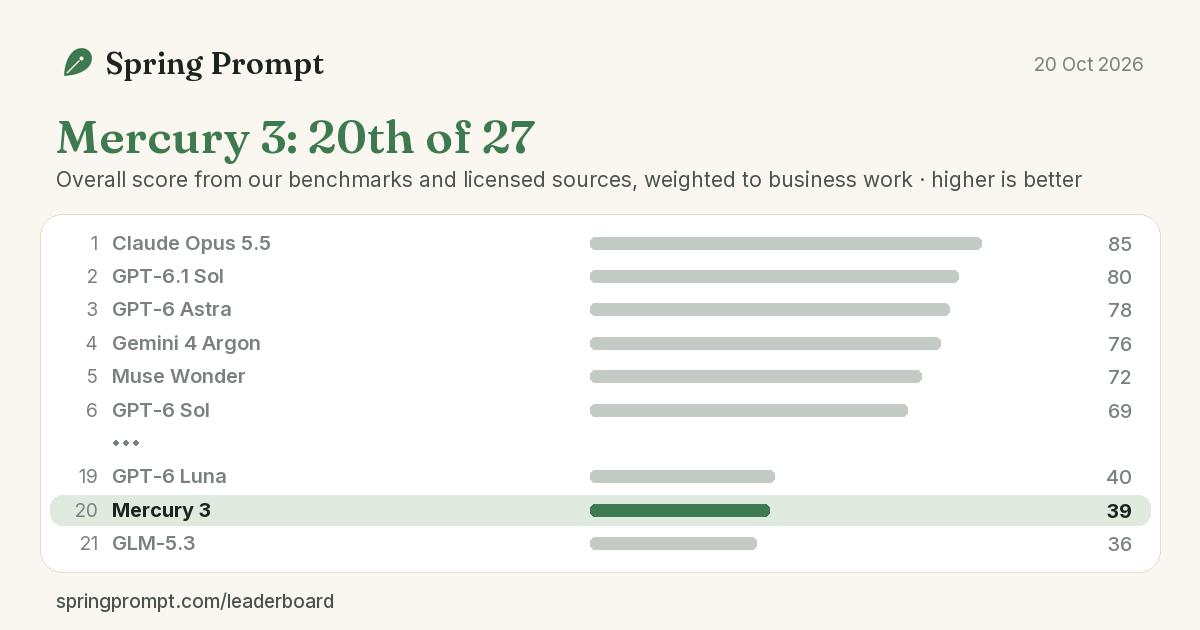
The result depends almost entirely on one setting. With thinking off it answered in under half a second a move and never lost on time. With thinking on, it raced through the opening and then sat on a single move for up to 105 seconds. On our business benchmarks it finished quickly but scored near the bottom of our tables.
Mercury 3 at a glance
- Use it for short, well-defined jobs where speed matters most, with thinking switched off.
- Don't use it for analysis, reports or planning: its survey analyses, slide decks and ad budgets were well behind GPT-6 Luna's.
- Price: $0.20/$0.70 per million input/output tokens at list; $0.10/$0.35 during the launch discount. Closed weights, text only.
- Speed: a median 0.42 seconds a move in our chess games with thinking off. With thinking on, some answers took over a minute.
What Inception says
Inception's table compares Mercury 3 at medium reasoning with GPT-6 Luna and Claude Haiku 5.5. It leads 9 of 12 rows, including IFBench (76.8 against Luna's 61.8), SWE-Bench Atlas (51.1 against 33.3) and τ³-bench Banking (30.2 against 23.0). It trails Haiku 5.5 on DeepSWE and MRCR v2, and Luna narrowly on AA-Omniscience and AA-LCR. It has a million-token context, four times Mercury 2.5's, and four reasoning settings from instant to high. These are the developer's claims. The table's price row uses the launch discount; at list, Mercury 3 costs twice as much per input token as Luna and Haiku.
Mercury 3 benchmarks, measured by Spring Prompt
The model page has every result as it lands. How to read this table: each row is one benchmark, with Mercury 3's score, its rank among the models we have tested on it, and its rank among models at its price.
| Benchmarkwhat it measures | Mercury 3its score | Rank among all modelsavailable today | Rank at its price$0.25–1 per million tokens, blended |
|---|---|---|---|
| BulletBench, 10 secondschess rating against a 10+1 clock | 555thinking off | 9th of 16Best: Gemini 3.5 Flash-Lite, 892 | 5th of 6Best: Gemini 3.5 Flash-Lite, 892 |
| BulletBench, one minutechess rating against a 60-second clock | 491thinking off | 10th of 25Best: Gemini 3.8 Flash, 1,068 | 4th of 7Best: Gemini 3.1 Flash-Lite, 912 |
| SurveyBenchhead-to-head rating of survey plans and analyses | 752default setting | 9th of 13Best: Claude Opus 5.5, 1,499 | 2nd of 4Best: DeepSeek-V4.1-Flash-1017, 1,221 |
| DeckBenchhead-to-head rating of slide decks | 812default setting | 18th of 24Best: GPT-6 Astra, 1,577 | 3rd of 4Best: DeepSeek-V4.1-Flash-1017, 1,145 |
| ROASBenchscore in a 12-month ad budget simulation | 26.1default setting | 18th of 24Best: GPT-6 Astra, 56.6 | 4th of 4 (last)Best: DeepSeek-V4.1-Flash-1017, 41.4 |
Ranked on the release we publish with this post. A group only counts models that benchmark has measured. GPT-6 Luna and Claude Haiku 5.5 ($0.20 blended) fall just below the price group; see the alternatives. There are no intelligence or speed groups yet, because Artificial Analysis hasn't measured it.
Speed chess: switch thinking off
BulletBench plays speed chess against a ladder of engines, so slow thinking loses on time. At the API default Mercury 3 played its first moves in about 0.6 seconds, then thought much longer once the position got complicated: in one three-minute game it spent 105 seconds on a single move after three invalid replies. It lost its first four games on time at every clock, at the default and at low reasoning; only one-minute games at low reasoning got past the screen, rating 147.
With reasoning switched off it was a different model: a median 0.42 seconds a move, no losses on time, and ratings of 555 in 10-second games and 491 in one-minute games. That is respectable, but below Inception's own Mercury Decide (614 and 572), which picks from a list of legal moves, and well below Gemini 3.5 Flash-Lite (892) and Gemini 3.8 Flash at low thinking (1,068 at one minute). BulletBench measures decisions against a clock, not general intelligence.
Business tasks: quick, but weak
On SurveyBench it planned and analysed all 12 surveys in about three minutes. Its plans were good (90 out of 100), but its analyses scored 47, and none of the 12 tasks came out without a fault; DeepSeek's new Flash managed four. Head to head it rated 752, 9th of 13. On DeckBench one of its eight decks never arrived and none was ready to present, mostly because the recommendation wasn't up front; it rated 812, 18th of 24. In ROASBench, a 12-month simulation of a skincare brand's ad budget, it lost money in five months and scored 26.1, 18th of 24, level with Claude Haiku 5.5. ROASBench is one simulated year per model, not evidence of real advertising returns.
In the playground
Mercury 3 also answered all 28 of our playground prompts, at its default setting. These are one-off tests, not a benchmark, but they show the same pattern as the chess. When it thinks little it is very quick: a fully working Flappy Bird in 8 seconds, against 47 to 55 seconds for GPT-6 Luna, Claude Haiku 5.5 and Gemini 3.8 Flash, and a spinning hexagon that keeps its ball inside in 21 seconds. On harder pages it thinks for tens of thousands of tokens: across the 20 pages those four models and it all answered, its median time was 65 seconds, against 44 for Haiku 5.5 and 47 for Luna. Its cassette recorder is a blank page, because one apostrophe in a tape label ends a string early and the script never runs.
Third-party results
None yet. Artificial Analysis, Arena and the agent and hallucination leaderboards have not published results for Mercury 3. Until they do, its overall score on our leaderboard rests on our own benchmarks and is provisional.
What people are saying
How the launch read on X and Hacker News: 65% positive, 19% mixed, 15% negative of the 26 posts and comments that took a side
NegativeMixedPositive
Within two hours of the launch we read the posts X served under "Top" for the model's name and every top-level comment on the main Hacker News thread, and labelled each one positive, mixed, negative, neutral or off-topic. Posts from Inception, its staff and launch partners are left out, as are neutral and off-topic items. Labels are by Claude Opus 5.5 against a written rubric, in one pass. Few people had tried it yet, so treat this as a first impression. Every labelled item.
A selection, with how we read each one:

Increasingly convinced diffusion LLMs (dLLM) are about to have their moment. An hour with Mercury-3 and it's clear this is a significant jump from @_inception_ai.

Pelicans aren't bad, a little quirky

Its own table: ahead of GPT-6 Luna and Claude Haiku 5.5 on SWE-Bench Atlas, behind Haiku on DeepSWE. I'd try it as a fast subagent.

$0.10 / $0.35 in that table is the 50% launch price. Inception's blog lists Mercury 3 at $0.20 / $0.70.
Mercury 3 vs GPT-6 Luna, Claude Haiku 5.5 and Gemini 3.5 Flash-Lite
These are the cheap, fast models people will weigh it against. Prices are blended per million tokens (three input to one output) at list price; Mercury 3's launch discount halves its figure for now.
| Modelwhy it's here | Priceblended, list | Chess, one minuteBulletBench rating | DeckBenchrating | ROASBenchscore | Compare |
|---|---|---|---|---|---|
| Mercury 3thinking off for chess | $0.33 | 491 | 812 | 26.1 | – |
| GPT-6 Lunathe cheap business default | $0.20 | 249 | 1,343 | 53.4 | Side by side |
| Claude Haiku 5.5in Inception's table | $0.20 | 310 | 1,197 | 24.1 | Side by side |
| Gemini 3.5 Flash-Litebest at fast chess near its price | $0.85 | 780 | 674 | 25.4 | Side by side |
For business writing and analysis, GPT-6 Luna is far ahead on our tests and cheaper at list price. For fast decisions, Mercury 3 with thinking off beats both of them at one-minute chess, but Gemini 3.5 Flash-Lite plays much stronger chess, taking about twice as long per move. Mercury 3's case is raw speed with thinking off, on jobs simple enough that a fast first answer is good enough.
Is Mercury 3 good? Who should use it
- Short, well-defined jobs where latency matters, with reasoning switched off. Expect answers in well under a second.
- Not with thinking on for anything time-bound. Its thinking time is unpredictable: most answers are quick, some take over a minute.
- Not for analysis, reports or planning. GPT-6 Luna did far better on our business benchmarks.
- Budget at the list price, $0.20/$0.70, not the launch discount.
These benchmarks aren't your data, so test it on your own prompts first. Its 28 playground answers sit beside other models' answers to the same prompts.
What we'll update
We'll add Artificial Analysis, Arena and the other sources as they publish. Until then, the Mercury 3 model page has every result as it lands.
Choosing or switching the model behind a product feature? Our custom evaluations test the models you are weighing on your own prompts and data, against your own definition of good. If AI writes your product content, the catalogue feed diagnostic measures how far you can trust it. Talk to us, or email hello@springprompt.com.
Quick answers
How much does Mercury 3 cost?
Inception lists it at $0.20 per million input tokens and $0.70 per million output tokens, with cached input at $0.02. At launch it is 50% off, at $0.10 and $0.35, with no end date given.
How fast is Mercury 3?
Inception says 1,068 tokens a second. In our speed chess games with thinking switched off it answered in a median 0.42 seconds a move. With thinking on, it sometimes thought for over a minute on a single move.
Is Mercury 3 good at speed chess?
With thinking off it never lost on time and rated 555 in 10-second games, 9th of 16, below Inception's own Mercury Decide (614) and Gemini 3.5 Flash-Lite (892). With thinking on it lost on time at every clock.
Is Mercury 3 open-weight?
No. Inception has not published weights, a licence or a model card. It takes text only.
Mercury 3 or GPT-6 Luna?
For business writing and analysis, GPT-6 Luna: it scored far higher on our slide deck and ad budget tests at a lower list price. Mercury 3 is the faster model when you switch its thinking off.