Muse Wonder review: good analysis, work that still needs checking
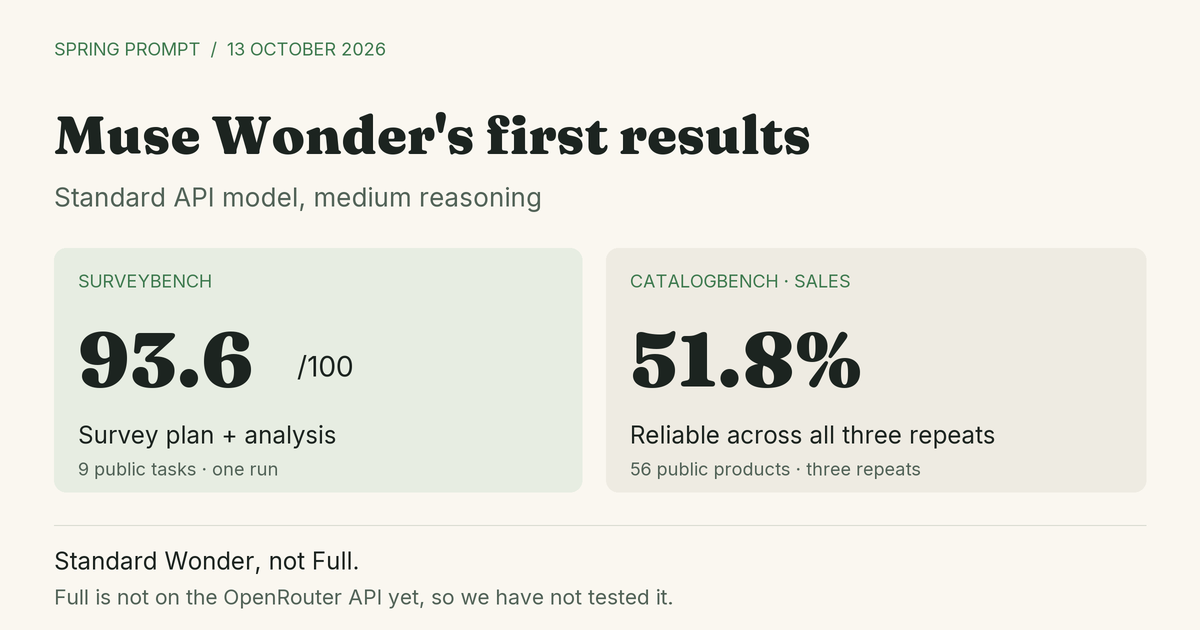
Muse Wonder's strongest result in our launch-day runs was survey analysis. It got every specified number and planted trap right across nine public tasks. Writing the survey was harder: only three of its nine plans passed all the checks.
That split appeared elsewhere. Its slide decks kept the facts and caveats, but five of six needed layout fixes. Asking it to sell products increased unsupported claims. Faster reasoning helped it survive a chess clock, but time losses remained common.
We ran six evaluations on 13 October 2026. These are measurements of the standard API model in our workflows, not a verdict on Full or on Meta's coding agent.
Muse Wonder benchmarks, measured by Spring Prompt
Each row uses its own measure; percentages, research scores and ratings are not interchangeable. Peers ran the same tasks and versions between 30 September and 8 October, at their provider defaults unless a setting is named.
| Test and measure | Wonder | Peers |
|---|---|---|
| CatalogBench: factual listings reliable across three repeats | 66.1% | Opus 5.5: 55.4% GPT-6 Sol: 66.1% |
| CatalogBench: sales listings reliable across three repeats | 51.8% | Opus 5.5: 21.4% GPT-6 Sol: 67.9% |
| SurveyBench: research score /100 | 93.6 | Opus 5.5: 96.1 GPT-6.1 Sol: 97.0 |
| DeckBench: public-task preference rating | 1,273 | Opus 5.5: 1,380 Muse Spark 1.3: 879 |
| ROASBench: 12-month simulation score /100 | 38.9 | Opus 5.5: 51.6 GPT-6 Sol: 54.1 |
| BulletBench: 60-second ladder rating | 409 (minimal) | GPT-6 Sol: 445 (no reasoning) |
| Waldo: pages found with tiles and verification | 12/29 (41.4%) | Haiku 5.5: 13/29 (44.8%) |
Public tasks only. Deck ratings have overlapping uncertainty intervals; chess ratings come from 12 games each. Waldo includes API timeouts. The dated results and settings keep those limits alongside the scores.
Good analysis, weaker survey questions
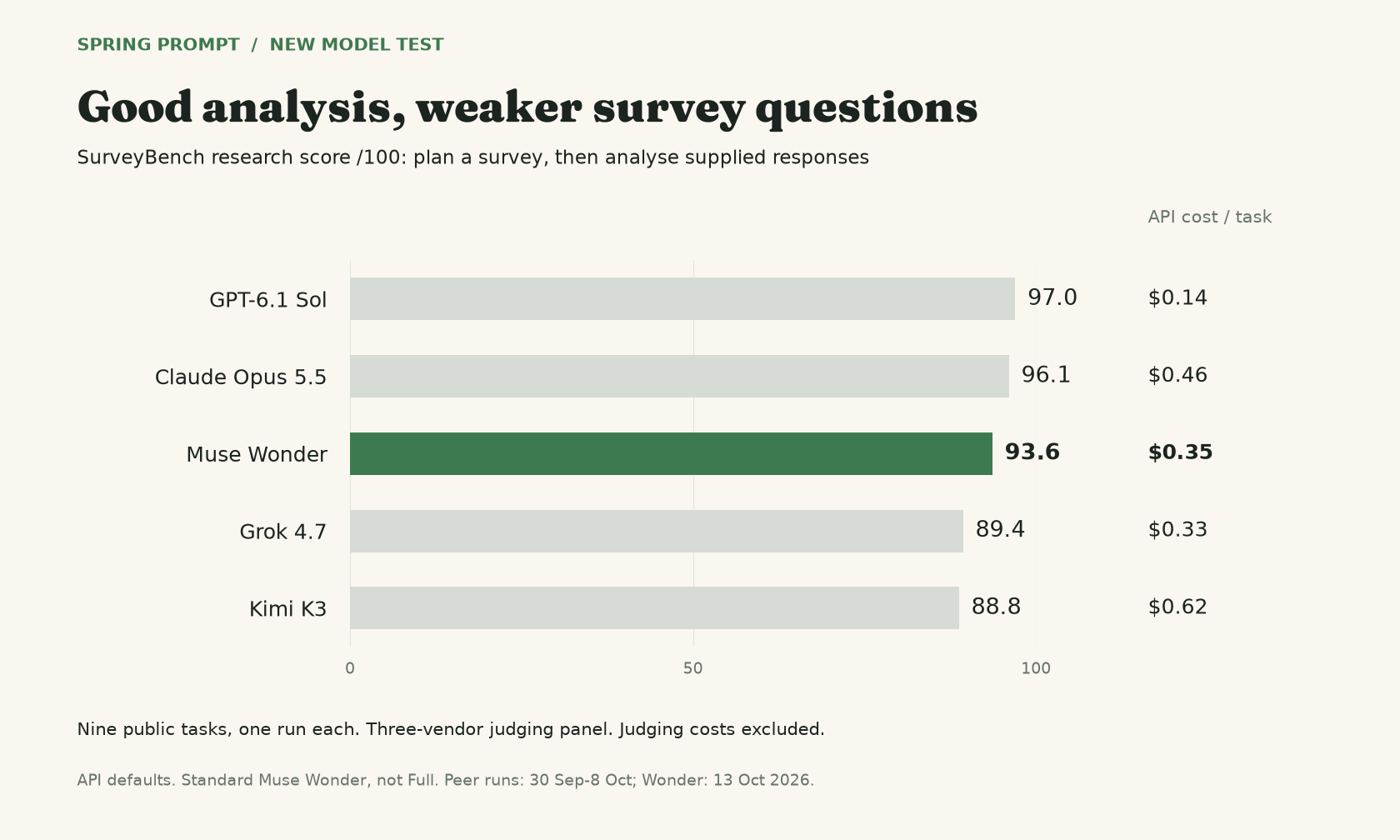
SurveyBench asks a model to plan a survey, then analyse supplied responses. Wonder scored 93.6/100 overall: 87.8 for planning and 96.2 for analysis. Every specified numerical check and planted analysis trap passed, though one analysis still included an unsupported finding.
Ten question flaws appeared across the nine plans. In a fictional freight-booking task, it asked:
How satisfied are you with the current accuracy and usefulness of Quaymark's online shipment tracking?
Accuracy and usefulness are two questions. A respondent could find tracking accurate but unhelpful, and cannot express that in one answer. Three tasks contained this kind of combined question.
Wonder cost $0.35 per task, versus Opus's $0.46 and GPT-6.1 Sol's $0.14. It is worth trying for analysing supplied responses; we would review its questionnaire before sending it.
Selling products made the claims less reliable
CatalogBench uses invented products, source data and images. A product counts as reliably publish-ready only if its listing passes in all three repeats. Wonder cleared that bar for 66.1% of factual listings, falling to 51.8% with a sales brief.
Unsupported claims rose from an average 11.7 per run of 56 products to 20. Those are claims, not percentages of products. No outputs were missing; the drop came from what the model wrote.
Wonder beat Opus on both briefs. GPT-6 Sol matched Wonder's factual result and did better at sales, at 67.9%. The sales listings cost $0.037 each with Wonder and $0.009 with Sol. We would keep a source check in the publishing workflow.
The slide content survived; the layout did not
On the six public DeckBench tasks, Wonder introduced no material unsupported claims and dropped no caveats. Five decks nevertheless needed layout fixes, often for tiny text. Only one was judged presentable.
Its public-task preference rating was 1,273, well above Muse Spark 1.3's 879. Opus scored 1,380. Wonder's 95% bootstrap interval was 1,175–1,385 and Opus's 1,278–1,507, so this small sample does not establish a clear gap between them. Wonder cost $0.18 per deck, versus Opus's $0.26.
Ad planning trailed the alternatives
In ROASBench, the model runs a simulated skincare brand's ad budget for 12 months. Wonder scored 38.9/100, against Opus's 51.6 and GPT-6 Sol's 54.1. The score combines simulated business results and decision quality; it is not a return percentage.
Wonder stayed within budget, but two months lost money and campaign changes triggered five learning-reset flags. Its API run cost $0.57, versus $1.06 for Opus and $0.24 for Sol. This is one simulated run per model, not evidence of real advertising returns.
The clock and the image API changed the outcome
At the default setting, Wonder lost all four 60-second chess screening games on time. Minimal reasoning got it through screening: four wins in 12 games, but seven time losses. Its BulletBench rating was 409, with a wide interval of 100–609.
GPT-6 Sol without reasoning rated 445. Median move times were 1.9 seconds for Wonder and 1.6 for Sol; costs were $0.066 and $0.030 per game. Both Wonder settings were screened out at the faster 10+1 clock. This measures chess decisions against a clock, not general intelligence.
On the 29-page Waldo slice of our visual-search study, tiled pages with verification produced 12 finds. Haiku 5.5 found 13 with the same setup. Wonder took a median 62 seconds per page and cost $17.53 for the set; Haiku took 14 seconds and cost $0.18.
Whole pages gave Wonder 11 finds for $1.16. Repeated zooming also gave 11, for $32.81. These scores include timeouts at our 60-second per-call limit: 11 whole-page calls, 19 calls in the tiled run and six in the zoom run. Costs count API-returned charges only; timed-out calls may still be billed. We cannot separate model accuracy from serving failures in this run.
What we tested, and what comes next
We used meta/muse-wonder through OpenRouter. Its listed default was medium reasoning. Peers used their own defaults, which can differ: Opus's was high. Only the explicitly labelled faster chess runs changed effort. OpenRouter listed Wonder at $4 per million input tokens and $20 per million output tokens on 13 October, the same base token prices as Opus. Equal token prices do not imply equal task costs.
CatalogBench used 56 public products, three repeats per brief, deterministic checks and GPT-6.1 Sol judging. The deck and survey figures use only six and nine public tasks respectively, scored by a three-vendor panel. Deck ratings and both sets of task costs were recomputed for that public slice. Other than the catalogue repeats, these are single runs. Costs exclude evaluation judges. No private task outputs or copyrighted Waldo pages are reproduced.
Our results do not test coding, persistent memory, the million-token context limit or Muse Code. Meta's launch covers both Wonder variants; its published results use maximum reasoning. A weak result here cannot establish that Full, or standard Wonder at maximum effort, would behave the same way.
We are checking hourly for Full on OpenRouter and will report it separately once we can run it. Until then, standard Wonder's survey analysis is the clearest strength in this sample. Its questionnaires, product claims and finished slides still need review.
Choosing the model behind a product workflow? Our custom evaluations test the alternatives on your prompts and data. If it writes product content, the catalogue feed diagnostic checks its claims against your source data.
Quick answers
Did you test Muse Wonder Full?
No. On 13 October 2026, Full was not available through the OpenRouter API we use for these runs. Meta offers it to Muse Code subscribers. Every Spring Prompt result here is for standard Muse Wonder.
Which reasoning setting did you use?
OpenRouter's default for standard Wonder was medium. We also tested minimal reasoning at the two faster chess clocks. Meta's published comparison uses maximum reasoning, so these are different settings.
How much does Muse Wonder cost?
OpenRouter listed standard Muse Wonder at $4 per million input tokens and $20 per million output tokens on 13 October 2026, the same base token prices as Claude Opus 5.5. Actual task costs varied: $0.037 per sales listing, $0.35 per survey task and $0.57 for the 12-month ad simulation, excluding judging.
Is Muse Wonder good at surveys?
It scored 93.6/100 on nine public SurveyBench tasks and got every specified numerical check and planted analysis trap right. Only three of nine survey plans passed every check, so its question design still needed review.
Does this show whether Muse Wonder is a good coding agent?
No. Our runs tested product listings, ad planning, slide decks, surveys, speed chess and visual search. They did not test coding, persistent memory or the Muse Code agent.