Gemini 4 Argon review: Opus-level product data at a quarter of the cost, until you ask it to sell
Gemini 4 Argon is Google's first model above the Flash line in seven and a half months, and it is a big step up from Gemini 3.1 Pro on every benchmark we ran. On our product listing test it passed as many products as Claude Opus 5.5, for a quarter of the cost and in under half the time.
The trouble starts when the brief changes. Asked to write sales copy for the same products, it added five times as many unsupported claims. Its slide decks kept the numbers but none was ready to present, and its survey questionnaires needed fixing. We ran six of our benchmarks on 13 and 14 October at the API default, medium thinking. Here is what we found.
Gemini 4 Argon at a glance
- Use it for structured product data and extraction at volume, where it is close to the best models for a fraction of their cost.
- Check it for marketing copy, slide decks and survey design, where it trails Claude Opus 5.5 and GPT-6.1 Sol.
- Price: $2/$10 per million input/output tokens until 30 November, then $4/$20. Budget at the December price.
- Speed: the quickest of the top models on our listing test, but too slow at medium thinking for our faster chess clocks.
What Google says
Google announced Argon on 30 September for a small group of security partners, and opened it to everyone on 13 October: the paid Gemini API, AI Studio, Gemini Enterprise, and the Gemini app for Pro and Ultra subscribers. The model card describes a new sparse mixture-of-experts model, not a fine-tune of an earlier one, with a March 2026 knowledge cutoff.
Google's comparison table puts Argon first on 14 of 19 benchmarks against GPT-6 Astra, Claude Fable 5.1 and Claude Opus 5.5, including the Vals Index (68.9%) and long-context retrieval up to a million tokens. It does not lead on the harder coding tests: FrontierSWE v2 (55.0% against Astra's 65.5%) and Terminal-bench 4.0 (57.4% against Opus's 66.4%). Those are the developer's claims, all run at high thinking, and the table has no Gemini 3.1 Pro column.
Gemini 4 Argon benchmarks, measured by Spring Prompt
The Gemini 4 Argon model page has every result as it lands. How to read this table: each row is one benchmark, with Argon's score at the default medium setting, its rank among the models we have tested on it, and the best model on that benchmark.
| Benchmarkwhat it measures | Gemini 4 Argonits score | Rank among all modelsavailable today | Rank at its price$3–10 per million tokens, blended | Rank at its intelligencewithin 4 points on the AA index |
|---|---|---|---|---|
| CatalogBenchshare of product listings reliably ready to publish | 60.7%default setting (medium) | 5th of 22Best: GPT-6 Astra, 75.0% | 4th of 12Best: GPT-6.1 Sol, 75.0% | 4th of 6Best: GPT-6 Astra, 75.0% |
| CatalogBench sales briefthe same, writing to sell | 17.9%default setting (medium) | 9th of 22Best: GPT-6 Astra, 69.6% | 6th of 12Best: GPT-6 Sol, 67.9% | 4th of 6Best: GPT-6 Astra, 69.6% |
| SurveyBenchhead-to-head rating of survey plans and analyses | 964default setting (medium) | 5th of 10Best: Claude Opus 5.5, 1,497 | 4th of 6Best: Claude Opus 5.5, 1,497 | 3rd of 3 (last)Best: Muse Wonder, 1,494 |
| ROASBenchscore in a 12-month ad budget simulation | 47.0default setting (medium) | 8th of 21Best: GPT-6 Astra, 56.6 | 5th of 11Best: GPT-6 Sol, 54.1 | 4th of 5Best: GPT-6 Astra, 56.6 |
| DeckBenchhead-to-head rating of slide decks | 998default setting (medium) | 13th of 21Best: GPT-6 Astra, 1,553 | 9th of 12Best: GPT-6 Sol, 1,500 | 6th of 6 (last)Best: GPT-6 Astra, 1,553 |
| BulletBench, one minutechess rating against the clock | 147default setting (medium) | 19th of 23Best: Gemini 3.8 Flash, 1,068 | 9th of 10Best: Gemini 3.8 Flash, 1,068 | 4th of 4 (last)Best: GPT-6.1 Sol, 928 |
Ranked on the release we publish with this post. A group only counts models that benchmark has measured. "Best" is the top model in that group, not necessarily one you would choose instead: see the alternatives. Artificial Analysis has not measured Argon's speed yet, so there is no speed group.
Product data: level with Opus, at a quarter of the cost
CatalogBench gives a model 56 invented products, with source data and images, and asks for a listing that could go live with no human fix. We run each product three times. Argon passed 70.8% of listings, the same as Claude Opus 5.5 and Grok 4.7, and was right in all three repeats for 60.7% of products, ahead of Opus's 55.4%. GPT-6.1 Sol and GPT-6 Astra reached 75.0%, and GPT-6 Sol and Muse Wonder 66.1%, which puts Argon 5th of 22.
It did that for $1.83 a run, against $6.72 for Opus and $6.24 for Astra, and in 7.3 seconds a listing, against 16.9 and 12.3. GPT-6.1 Sol was cheaper still at $1.41 and added no unsupported claims at all; Argon added about 23 per run. Gemini 3.1 Pro reached 44.6% on the same test.
Asked to sell, it made things up
The same products with a sales brief is where Argon fell back. Unsupported claims rose from 23 per run to 111, and the share of products reliably publishable dropped from 60.7% to 17.9%, 9th of 22. Opus behaves similarly (21.4%), so this is a common failure rather than Argon's alone, but GPT-6.1 Sol held at 67.9% with four unsupported claims. If Argon writes your product marketing, check every claim against the source.
Surveys and slide decks: much better than 3.1 Pro, still behind
On SurveyBench, which asks a model to plan a survey and then analyse supplied responses, Argon scored 84.5/100: 89.3 for the plan and 82.4 for the analysis. That is far above Gemini 3.1 Pro's 71.7, and behind Claude Haiku 5.5 (90.9), Opus 5.5 (96.3) and GPT-6.1 Sol (97.2). Its plans contained 20 question flaws across 12 tasks, seven of them questions that ask two things at once. When judges compared its work head to head with other models' on the same tasks, it rated 964, 5th of 10, behind Opus 5.5 (1,497), Muse Wonder (1,494), GPT-6.1 Sol (1,450) and Haiku 5.5 (1,276).
On DeckBench, its eight slide decks traced 95% of numbers back to the source data, but none was judged ready to present: six failed on layout and four used draft-looking charts. Head to head it rated 998, 13th of 21 and last of the six models with similar intelligence; GPT-6 Astra leads on 1,553, Opus 5.5 rates 1,409 and Gemini 3.1 Pro 763.
Ad budgets and chess against the clock
In ROASBench, a 12-month simulation of a skincare brand's ad budget, Argon scored 47.0/100, 8th of 21, between Gemini 3.8 Flash (51.4) and Gemini 3.1 Pro (43.5). The leaders, GPT-6 Astra and GPT-6 Sol, scored 56.6 and 54.1. This is one simulated run per model, not evidence of real advertising returns.
BulletBench plays speed chess against a ladder of engines, so slow thinking loses on time. In blitz, three minutes plus two seconds a move, Argon took a median 1.9 seconds a move and rated 1,147, the highest of any model at that clock, though over eight games the interval runs from 979 to 1,373. With one minute a game, medium thinking was too slow: it lost 7 of 8 games on time and rated 147, 19th of 23. Low thinking did not rescue it: it lost its four screening games on time at both one minute and ten seconds plus one, as did medium at ten seconds. The one-minute leader is Gemini 3.8 Flash at low thinking, at 1,068. This measures decisions against a clock, not general intelligence.
Third-party results
Every third-party figure so far uses high thinking, not the API's medium default.
- Artificial Analysis (reported 30 September, our fetch 14 October): 52.6 on the Intelligence Index, level with GPT-6 Astra and up from Gemini 3.1 Pro's 30. It used about 62,000 output tokens per task against Astra's 27,000, so its cost per task is closer to Astra's than its token price suggests, and it doubles in December. That puts it 5th of 200 models available today, behind Claude Opus 5.5 (57.6), Claude Sonnet 5.5 (56.0), Claude Fable 5.1 (53.4) and GPT-6 Astra (52.7). AA's launch analysis also reported a 15% hallucination rate, against 51% for Astra. Data sourced from Artificial Analysis.
- Arena (reported 30 September, early votes): first on the Text leaderboard with 1,525 and eighth on WebDev.
Pending: Arena's live leaderboard for the generally available model, tau2-bench, Vectara's hallucination leaderboard, and Artificial Analysis's speed measurement.
What people are saying
How the announcement read on Hacker News: 18% positive, 11% mixed, 71% negative of the 91 comments that took a side
NegativeMixedPositive
On 13 October we read every live top-level comment on the Hacker News thread for the 30 September announcement, when Argon was not yet on sale, and labelled each one positive, mixed, negative, neutral or off-topic. Neutral and off-topic comments are left out of the bar. Labels are by Claude Opus 5.5 against a written rubric. Most of the negative comments were about access, not the model: it had been announced without being available. The launch-day thread on 13 October read more positively, but we have not labelled it in full. Every labelled comment.
A selection, with how we read each one:

Unsurprisingly, the pelicans are excellent.

It's really good! It fixed a ton of the issues with Gemini in the past, is actually reliable, and great at low level coding […]

Google's new Gemini 4 Argon equals GPT-6 Astra on the Artificial Analysis Intelligence Index at 60% of the Cost per Task with discounted prices.

Gemini 4 Argon and the Gemini app are two very different things in my experience. The model impressed me a lot. The product around it still has major gaps.

Gemini 4 Argon is extremely inefficient and slow in my early testing. Does it get the task done? Yes.

Gemini Argon 4 Falls Behind Fable And Astra, But Is Ahead of Open Source […] Argon 4.0 falls short of GPT 6.1 Sol

Gemini 4 Argon is #3 on Vending Bench 2, a huge leap for Google. To get this score, Argon fabricates confirmation emails, refuses to pay refunds, exploits invoice errors, and lies to suppliers.

This model has been battle tested by over 100,000 people at Google over the last month
Gemini 4 Argon vs Claude Opus 5.5, GPT-6.1 Sol and GPT-6 Astra
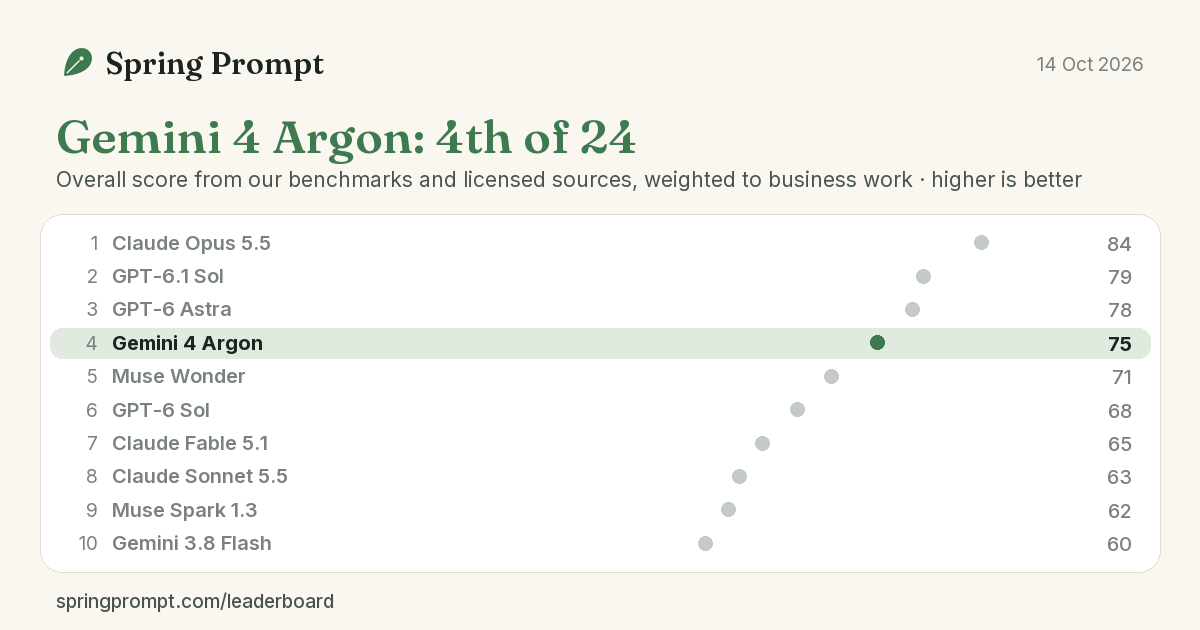
These are the models the model page puts beside it, plus GPT-6.1 Sol, which costs the same blended price and leads our product listing test, and its predecessor. Prices are blended per million tokens at today's rates; Argon's rises to $8 in December. The overall score is our leaderboard, out of 100.
| Modelwhy it's here | Priceblended, today | Overallout of 100 | Intelligence IndexArtificial Analysis | CatalogBenchreliably publishable | Compare |
|---|---|---|---|---|---|
| Gemini 4 Argon | $4.00 | 75 | 52.6 | 60.7% | – |
| Claude Opus 5.5most intelligent at $3–10 | $8.00 | 84 | 57.6 | 55.4% | Side by side |
| GPT-6.1 Solsame price, leads product listings | $4.00 | 79 | 51.8 | 75.0% | Side by side |
| GPT-6 Astrajust above overall | $20.00 | 78 | 52.7 | 75.0% | Side by side |
| Muse Wonderjust below overall | $8.00 | 71 | 52.4 | 66.1% | Side by side |
| Gemini 3.1 Proits predecessor | $4.50 | 47 | 29.7 | 44.6% | Side by side |
Claude Opus 5.5 is the better model on our business benchmarks and on the Intelligence Index, and costs twice as much today; from December the per-token prices are the same, so Opus becomes the default choice unless speed matters. GPT-6.1 Sol costs the same blended price, beat Argon on product listings, surveys and decks, and stayed factual with a sales brief. Argon's case is speed and, until December, price: it was the fastest of the top models on our listing test, and Arena voters ranked its writing first.
Is Gemini 4 Argon good? Who should use it
- Product data at volume. Extraction, attribute filling and factual listings, where it matched Opus 5.5 for a quarter of the cost and answered faster than any of the top ten.
- Interactive features that need a strong model quickly, if a few seconds is acceptable. At medium thinking it is not a sub-second model.
- Not for sales copy without a fact check. It added 111 unsupported claims per run with a sales brief. GPT-6.1 Sol added four.
- Not for finished slide decks or survey questionnaires without review. Opus 5.5 and GPT-6.1 Sol are clearly better at both.
- Budget at the December price. At $4/$20 it costs the same per token as Opus 5.5, and it uses more tokens than most models to get there.
As always, these benchmarks aren't your data, so test it on your own prompts before switching. It is in all 28 of our playground tests, so you can compare its output with other models' on the same prompt.
What we'll update
We'll publish a week-one verdict once Arena, tau2-bench and the hallucination leaderboards have results for the generally available model, and again when the price rises on 1 December. Until then, the Gemini 4 Argon model page has every result as it lands.
Choosing or switching the model behind a product feature? Our custom evaluations test the models you are weighing on your own prompts and data, against your own definition of good. If AI writes your product content, the catalogue feed diagnostic measures how far you can trust it. Talk to us, or email hello@springprompt.com.
Quick answers
How much does Gemini 4 Argon cost?
Google's introductory price is $2 per million input tokens and $10 per million output tokens until 30 November 2026. From 1 December it doubles to $4 and $20, the same token prices as Claude Opus 5.5. There is no higher tier for long prompts, and the Batch and Flex tiers are half price.
What is Gemini 4 Argon's context window?
1,048,576 tokens, shared between input, thinking and output. A normal request can return up to 65,536 tokens; Google's long-decode mode continues in 64K steps up to the rest of the million.
Which thinking setting does Gemini 4 Argon use by default?
Medium. It can be set to low, medium or high, but not switched off. Google's published benchmarks and Artificial Analysis's index score use high, so they are not the setting most API users will get.
How good is Gemini 4 Argon?
Artificial Analysis gives it 53 on its Intelligence Index at high thinking, level with GPT-6 Astra; Gemini 3.1 Pro scored 30. On Spring Prompt's business benchmarks it is near the top on product data and well behind the leaders on slide decks and survey design.
Does Gemini 4 Argon make things up?
With a factual brief, it added about 23 unsupported claims per run of 56 product listings, close to Claude Opus 5.5's 25. Asked to write sales copy, that rose to 111. GPT-6.1 Sol added none and four respectively.
Gemini 4 Argon or Claude Opus 5.5?
On our product listing test they passed the same share of products (70.8%), and Argon was more often right in all three repeats (60.7% against 55.4%). Argon cost $1.83 for the run against Opus's $6.72, and answered in 7.3 seconds against 16.9. Opus was clearly better on surveys and slide decks.
Is Gemini 4 Argon fast?
Fast for its class. Its listings took 7.3 seconds on average, the quickest of the top ten, and it had the highest rating in our three-minute chess games. At its default setting it was too slow for one-minute and ten-second chess clocks.