How each model did
Ranked by our pick, then checks passed, then cost. Time and cost count every try; each dot is one check, in the order listed below (filled: passed, half: partly, empty: failed). Click a model for its notes.
Notes on each answer
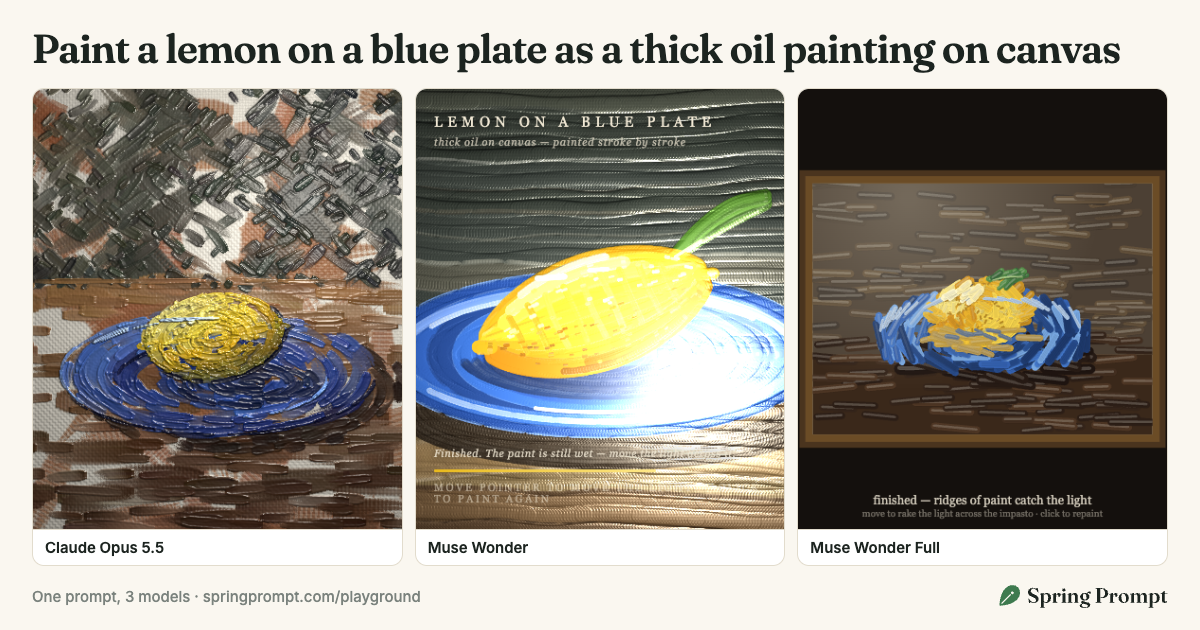
Paints the whole canvas stroke by stroke: a warm ground, a grey-green background in crossing strokes, brown table strokes, a plate in swirls of blue, then the lemon in layered yellow impasto. The ridges catch the light and shift as you move the pointer. The background is busy, but this is the one that looks like oil paint. 7.2 minutes, $0.90.
7.2 min · 44,809 output tokens (31,790 thinking) · $0.897
2
Muse Wonder Full
3 of 4
Made in Muse Code, not over the API: Full could screenshot its own work and fix it, and took 3 rounds. A framed canvas painted in a sensible order: the background blocked in with short horizontal dashes, the plate laid in, the lemon stroke by stroke, then the leaf and highlights last. But the lemon is small and breaks up into scattered yellow dashes on a nest of blue strokes, and the ridges barely change as the light moves.
- ◐ Thick paint and brush marks show, and the ridges catch the light as the pointer moves (partly)
- ◐ The finished picture clearly reads as a lemon on a blue plate (partly)
–
A dark streaked background, a wooden table, a blue plate with white rings and a glossy lemon with a long green leaf, mostly in place within eight seconds. The pointer drags a large glare across the plate. It looks like a rendered 3D lemon with a paint texture laid over it rather than an oil painting. Our first two requests were refused before it wrote anything (by our account's credit limit at its listed 943,718 tokens of room, then over a thinking setting this endpoint does not take); the third, with 128,000 tokens, is the answer. 2.6 minutes, $0.30.
- ◐ Paints in a real order: background and plate first, then the lemon, stroke by stroke (partly)
- ◐ Thick paint and brush marks show, and the ridges catch the light as the pointer moves (partly)
2.6 min · 14,958 output tokens (6,067 thinking) · $0.300 for this answer; 2.6 min and $0.300 over 3 tries
Took 3 tries: failed at 943,718 tokens; failed at 943,718 tokens, low thinking; finished at 128,000 tokens.
One answer per model, at each model's default settings unless the card says otherwise, through OpenRouter. If an answer ran out of room or stopped short, we asked again with more room, then with thinking off, and say so. This is a quick look, not a benchmark: run it again and every answer will differ. For measured results, see our benchmarks.
How we pick. Claude Opus 5.5 tried every answer (clicking, dragging and playing it in a browser), marked the checks and drafted the notes. Our pick is a judgement among the answers with the most checks passed, not a score: the checks show what works, the pick is which of those we would rather use. Opus is an Anthropic model, and Claude answers are our pick in 17 of 28 tests, so weigh Claude picks with that in mind. GPT-6.1 Sol, shown anonymised stills and our check marks, put Claude Opus 5.5 first for brushwork that reads as thick oil paint, then Muse Wonder, whose texture it found glossy and repetitive, then Muse Wonder Full. We agree.
What we checked, by trying each answer ourselves: Paints in a real order: background and plate first, then the lemon, stroke by stroke; Thick paint and brush marks show, and the ridges catch the light as the pointer moves; The finished picture clearly reads as a lemon on a blue plate; Finishes, holds on the finished piece, and starts again on a click. A partial pass counts as half.
Verdict
Claude Opus 5.5's lemon is the one with real impasto: layered strokes with ridges that catch the light as you move the pointer, on a plate painted in swirls of blue. Its background is busy, which keeps this close. Muse Wonder's picture is cleaner but looks rendered rather than painted, and Muse Wonder Full, after three rounds in Muse Code, paints in the right order but ends on a small, scrambled lemon.