How each model did
Ranked by our pick, then checks passed, then cost. Time and cost count every try; each dot is one check, in the order listed below (filled: passed, half: partly, empty: failed). Click a model for its notes.
Notes on each answer
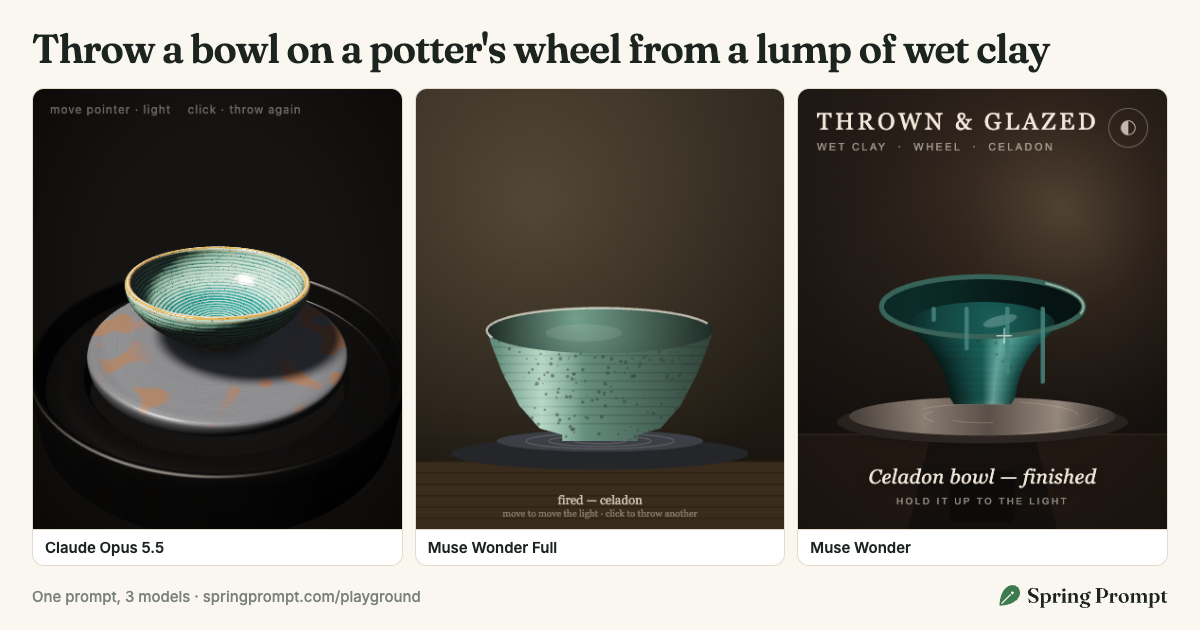
A wheel seen from above at an angle, drawn in 3D. A cone of terracotta clay is centred, opened and pulled into a bowl with throwing rings, dried to leather-hard, then glazed in a celadon that pools in the rings, with a pale rim. Moving the pointer swings the highlight and the bowl's shadow round the wheel. 7.4 minutes, $0.90.
7.4 min · 44,979 output tokens (31,851 thinking) · $0.900
2
Muse Wonder Full
3.5 of 4
Made in Muse Code, not over the API: Full could screenshot its own work and fix it, and took 2 rounds. A side view with the inside showing: the clay is centred, coned up, opened, given a floor, pulled up and shaped, the foot trimmed, then the bowl is dipped in glaze and fired to a speckled celadon. The sheen and the shadow follow the pointer, but the shading is flat beside Opus's bowl. Its one fix removed a pair of hands it had drawn.
- ◐ The finished bowl looks like a real thrown and glazed bowl (partly)
–
Two cartoon hands centre the clay and pull up the walls, then glaze pours in from a jug. But the piece ends as a teal funnel on a narrow foot rather than a bowl, with glaze drips drawn as straight bars down the outside and a glassy ring for a rim, and the light barely moves on it. Our first two requests were refused before it wrote anything (by our account's credit limit at its listed 943,718 tokens of room, then over a thinking setting this endpoint does not take); the third, with 128,000 tokens, is the answer. 2.7 minutes, $0.30.
- ◐ Shows the real steps: centring the clay, opening it, pulling up the walls, then glazing (partly)
- ✗ The finished bowl looks like a real thrown and glazed bowl
- ◐ Moving the pointer moves the light, and the glaze catches it (partly)
2.7 min · 14,812 output tokens (7,620 thinking) · $0.297 for this answer; 2.7 min and $0.297 over 3 tries
Took 3 tries: failed at 943,718 tokens; failed at 943,718 tokens, low thinking; finished at 128,000 tokens.
One answer per model, at each model's default settings unless the card says otherwise, through OpenRouter. If an answer ran out of room or stopped short, we asked again with more room, then with thinking off, and say so. This is a quick look, not a benchmark: run it again and every answer will differ. For measured results, see our benchmarks.
How we pick. Claude Opus 5.5 tried every answer (clicking, dragging and playing it in a browser), marked the checks and drafted the notes. Our pick is a judgement among the answers with the most checks passed, not a score: the checks show what works, the pick is which of those we would rather use. Opus is an Anthropic model, and Claude answers are our pick in 17 of 28 tests, so weigh Claude picks with that in mind. GPT-6.1 Sol, shown anonymised stills of the three answers (mid-build, finished, and with the light moved) and our check marks, put Claude Opus 5.5 first for its depth, throwing rings and glossy glaze, Muse Wonder Full second and Muse Wonder third. We agree.
What we checked, by trying each answer ourselves: Shows the real steps: centring the clay, opening it, pulling up the walls, then glazing; The finished bowl looks like a real thrown and glazed bowl; Moving the pointer moves the light, and the glaze catches it; Finishes, holds on the finished piece, and starts again on a click. A partial pass counts as half.
Verdict
Claude Opus 5.5 makes the bowl you would believe came off a wheel: a 3D form with throwing rings, a foot and a celadon glaze that pools in the rings, and the highlight swings round as you move the pointer. Muse Wonder Full shows the most complete process, from centring the clay to firing, and ends on a believable bowl, but it is drawn side on and flatter. Muse Wonder, in one try over the API, ends on a funnel with cartoon hands.
Full's answer was made differently: in Muse Code it could look at its page and fix it, which it did once here, so it is not a like-for-like comparison with the single tries.