GPT-6.1 Terra review: close to the top of our business tests at half the price of Sol
OpenAI released GPT-6.1 Terra on 26 October, a mid-priced model it pitches at computer use, visual reasoning and writing. The list price is $1/$5 per million tokens, half that of GPT-6.1 Sol.
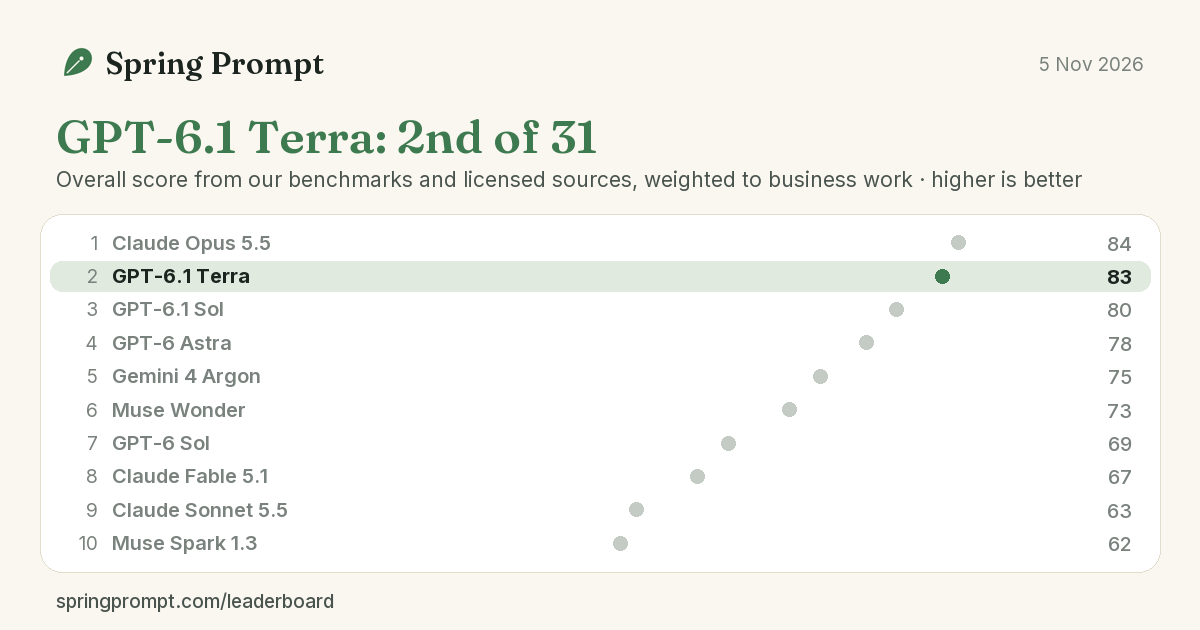
On our benchmarks it did better than that price suggests. It set the best score we have measured on our ad budget simulation, and led its price band on all four business tests. It is 2nd of 31 on our leaderboard, but that rank needs reading carefully: GPT-6.1 Sol scored higher on decks, surveys and factual listings, and Terra's score does not yet include any third-party results.
GPT-6.1 Terra at a glance
- Use it for high-volume business work: product listings, slide decks, survey analysis and budget planning, where it led every model priced $1 to $3 per million tokens.
- Pay for GPT-6.1 Sol instead when quality matters more than a doubled bill. Sol scored higher on factual listings, decks and surveys.
- Don't use it at the default setting for anything on a tight clock. It lost every game of 10-second and one-minute chess on time until we lowered its reasoning.
- Price: $1/$5 per million input/output tokens, $0.05 cached. Closed weights.
- Speed: about 10 seconds a product listing and just over two minutes a slide deck in our runs of 27 October.
What OpenAI says
OpenAI's launch post calls Terra "a fast, efficient model" for visual reasoning, computer use and writing. On Agents' Last Exam at medium reasoning it claims 15 percentage points over GPT-5.6 Terra at about a third of the cost, and performance on par with GPT-6 Astra at a tenth of the price per token. On its own set of error-inducing prompts, the error rate at low reasoning fell from 53.6% with GPT-5.6 Terra to 16.7%. On Terminal-Bench 4.0 at maximum reasoning it solves 50.3% of tasks, against 21.5% for GPT-5.6 Terra, though OpenAI says Sol and Astra remain the better choice for the hardest coding work. OpenAI also says Terra meets the Critical cybersecurity threshold in its Preparedness Framework.
Its model page lists a 1,050,000-token context, 128,000 tokens of output, text and image input, and a knowledge cutoff of 1 June 2026. These are the developer's claims. We have not measured computer use, vision or coding.
GPT-6.1 Terra benchmarks, measured by Spring Prompt
The model page has every result. How to read this table: each row is one benchmark, with Terra's score and setting, its rank among models we have tested that are on sale today, and its rank among models priced $1 to $3 per million tokens. There is no intelligence or speed group yet, because the Artificial Analysis data in this release predates the launch.
| Benchmarkwhat it measures | GPT-6.1 Terraits score | Rank among all modelsavailable today | Rank at its price$1–3 per million tokens, blended |
|---|---|---|---|
| ROASBenchscore in a 12-month ad budget simulation | 58.4default setting | 1st of 28Next: GPT-6 Astra, 56.6 | 1st of 6Best: GPT-6.1 Terra, 58.4 |
| CatalogBench, sales brieflistings publish-ready in all three repeats | 67.9%default setting | Joint 2nd of 27Best: GPT-6 Astra, 69.6% | 1st of 5Best: GPT-6.1 Terra, 67.9% |
| CatalogBench, factual brieflistings publish-ready in all three repeats | 64.3%default setting | 5th of 27Best: GPT-6 Astra, 75.0% | 1st of 5Best: GPT-6.1 Terra, 64.3% |
| SurveyBenchhead-to-head rating of survey plans and analyses | 1,273default setting | 5th of 17Best: Muse Wonder, 1,510 | 1st of 3Best: GPT-6.1 Terra, 1,273 |
| DeckBenchhead-to-head rating of slide decks | 1,344default setting | 6th of 28Best: GPT-6 Astra, 1,606 | 1st of 5Best: GPT-6.1 Terra, 1,344 |
| BulletBench, 10 secondschess rating against a 10+1 clock | 491low reasoning | 11th of 18Best: Gemini 3.5 Flash-Lite, 892 | 2nd of 4Best: GPT-5.4 mini, 571 |
| BulletBench, one minutechess rating against a 60-second clock | 358low reasoning | 16th of 29Best: Gemini 3.8 Flash, 1,068 | 2nd of 5Best: Claude Haiku 4.5, 445 |
Ranked on the release of 5 November 2026 (44c5fb63d296). A group only counts models that benchmark has measured. Ranks are provisional and can move as models are added. The model page ranks Terra at $2.20 blended, the typical OpenRouter host; at OpenAI's own $1/$5 it is $2.00, in the same band.
What 2nd overall does and doesn't mean
Terra scores 83 on our overall leaderboard, a point behind Claude Opus 5.5 and three ahead of GPT-6.1 Sol. Our score leaves out groups a model has no results in. Terra has results in 2 of 5: our own benches and knowledge work, both run by us. Agents, writing and factuality have nothing yet. Sol has all five, and its writing (58) and factuality (66) scores pull it down; on our own benches it scores 94 to Terra's 85. So the rank says Terra did very well on what we have measured. It does not say Terra is better than Sol, and it could move a long way once third-party results arrive.
Ad budgets: the best score so far, on one simulated year
In ROASBench, a 12-month simulation of a skincare brand's ad budget, Terra scored 58.4, the highest of 28 models. It never overspent, made a loss in one month and finished with $701,059 of simulated profit. Kimi K3.1 Pro made more ($858,023) and scored lower, 55.1, because the score also weighs planning and how the budget was handled. It cost $0.11 to run. This is one simulated year per model, not evidence of real advertising returns, and GPT-6.1 Sol has not been run on it, so the top spot does not include Terra's nearest sibling.
Product listings: reliable and quick, but less findable
CatalogBench asks a model to turn sparse feeds and photos for 56 invented products into listings. Across three repeats, 74.4% of Terra's listings were publish-ready on each brief. Those passing all three times were 64.3% on the factual brief and 67.9% on the sales brief, joint 2nd with GPT-6.1 Sol and GPT-6 Sol. It added few unsupported claims: 0.03 per product on the factual brief and 0.09 on the sales brief. It took about 10 seconds and under half a cent a product.
The weak spot was search. On the sales brief, 13.7% of its listings lost a simulated shopper search to near-identical rivals, 29th of 30 results in that table; on the factual brief, 10.7%, 27th of 30. These are invented products, so your own catalogue may behave differently.
Decks and surveys: good, not the best
On DeckBench all eight decks arrived, in about 135 seconds and $0.07 each. It rated 1,344 (range 1,241 to 1,459), 6th of 28. That range overlaps Claude Opus 5.5, Sonnet 5.5 and GPT-6.1 Sol, so don't read much into the order among them. Three of the six public decks could be presented as they were, and all six got the numbers right. These are invented companies, with one deck per model per task.
On SurveyBench it rated 1,273 (range 1,190 to 1,363), 5th of 17, clearly behind Muse Wonder, GPT-6.1 Sol and Claude Opus 5.5. Plans scored 94 of 100 and analyses 92, at about 92 seconds and $0.06 a task, but only three of the nine public tasks came through with no fault. Its analysis faults were mostly survey traps it didn't flag, such as a question-order effect.
Speed chess: lower the reasoning
BulletBench plays speed chess against a ladder of engines, so slow thinking loses on time. At the default setting Terra lost its first four games on time at both 10 seconds and one minute, and was screened out. At low reasoning it qualified, rating 491 and 358, though it still lost five of eight and six of eight games on time, so those ratings have wide ranges (0 to 727 and 0 to 595). With three minutes a game the default setting was fine: 683 (range 487 to 1,130), with four wins from eight games and no invalid moves. BulletBench measures decisions against a clock, not general intelligence.
In the playground
Terra also answered all 29 of our playground prompts on 27 October, each at the first try: a median of about 68 seconds a page, none over 2.2 minutes, and $0.85 in all. We have since opened every answer by hand. It is our pick on one page, latte art, and two answers came out blank: the cassette deck and whale breach both load a three.js add-on with no import map, so the script stops before anything is drawn. These are one-off prompts, not a benchmark, so read them as examples of what it makes. All 29 answers are here.
Third-party results
None count towards Terra's rank yet, because the Artificial Analysis data in our 5 November release dates from 20 October. Until we refresh it, the model page shows Terra as not measured. Artificial Analysis has in fact published results. Its page, read on 5 November, gives Terra at maximum reasoning 51 on Intelligence Index v5.0.1, #14 of 66, behind GPT-6.1 Sol (55), GPT-6 Astra (57) and Claude Opus 5.5 (59). It reports 77 tokens a second, 13.0 minutes and $0.96 per index task. That is a broader and more technical test than ours, and it places Terra lower among OpenAI's models than our leaderboard does. Data sourced from Artificial Analysis. We have not checked Arena or the agent and hallucination leaderboards for Terra.
What people are saying
How it read on Hacker News: 42% positive, 11% mixed, 47% negative of the 19 comments that took a side
NegativeMixedPositive
On 5 November we read every top-level comment on the main Hacker News thread, posted in the two days after launch, and labelled each one positive, mixed, negative, neutral or off-topic. Neutral and off-topic comments are left out. Labels are by Claude Opus 5.5 against a written rubric, in one pass. This is one forum, not X or a sample of users, and most comments came before people had used it for long. Every labelled item.
A selection, with how we read each one:
In my tests [1], GPT-6.1 Terra joins the Pareto Frontier in between GPT-6 Luna and GPT-6.1 Sol. So, exactly as advertised!
This tier is what I'd actually point opencode at for PR reviews.
on max effort, it's worse than 6.1 sol and 2x more expensive
it will stop at an earliest excuse and no amount of prompting not to stop until X is done will convince it otherwise.
Can anyone give me the compelling reason for Terra and Sonnet to exist?
Cheaper inference improves one component of agent economics.
I'd say Terra is probably better than Astra and Sol at technical communication, similar on vision and computer use (but much faster!), and a bit worse on most other things.
GPT-6.1 Terra vs GPT-6.1 Sol, Claude Opus 5.5 and Kimi K3.1 Pro
Prices are blended per million tokens (three input to one output) at list price. All scores were measured by Spring Prompt at each model's best configuration, and a dash means we have no result. GPT-5.6 Terra, the predecessor, was never run on our benchmarks, so we can't compare the two.
| Modelwhy it's here | Priceblended, list | Overallprovisional where marked | CatalogBenchfactual, reliably ready | DeckBenchrating | SurveyBenchrating | ROASBenchscore | Compare |
|---|---|---|---|---|---|---|---|
| GPT-6.1 Terrathis review | $2.00 | 83, provisional | 64.3% | 1,344 | 1,273 | 58.4 | – |
| GPT-6.1 Solthe next tier up | $4.00 | 80 | 75.0% | 1,433 | 1,489 | – | Side by side |
| Claude Opus 5.5top of the leaderboard | $8.00 | 84 | 55.4% | 1,391 | 1,486 | 51.7 | Side by side |
| GPT-6 AstraOpenAI's largest model | $20.00 | 78 | 75.0% | 1,606 | – | 56.6 | Side by side |
| Claude Sonnet 5.5Anthropic's mid-tier | $4.00 | 63 | 32.1% | 1,366 | – | 52.0 | Side by side |
| GPT-6 Lunathe cheap option | $0.20 | 39 | 55.4% | 1,296 | – | 53.4 | Side by side |
| Kimi K3.1 Proopen weights, launched the same week | $4.00 | 56, provisional | – | 1,247 | 608 | 55.1 | Side by side |
Sol is the real comparison. It costs twice as much and is ahead on factual listings, decks and surveys, by a wide margin on surveys, and level on sales-brief listings. If your bill is small, buy Sol. GPT-6 Luna is the other edge of the choice: at a tenth of Terra's blended price its decks rated 1,296 against 1,344, with overlapping ranges, so try Luna first on simple writing at high volume. Against Claude Sonnet 5.5 at twice the price, Terra is far more reliable on listings and about level on decks. Kimi K3.1 Pro has its own first look.
Is GPT-6.1 Terra good? Who should use it
- Product listings and catalogue enrichment at volume, if you check how listings perform in search. It was reliable and very cheap per product, but less findable than most.
- Routine decks and survey analysis, with a person reading the result. Half its public decks needed work, and it missed survey traps.
- Budget and planning drafts, where it did best of all, keeping in mind that this is one simulated year.
- Not as a straight replacement for Sol where quality comes first. Sol scored higher on decks, surveys and factual listings.
- Not at the default setting for real-time decisions. Lower the reasoning and test the timing.
- Budget for long prompts: over 272,000 input tokens the rates go up.
These benchmarks aren't your data, so test it on your own prompts first. We haven't measured its computer use, which is the main thing OpenAI is selling it on.
What we'll update
We'll add the refreshed Artificial Analysis data and the other third-party sources as they enter the catalogue, and Terra's rank may change when they do. Until then, the GPT-6.1 Terra model page has our results as they stand.
Choosing or switching the model behind a product feature? Our custom evaluations test the models you are weighing on your own prompts and data, against your own definition of good. If AI writes your product content, the catalogue feed diagnostic measures how far you can trust it. Talk to us, or email hello@springprompt.com.
Quick answers
How much does GPT-6.1 Terra cost?
OpenAI lists it at $1 per million input tokens, $5 per million output and $0.05 per million cached input, half the price of GPT-6.1 Sol. Prompts over 272,000 input tokens cost twice as much for input and 1.5 times for output.
What is GPT-6.1 Terra's context window?
OpenAI lists 1,050,000 tokens, with up to 922,000 of input and 128,000 of output. It takes text and images and returns text. Its knowledge cutoff is 1 June 2026.
Is GPT-6.1 Terra good?
On our tests, yes, for the price. On 5 November 2026 it was 2nd of 31 on our provisional leaderboard and first among models priced $1 to $3 on all four business benchmarks. GPT-6.1 Sol still scored higher on decks, surveys and factual listings.
Is GPT-6.1 Terra better than GPT-6.1 Sol?
Not on our shared tests. Sol scored higher on factual product listings, slide decks and survey analysis, and tied on sales-brief listings, at twice the list price. Terra ranks above Sol overall only because third-party groups that pull Sol down have no Terra results yet.
Does GPT-6.1 Terra make things up?
Rarely on our product listing test: 0.03 unsupported claims per product with a factual brief and 0.09 with a sales brief, on invented products, in October 2026. OpenAI reports an error rate of 16.7% at low reasoning on its own deliberately hard prompts.
Is GPT-6.1 Terra open-weight?
No. It is available through OpenAI's API, ChatGPT Work and Codex, and through other hosts on OpenRouter.
GPT-6.1 Terra or Kimi K3.1 Pro?
Terra, for most business work on our tests. It costs half as much at list price and finished a slide deck in about two minutes against Kimi's 21. Kimi's advantage is that its weights are published.