Muse Ember review: GPT-6 Luna's price, better at analysis, and no Gemini Flash against a clock
Meta released Muse Ember on 9 November at $0.10/$0.50 per million tokens. That is exactly the price of OpenAI's GPT-6 Luna and Anthropic's Claude Haiku 5.5, so the question for anyone choosing a small model is where a third option fits. We ran it through all five of our business benchmarks that night.
It landed beside Luna. The two were one product apart on factual product listings. Ember was clearly the better analyst and Luna the better copywriter and deck builder. Ember also reasons at maximum effort unless you tell it otherwise, which made it up to four times as expensive as Luna per job. Against a clock it is no Gemini Flash: with its reasoning turned down as far as it goes, it kept pace with Luna and Haiku and no more.
Muse Ember at a glance
- Use it for cheap analysis and research work: it was 5th of 20 at survey analysis, ahead of GPT-6.1 Terra, which costs ten times as much per token.
- Level with GPT-6 Luna on factual product listings (53.6% against 55.4% reliably publish-ready), and behind it on sales copy (35.7% against 51.8%) and slide decks.
- Not a quick-reply model. It cannot answer without reasoning first. At the default it lost 15 of 16 timed chess games on the clock. At minimal effort it matched Luna and Haiku 5.5 at one-minute chess, a long way behind Gemini 3.8 Flash.
- Quick on long jobs, though. It writes at roughly 575 tokens a second, so a deck took 30 seconds and a survey task 73, both faster than Luna.
- Price: $0.10/$0.50 per million input/output tokens, $0.004 cached. In our runs that came to $2.04 per thousand listings, against $0.48 for Luna, because 86% of its output tokens on listings were reasoning.
Muse Ember benchmark results in one table
Independent results, measured by Spring Prompt on 10 November 2026 at the API default setting. All of it is free to reuse with a link (CC BY 4.0), and the full rows are in our open data.
| Taskbenchmark | Muse Ember | GPT-6 Lunasame price | Best model | Rankmodels on sale today |
|---|---|---|---|---|
| Survey analysisSurveyBench rating | 1,392 | 1,102 | Claude Fable 5.2, 1,664 | 5th of 20 |
| Ad budget, 12 simulated monthsROASBench score | 51.8 | 53.4 | Claude Fable 5.2, 61.3 | 8th of 29 |
| Product listings, factual briefCatalogBench, publish-ready in all three runs | 53.6% | 55.4% | GPT-6.1 Sol and GPT-6 Astra, 75.0% | 11th of 29 |
| Product listings, sales briefCatalogBench, publish-ready in all three runs | 35.7% | 51.8% | GPT-6 Astra, 69.6% | 9th of 29 |
| Slide decksDeckBench rating | 1,193 | 1,286 | GPT-6 Astra, 1,588 | 15th of 29 |
| Chess, one minute a sideBulletBench 60-second rating, quickest setting | 310 | 249 | Gemini 3.8 Flash, 1,068 | 19th of 30 |
Products, companies and survey data are invented, and each benchmark except CatalogBench ran once. Ratings are head-to-head scores, where a higher number wins more comparisons.
Where Muse Ember fits
Three labs now sell a small model at the same list price. On our tests Ember sits next to Luna, with a different shape: it thinks more, so it is stronger where the work is reasoning over data and dearer and slower where the work is a short reply.
| Modelwhy it's here | Priceblended, list | Survey analysisrating | Listingsfactual, reliably ready | Listingssales brief | Decksrating | Ad budgetscore | Chess, one minuterating | Compare |
|---|---|---|---|---|---|---|---|---|
| Muse Emberthis review | $0.20 | 1,392 | 53.6% | 35.7% | 1,193 | 51.8 | 310 | – |
| GPT-6 Lunasame price, OpenAI | $0.20 | 1,102 | 55.4% | 51.8% | 1,286 | 53.4 | 249 | Side by side |
| Claude Haiku 5.5same price, Anthropic | $0.20 | 1,248 | 26.8% | 10.7% | 1,151 | 24.1 | 310 | Side by side |
| GPT-6.1 Terrathe step up, ten times the price | $2.00 | 1,247 | 64.3% | 67.9% | 1,326 | 58.4 | 358 | Side by side |
| Gemini 3.8 FlashGoogle's quick model | $3.00 | 898 | 35.7% | 3.6% | 808 | 51.4 | 1,068 | Side by side |
| DeepSeek V4.1 Flash 1017open weights | $0.53 | 1,168 | 21.4% | 0.0% | 1,075 | 41.4 | 147 | Side by side |
| Muse WonderMeta's largest, forty times the price | $8.00 | 1,471 | 66.1% | 51.8% | 1,232 | 38.9 | 409 | Side by side |
Measured by Spring Prompt, each model at its best configuration, release of 10 November 2026. Blended price is three parts input to one part output at list price; DeepSeek's is the typical host on OpenRouter. Chess ratings are at each model's quickest setting.
Against GPT-6 Luna it is a trade. Ember wins survey analysis by a margin the ranges don't close. Luna wins sales copy and decks, is a hair ahead on factual listings and the ad budget, answers short questions a little faster and costs less per job. If you already run Luna for content, we see no reason to move. If you run it for analysis, Ember is worth a test.
Against Claude Haiku 5.5, at the same price, Ember was ahead on every business benchmark we ran, and by a long way on listings and the ad budget. At one-minute chess the two rated the same.
Against GPT-6.1 Terra the gap is what ten times the price buys: Terra's listings are more reliable, its sales copy much more so, and half its decks could be presented as they came. Ember still out-rated it at survey analysis, with ranges that barely touch.
Against Gemini 3.8 Flash the two are opposites. Gemini is the model for decisions against a clock: it tops our one-minute chess table. Ember was ahead on survey analysis, listings and decks and level on the ad budget, at a fifteenth of the price. "Flash" and "Ember" are not the same kind of small model.
Against DeepSeek V4.1 Flash 1017, the open-weights option, Ember was ahead on everything we ran. DeepSeek's weights are public and Ember's are not, which for some teams settles it.
Against Muse Wonder, Ember gets surprisingly close on analysis (1,392 against 1,471, ranges overlapping) for a fortieth of the price, and scored higher on the ad budget. Wonder is well ahead on listings.
Cheap per token, not per job
Ember and Luna have the same list price, and Ember cost more to do the same work on every job: 1.3 times as much for a deck, about twice for a survey task or an ad year, and over four times for a product listing. The reason is the default: with no effort set, Ember reasons at max, and reasoning tokens are billed as output. About 85% of its output tokens on listings and survey tasks were reasoning. It used 40,298 tokens a task where Luna used 14,333, and 3,816 a product listing where GPT-6.1 Terra used 457.
| Per jobcost at list price · time | Muse Ember | GPT-6 Luna | Claude Haiku 5.5 | GPT-6.1 Terra | Gemini 3.8 Flash |
|---|---|---|---|---|---|
| 1,000 product listingsCatalogBench, factual brief | $2.048.1 s each | $0.488.2 s each | $1.2111.0 s each | $3.5610.1 s each | $10.2918.7 s each |
| One survey taskSurveyBench, plan and analysis | $0.02173 s | $0.009138 s | $0.018147 s | $0.05792 s | $0.094131 s |
| One slide deckDeckBench | $0.01130 s | $0.009101 s | $0.00962 s | $0.067135 s | $0.06193 s |
| One simulated ad yearROASBench | $0.030 | $0.014 | $0.031 | $0.111 | $0.162 |
Measured by Spring Prompt, each model at its API default, on the release of 10 November 2026. Costs are what the runs were billed, without judging.
Two things stand out. The first is that these are still very small sums: a thousand listings for two dollars. The second is that Ember is not slow at work of any length. It generated a median of about 590 tokens a second on the 20 playground prompts that Luna and Gemini 3.8 Flash also answered, against 124 and 146, so it finished decks and survey tasks sooner than either despite writing two to three times as much. What it cannot do is skip the thinking. A lower effort setting should cut both the bill and the wait. We have only tested that on chess so far, where minimal effort roughly halved the time per move and cut the cost per game by two thirds.
What Meta says
Meta's launch post calls Ember its "smallest and most efficient model", built for "the work agents repeat all day: tool calls, coding subtasks, routing, extraction, and long document parsing". The suggested pattern is a pair: "Muse Wonder plans, Muse Ember handles the volume." Its model guide also assigns Ember "latency-sensitive turns", and sends hard one-off coding problems and knowledge-heavy questions to Muse Spark or Muse Wonder.
The headline claim is value: more intelligence per dollar than Claude Haiku 5.5 or GPT-6 Luna, matching Haiku's best Artificial Analysis score at about a third of the cost per task. Meta's table, with all three models at max effort, has Ember ahead on agent benchmarks such as AutomationBench-AA (37.8% against 20.2% for Luna) and OSWorld 2.1. The same table has Haiku 5.5 ahead on FrontierCode 2.0 (34.9% to 27.2%), and four of its rows are Meta's own runs. Meta gives no speed figure itself; the speed claims in the post are quotes from partners.
The model page lists a 1,048,576-token context, up to 524,288 tokens of output, and text, image, video, audio and PDF input. Reasoning has six levels from minimal to max, cannot be turned off, and defaults to max. Pricing is $0.10/$0.50 with cached input at $0.004, and a request over 200,000 input tokens is billed in full at $0.30/$1.50. No batch price is listed, no weights are released and no knowledge cutoff is stated. It is on Meta's Model API, in Muse Code and on OpenRouter, and Meta says it is on Google Cloud and Oracle Cloud. These are the developer's claims. We have not measured tool use, coding or agents.
Muse Ember benchmarks, measured by Spring Prompt
The model page has every result. How to read this table: each row is one benchmark, with Ember's score and setting, its rank among models we have tested that are on sale today, and its rank among models priced under $0.25 per million tokens. There is no intelligence or speed group yet, because the Artificial Analysis data in this release predates the launch.
| Benchmarkwhat it measures | Muse Emberits score | Rank among all modelsavailable today | Rank at its priceunder $0.25 per million tokens, blended |
|---|---|---|---|
| SurveyBenchhead-to-head rating of survey plans and analyses | 1,392default setting (max) | 5th of 20Best: Claude Fable 5.2, 1,664 | 1st of 4Next: Claude Haiku 5.5, 1,248 |
| ROASBenchscore in a 12-month ad budget simulation | 51.8default setting (max) | 8th of 29Best: Claude Fable 5.2, 61.3 | 2nd of 4Best: GPT-6 Luna, 53.4 |
| CatalogBench, sales brieflistings publish-ready in all three repeats | 35.7%default setting (max) | 9th of 29Best: GPT-6 Astra, 69.6% | 2nd of 4Best: GPT-6 Luna, 51.8% |
| CatalogBench, factual brieflistings publish-ready in all three repeats | 53.6%default setting (max) | 11th of 29Best: GPT-6.1 Sol and GPT-6 Astra, 75.0% | 2nd of 4Best: GPT-6 Luna, 55.4% |
| DeckBenchhead-to-head rating of slide decks | 1,193default setting (max) | 15th of 29Best: GPT-6 Astra, 1,588 | 2nd of 4Best: GPT-6 Luna, 1,286 |
| BulletBench, one minutechess rating against a 60-second clock | 310minimal effort; 147 at default and low | 19th of 30Best: Gemini 3.8 Flash, 1,068 | 2nd of 4Best: Seed-2.0-Mini, 453 |
Ranked on the release of 10 November 2026. A group only counts models that benchmark has measured; at this price those are GPT-6 Luna, Claude Haiku 5.5, Particle-1 and Muse Ember, with Seed-2.0-Mini on chess. Ranks are provisional and can move as models are added. Blended price is three parts input to one part output: $0.20 for Muse Ember.
What 10th overall does and doesn't mean
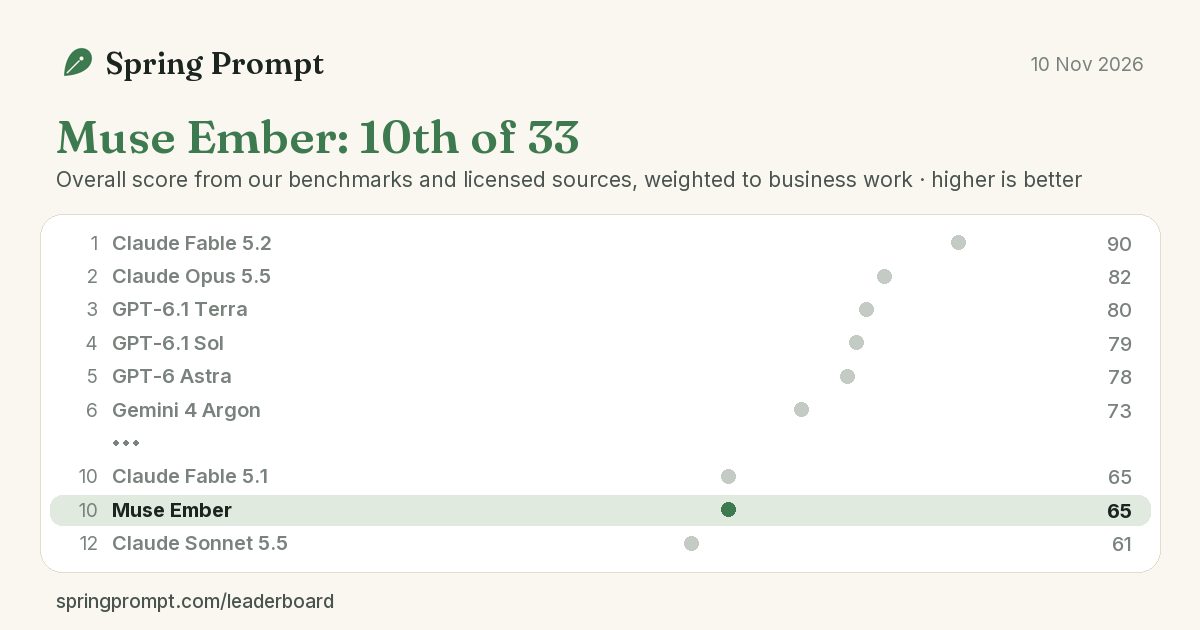
Ember scores 65 on our overall leaderboard, joint 10th of 33, where GPT-6 Luna is 23rd on 39. Don't read that as Ember being the better model. Our score leaves out groups a model has no results in, and Ember has results in 2 of 5: our own benchmarks (64) and knowledge work (66). Luna has all five, and its low rank comes from third-party agent, writing and factuality results that Ember doesn't have yet. On our own benchmarks alone, Luna scores higher, 70 to 64.
Survey analysis: its best result
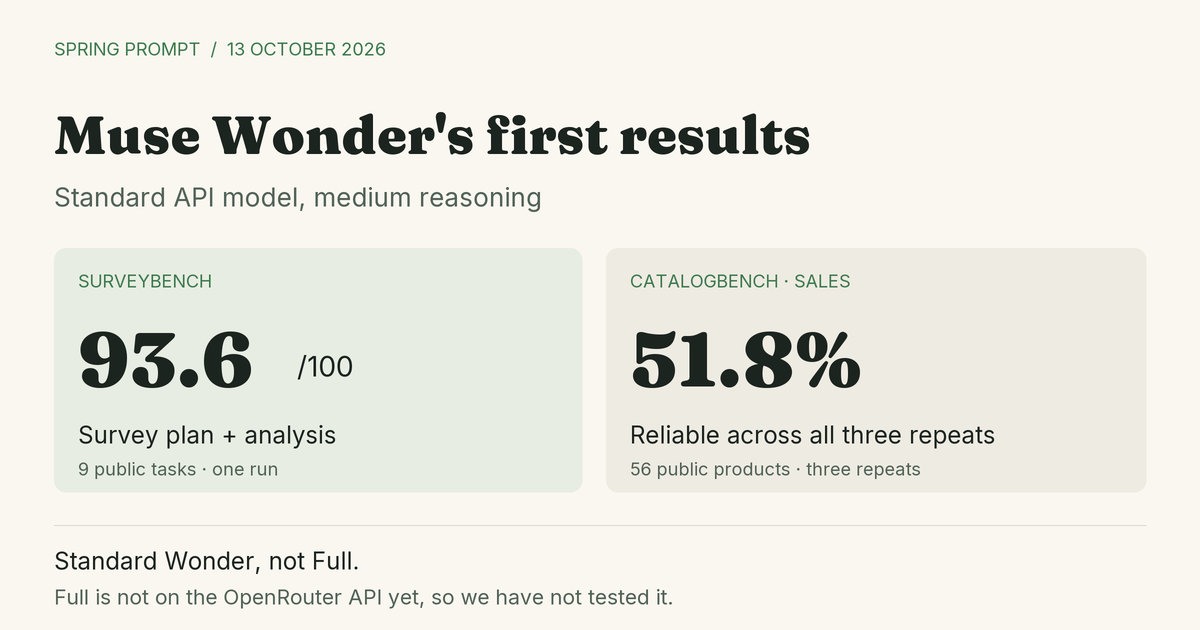
SurveyBench asks a model to plan a survey, then analyse the responses, with traps in the data. Ember rated 1,392 (range 1,323 to 1,501), 5th of 20 behind Claude Fable 5.2, Muse Wonder, Claude Opus 5.5 and GPT-6.1 Sol, all of which cost at least twenty times as much per token. GPT-6.1 Terra rated 1,247, Claude Haiku 5.5 1,248 and GPT-6 Luna 1,102; Ember's range clears Luna's and Haiku's and only just touches Terra's.
Every figure it quoted was right and it handled 98% of the traps. Its weak points were the survey questions it drafted, with three of nine plans carrying a flawed question, and one outright failure: on the bin collection task its analysis came back empty, because the reply hit its length limit before any answer appeared. That one empty answer pulls its score on the nine public tasks down to 87 of 100; the other eight averaged 94. Two of nine tasks came through with no fault at all, against three for Luna and Terra. A task took 73 seconds and $0.021.
Product listings: level with Luna on facts, behind on sales copy
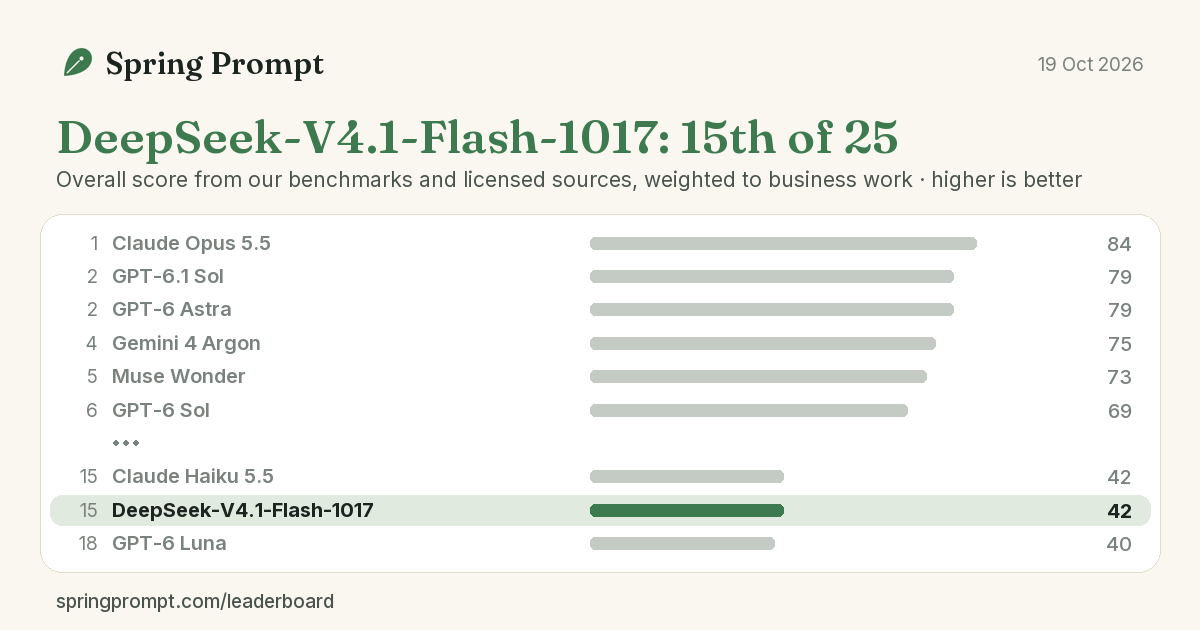
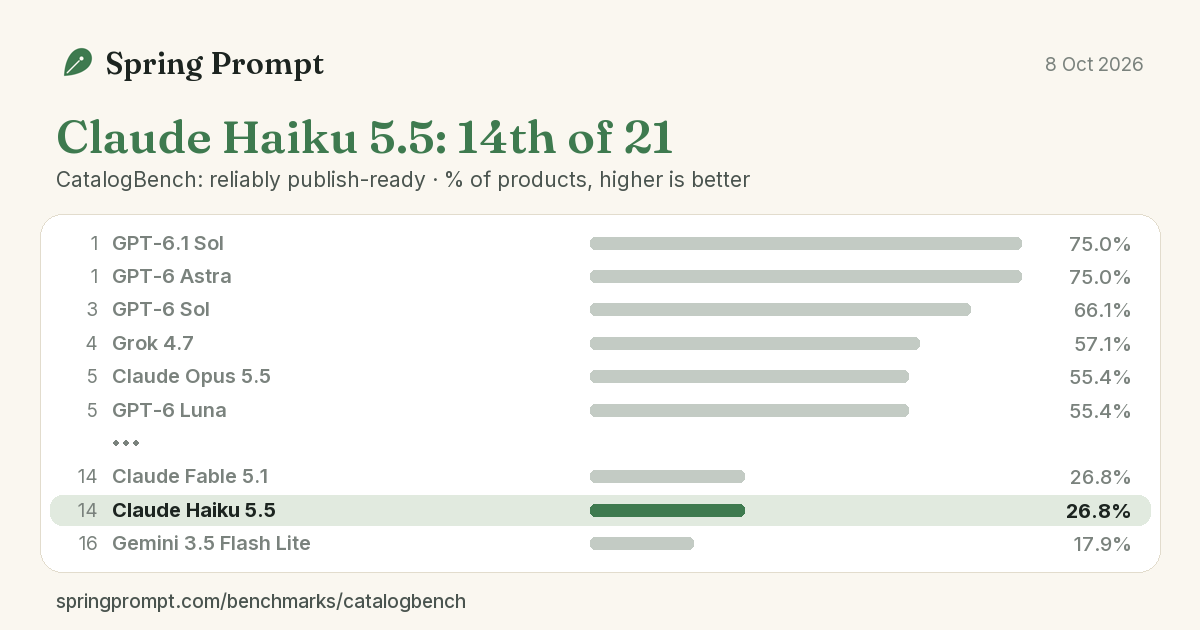
CatalogBench asks a model to turn sparse feeds and photos for 56 invented products into listings that could go live. On the factual brief, 53.6% of Ember's listings were publish-ready in all three repeats: 30 of 56 products, against 31 for GPT-6 Luna. It added 0.29 unsupported claims per product, about the same as Luna's 0.31, and caught every planted mismatch between feed and photo. That is 11th of 29, well ahead of Gemini 3.8 Flash (35.7%), Claude Haiku 5.5 (26.8%) and DeepSeek V4.1 Flash 1017 (21.4%).
With a sales brief it loosened up more than Luna did. Unsupported claims rose to 0.69 per product, twice Luna's 0.35, and reliably ready listings fell to 35.7% against Luna's 51.8%. A third of its sales listings failed on claims. If the job is persuasive copy at this price, Luna is the safer of the two. Each listing took 8.1 seconds and a fifth of a cent. These are invented products, so your own catalogue may behave differently. Our guide to the best AI for product descriptions has the full table.
Ad budgets: mid-table, no overspending
In ROASBench, a 12-month simulation of a skincare brand's ad budget, Ember scored 51.8, 8th of 29 and just behind Luna's 53.4. It never overspent and finished with $621,558 of simulated profit, against $738,879 for Luna. Claude Haiku 5.5, at the same price, scored 24.1. The run cost three cents. This is one simulated year per model, not evidence of real advertising returns.
Slide decks: right numbers, untidy slides
On DeckBench it rated 1,193 (range 1,107 to 1,277), 15th of 29. Luna rated 1,286 and the two ranges overlap, so the order between them is not settled. Seven of eight decks arrived. The eighth is missing because the API rejected the request on launch night with a "not a valid model ID" error, which says nothing about the model, but under our rules a deck that doesn't arrive counts as missing.
On the six public tasks none of its decks could be presented as it came: all five that arrived failed our layout check. The content was better than the slides. Four of those five got every number right, and 97% of the figures across its decks traced back to the source data. A deck took 30 seconds and about a cent. These are invented companies, with one deck per model per task.
Speed chess: it cannot answer without thinking
BulletBench plays speed chess against a ladder of engines, so slow thinking loses on time. It is our test of quick decisions, and it is where Ember's mandatory reasoning shows. At the default setting, with three minutes a side, it lost its first four games on time and was screened out: a median move took 7.8 seconds and some took nearly a minute. At one minute a side it rated 147, with seven of eight games lost on the clock at 3.4 seconds a move. Low effort gave the same rating at 2.8 seconds.
Minimal effort, the lowest setting Meta offers, brought a move down to 1.8 seconds and the rating up to 310 (range 0 to 595), with five of eight games still lost on time. That is level with Claude Haiku 5.5 (310) and GPT-6 Luna (249), both with reasoning off, and 19th of 30. Gemini 3.8 Flash rates 1,068 on the same clock. At ten seconds a side Ember lost its first four games on time at all three settings. It made no invalid moves in the one-minute games. BulletBench measures decisions against a clock, not general intelligence, and eight games give wide ranges.
In the playground
Ember also answered all 29 of our playground prompts, one-off creative coding tasks such as a working chess board or an animated solar system. Every one returned at the first try, in a median of 33 seconds, and the whole set cost $0.41. Our automatic judge passed 159 of its 172 checks. We have not tried the answers by hand yet, so treat that as a first read; these are one-off prompts, not a benchmark. All 29 answers are here.
Third-party results
None count towards Ember's rank yet, because the third-party data in our 10 November release predates the launch. Two testers have published, both read on 10 November. Artificial Analysis gives Ember at max effort 36 on its Intelligence Index, the same as Claude Haiku 5.5 at max, at $0.14 per index task where it reports $0.41 for Haiku. It measured 446 output tokens a second and 4.4 seconds to the first answer token, which fits what we saw: quick to write, slow to start. It also found knowledge to be the weak spot, with Ember declining to answer 64% of its AA-Omniscience questions. Data sourced from Artificial Analysis.
Vals AI reports 60.48% on its Vals Index at max effort, 13th of 36 models, at the lowest cost per test on that index. Epoch AI, LiveBench, METR and Vectara's hallucination leaderboard had no Muse Ember entry on 10 November.
What people are saying
How it read on Hacker News: 3 positive, 0 mixed, 5 negative of the 8 comments that took a side
NegativeMixedPositive
On 10 November we read every top-level comment on the main Hacker News thread, posted in the day after launch, and labelled each one positive, mixed, negative, neutral or off-topic. It is a small thread: 29 comments, of which 8 took a side, so we give counts and no percentages. Three of the five negatives are only about the weights not being released. Nobody in the thread reported the model's speed, good or bad. Labels are by Claude Fable 5.2 against a written rubric, then read through a second time. This is one forum, not a sample of users. Every labelled item.
A selection, with how we read each one:
the fact an even cheaper model for comparable intelligence is out there now is great news!
Ember also looks like a particularly inexpensive option for some agent workflows.
This is the first time I've seen that correlation appear to break - more reasoning tokens doesn't seem to produce an obviously better SVG.
Notable cache cost of 4% input, compared to Luna/Haiku's 10% of input.
Why no comparisons with DeepSeek?
When they said the model was the "smallest" of their models yet, I was really hoping it would be open weights.
If you want customers to switch over, you better make the price at least half of your competitor's.
it feels like Meta is making benchmaxxed models that are exciting on bench cards but not really useful in real world scenarios.
Beyond the forum, Simon Willison placed it as Meta's "entry in the Claude Haiku/GPT Luna category" and drew his usual pelican at all six reasoning levels: the "high" level "failed to return a full SVG", and more reasoning did not reliably mean a better drawing. That matches our one empty survey analysis.
Is Muse Ember good? Who should use it
- Analysis and research at volume, where it out-rated every model we have tested that costs less than $4 per million tokens. Have someone read the survey questions it drafts, and check for empty replies.
- Factual product listings, if you are already on Meta's API: it matched Luna, at about four times Luna's cost per listing at the default setting.
- Batch jobs that can wait a minute. Whole tasks finished quickly even with maximum reasoning.
- Not for sales copy left unchecked. It averaged 0.69 unsupported claims per sales listing, twice GPT-6 Luna's rate.
- Not for slides you present as they come. None of its decks passed our layout check.
- Not for replies needed within a second. Even at minimal effort a chess move took 1.8 seconds, and it lost every ten-second game on time. The Gemini Flash models are the ones built for that.
- Set the reasoning effort yourself. The default is max. If you leave it, you pay for the most thinking on every call.
These benchmarks aren't your data. We haven't measured tool calls, routing or coding subtasks, which is the work Meta built it for, and a model that reasons before every step may suit an agent loop better than it suits a chess clock.
What we'll update
We'll add Artificial Analysis and the other third-party sources as they enter the catalogue, and Ember's overall rank may change when they do. We also plan to rerun the business benchmarks at a lower reasoning effort, to see how much of the cost goes and how much of the quality stays. Until then, the Muse Ember model page has our results as they stand, and Meta's release timeline shows where it sits among recent launches.
Is Muse Ember good enough for your prompt? Paste it and we'll draft the cases and checks, run it on Ember, Luna and other models, and show you the cheapest one that passes. Test your prompt →
Cheapest model that passes
On our benchmarks that define a pass for each task: what one passing answer cost in our run, failed attempts included, and whether a cheaper model passed.
- CatalogBench · cost per 1,000 accepted listings
Muse Ember passed 120 of 168 attempts, with no estimate: failed-call costs incomplete. Cheapest: GPT-6 Luna at $0.70 (114 of 168 attempts). - DeckBench · cost per presentable deck
Muse Ember: no presentable decks (0 of 6 tasks). Cheapest: GPT-6.1 Terra at $0.13 (3 of 6 tasks). - SurveyBench · cost per sound survey task
Muse Ember passed 2 of 9 tasks, with no estimate: failed-call costs incomplete. Cheapest: GPT-6 Luna at $0.03 (3 of 9 tasks).
Cost per attempt divided by the share that passed, at the run date's prices, excluding judging. Each model at its cheapest setting per passing answer. With a handful of tasks, a pass or two either way is within chance. No estimate where a run had missing outputs, because their cost may not have been recorded.
Quick answers
How much does Muse Ember cost?
Meta lists it at $0.10 per million input tokens and $0.50 per million output, the same as GPT-6 Luna and Claude Haiku 5.5. Cached input is $0.004 per million. A request with more than 200,000 input tokens is billed in full at $0.30 and $1.50. Reasoning tokens are billed as output.
Is Muse Ember good?
For its price, yes on analysis. On our business tests of 10 November 2026 it came 5th of 20 models at survey analysis, ahead of GPT-6.1 Terra at a tenth of the price per token. It was mid-table on product listings, slide decks and an ad budget simulation, and in the bottom half at speed chess.
Muse Ember or GPT-6 Luna?
They cost the same per token and scored within one product of each other on factual product listings. Ember was clearly better at survey analysis. Luna was better at sales copy and slide decks, quicker at short decisions, and cost less per job in our runs, a quarter as much on listings.
Is Muse Ember fast?
It generates text quickly, at a median of about 575 tokens a second in our runs, and finished whole jobs faster than GPT-6 Luna. It is slow to give a short answer, because it reasons before every reply: about 3.4 seconds a chess move at the default setting and 1.8 at minimal. At minimal it played one-minute chess about as well as GPT-6 Luna and Claude Haiku 5.5, and far below Gemini 3.8 Flash.
Can you turn off reasoning on Muse Ember?
No. Meta's documentation says reasoning cannot be disabled. There are six effort levels from minimal to max, and the API default is max, so a call that sets nothing gets the slowest and most expensive setting.
Is Muse Ember open source?
No. Meta hosts it on its Model API and in Muse Code and has not released weights. Muse Glimmer and Muse Spark Open are Meta's open-weight models.
What is Muse Ember's context window?
Meta lists 1,048,576 tokens of context and up to 524,288 tokens of output. It takes text, images, video, audio and PDFs and returns text. Meta has not stated a knowledge cutoff.
What is Muse Ember for?
Meta pitches it for the repeated steps inside agent workflows: tool calls, coding subtasks, routing, extraction and long document parsing. We have not measured tool use or coding. On our tests its best fit was cheap analysis and research work that can wait a minute for an answer.