How each model did
Ranked by our pick, then checks passed, then cost. Time and cost count every try; each dot is one check, in the order listed below (filled: passed, half: partly, empty: failed). Click a model for its notes.
Notes on each answer
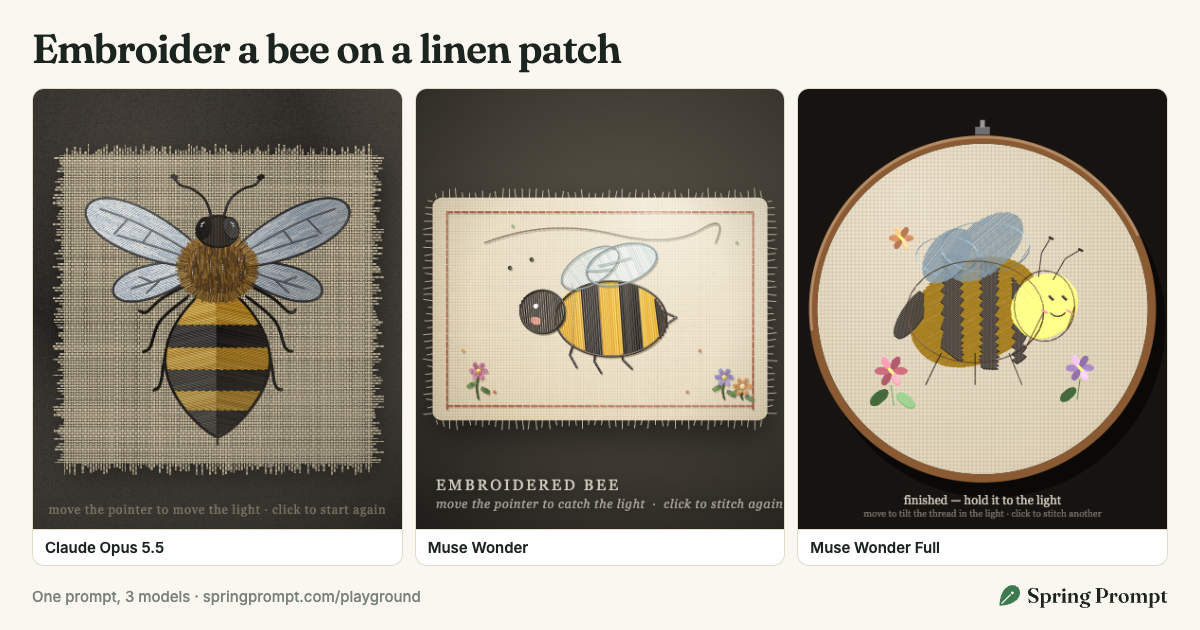
A square of frayed linen seen from above. It stitches the legs first, then silver-white wings with veins, a striped satin body, a fuzzy thorax in long stitches, and the head with eyes and antennae last. The thread really looks like thread, and the wings and stripes turn from bright to grey as you move the light. 6.6 minutes, $0.79.
6.6 min · 39,549 output tokens (27,838 thinking) · $0.792
2
Muse Wonder Full
3 of 4
Made in Muse Code, not over the API: Full could screenshot its own work and fix it, and took 2 rounds. A cheerful patch in a wooden hoop: linen with a traced design, a satin body, wings, legs and antennae, then a smiling face and two flowers. It has charm, but the outlines miss the fills (the wing and body outlines sit off the satin), the stripes zigzag and the legs are single straight lines. The sheen on the thread is faint. Its one fix made the satin stitch denser.
- ◐ The finished bee is all there: head, body, wings, legs and antennae (partly)
- ◐ The thread looks like shiny cotton, and its sheen follows the pointer (partly)
–
A cartoon bee, side on, on a cream patch with a running-stitch border: a round face with a blush, satin stripes, pale blue wings, and flowers stitched into the corners. Most of it appears in the first eight seconds. Its antennae are two loose dots above the head, and the light moves as a broad sheen across the linen rather than along the threads. Our first two requests were refused before it wrote anything (by our account's credit limit at its listed 943,718 tokens of room, then over a thinking setting this endpoint does not take); the third, with 128,000 tokens, is the answer. 1 minute, $0.20.
- ◐ The finished bee is all there: head, body, wings, legs and antennae (partly)
- ◐ The thread looks like shiny cotton, and its sheen follows the pointer (partly)
60 s · 9,871 output tokens (3,653 thinking) · $0.198 for this answer; 60 s and $0.198 over 3 tries
Took 3 tries: failed at 943,718 tokens; failed at 943,718 tokens, low thinking; finished at 128,000 tokens.
One answer per model, at each model's default settings unless the card says otherwise, through OpenRouter. If an answer ran out of room or stopped short, we asked again with more room, then with thinking off, and say so. This is a quick look, not a benchmark: run it again and every answer will differ. For measured results, see our benchmarks.
How we pick. Claude Opus 5.5 tried every answer (clicking, dragging and playing it in a browser), marked the checks and drafted the notes. Our pick is a judgement among the answers with the most checks passed, not a score: the checks show what works, the pick is which of those we would rather use. Opus is an Anthropic model, and Claude answers are our pick in 17 of 28 tests, so weigh Claude picks with that in mind. GPT-6.1 Sol, shown anonymised stills and our check marks, put Claude Opus 5.5 first as the most complete and convincing embroidery, then Muse Wonder, then Muse Wonder Full, and thought Muse Wonder's sheen deserved a partial rather than a pass; we agreed and changed it.
What we checked, by trying each answer ourselves: Builds the bee stitch by stitch, with satin fill and outlines; The finished bee is all there: head, body, wings, legs and antennae; The thread looks like shiny cotton, and its sheen follows the pointer; Finishes, holds on the finished piece, and starts again on a click. A partial pass counts as half.
Verdict
Claude Opus 5.5's bee is the one that looks embroidered: linen you can see the weave of, satin stripes, a fuzzy thorax and veined silver wings whose sheen follows the pointer. It is stitched in an odd order, legs first and head last, but it finishes with every part. Muse Wonder's side-on bee has the most charm for the least work, with a face and flowers, though its antennae float free. Muse Wonder Full, made in Muse Code with one round of fixes, puts a smiling bee in a hoop, but its outlines and fills do not line up.