How each model did
Ranked by our pick, then checks passed, then cost. Time and cost count every try; each dot is one check, in the order listed below (filled: passed, half: partly, empty: failed). Click a model for its notes.
Notes on each answer
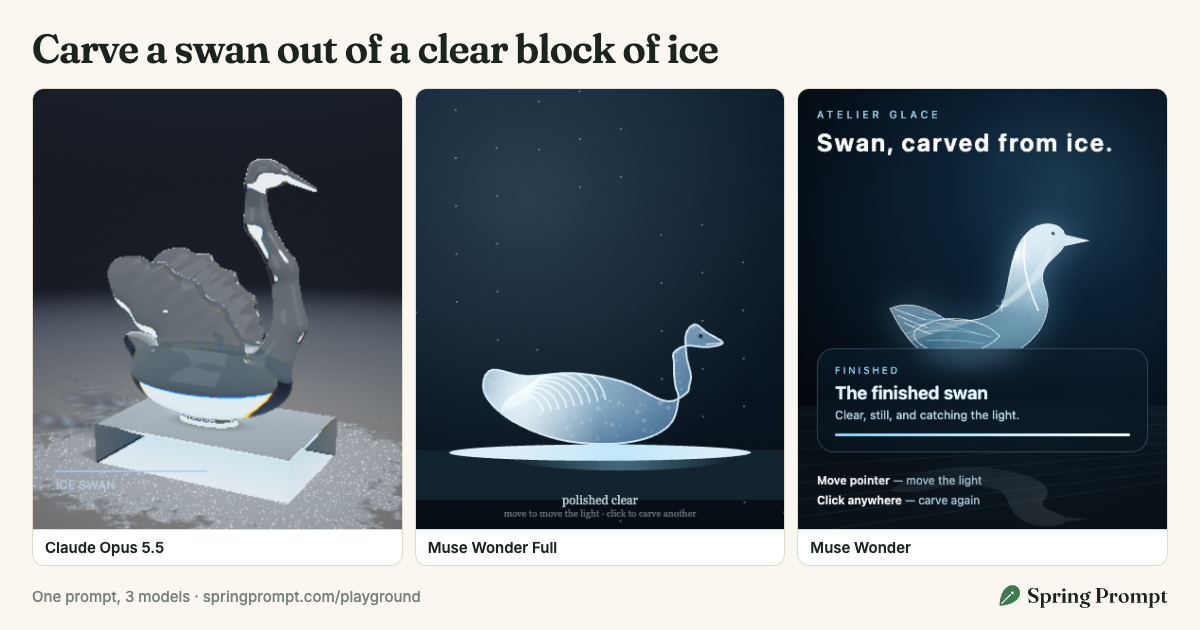
The most sculptural answer: a block on an ice base is roughed out with a chainsaw, refined with a chisel, given feathered wings, then polished with a torch. The finished swan is carved in the round, with a curved neck and stacked wing feathers, and glints that move with the pointer. 9.5 minutes, $1.15.
9.5 min · 57,693 output tokens (40,353 thinking) · $1.154
2
Muse Wonder Full
3.5 of 4
Made in Muse Code, not over the API: Full could screenshot its own work and fix it, and took 8 rounds. The whole routine is here: a clear block, the chainsaw throwing chips, chisels, feather detail and a torch polish with an orange glow. But the swan is a flat side profile with a long low body and a thin, kinked neck, more goose than swan, and most of its rounds went on fixing that neck. The ice glints as the pointer moves.
- ◐ The finished piece reads as a swan carved in the round (partly)
–
A chainsaw traces a line across a flat block, then a glowing translucent outline of a bird appears, with wing lines drawn inside it. It reads as a duck more than a swan, and as a drawing on glass rather than carved ice. The light shifts its glow. Our first two requests were refused before it wrote anything (by our account's credit limit at its listed 943,718 tokens of room, then over a thinking setting this endpoint does not take); the third, with 128,000 tokens, is the answer. 1.4 minutes, $0.20.
- ◐ Shows the carving: chainsaw roughing, then chisels, then a finish (partly)
- ✗ The finished piece reads as a swan carved in the round
- ◐ It looks like clear ice, and it glints as the pointer moves the light (partly)
83 s · 10,183 output tokens (3,570 thinking) · $0.204 for this answer; 83 s and $0.204 over 3 tries
Took 3 tries: failed at 943,718 tokens; failed at 943,718 tokens, low thinking; finished at 128,000 tokens.
One answer per model, at each model's default settings unless the card says otherwise, through OpenRouter. If an answer ran out of room or stopped short, we asked again with more room, then with thinking off, and say so. This is a quick look, not a benchmark: run it again and every answer will differ. For measured results, see our benchmarks.
How we pick. Claude Opus 5.5 tried every answer (clicking, dragging and playing it in a browser), marked the checks and drafted the notes. Our pick is a judgement among the answers with the most checks passed, not a score: the checks show what works, the pick is which of those we would rather use. Opus is an Anthropic model, and Claude answers are our pick in 17 of 28 tests, so weigh Claude picks with that in mind. GPT-6.1 Sol, shown anonymised stills and our check marks, put Claude Opus 5.5 first for its in-the-round volume and refractive ice, then Muse Wonder Full, whose neck it found awkward and flat, then Muse Wonder. We agree.
What we checked, by trying each answer ourselves: Shows the carving: chainsaw roughing, then chisels, then a finish; The finished piece reads as a swan carved in the round; It looks like clear ice, and it glints as the pointer moves the light; Finishes, holds on the finished piece, and starts again on a click. A partial pass counts as half.
Verdict
Claude Opus 5.5 is the only one that carves: its swan is a 3D sculpture on an ice base, roughed out with a chainsaw, chiselled and polished clear with a torch, and the glints move with the light. Muse Wonder Full goes through every stage of the craft, chips flying, but ends on a flat, goose-like profile after eight rounds of fixing it in Muse Code. Muse Wonder drew a glowing outline of a duck.