Gemini 4 Carbon review: slower than Argon on our business tests
Gemini 4 Carbon spent more time on our business tasks than Argon, and the extra work brought mixed results. It scored higher on survey analysis and an ad-budget simulation. On product listings, fewer products were reliably ready to publish, and the average factual listing took 45 seconds against Argon's seven.
The survey result shows why checking the final answer still matters. Carbon answered all 102 fixed numeric questions correctly, yet seven of its nine public analyses included an unsupported finding. Only one complete survey plan and analysis passed without a critical fault.
Gemini 4 Carbon at a glance
- Product listings: 53.6% ready to publish in all three factual-brief repeats, down from Argon's 60.7%. A sales brief reduced that to 14.3%.
- Survey work: better numeric accuracy and a higher head-to-head point estimate than Argon, with overlapping rating intervals. Unsupported conclusions remained common.
- Time and cost: slower and more expensive than Argon per listing, deck and survey task in these runs.
- Price: an introductory $2/$10 per million input/output tokens through 30 November, then $4/$20 from 1 December.
What Google says Carbon is for
Google opened Carbon to paying API users on 10 November, following its limited announcement on 28 October. It describes Carbon as a model for demanding multi-step engineering and scientific work, while continuing to recommend Argon for most software engineering and knowledge work. Its launch demonstrations use agent workflows with tools and verification loops. We have not evaluated those workflows or its cybersecurity claims.
The model documentation gives a unified input-and-output limit of 1,048,576 tokens, multimodal input and text output. Google's pricing page confirms the introductory rate above, including thinking tokens in output charges. Our measured task costs used that introductory rate; they are not forecasts for December.
Gemini 4 Carbon benchmarks, measured by Spring Prompt
Each row below names the job and its measure. Ranks count models with a result that were available to buy in our local catalogue release dated 11 November. The price group uses regular list prices, excluding temporary offers: $3–10 per million tokens, blended as three parts input to one part output. Carbon's regular blended price is $8.
| Taskbenchmark and measure | Carbonsetting | Argonsaved baseline | Rankmodels available to buy | Rank at its price$3–10 per million, regular blended price |
|---|---|---|---|---|
| Product listingsFactual brief, ready in all three repeats | 53.6%default | 60.7% | 11th of 30 | 7th of 13Best: GPT-6.1 Sol, 75.0% |
| Product listingsSales brief, ready in all three repeats | 14.3%default | 17.9% | 15th of 30 | 8th of 13Best: GPT-6 Sol, 67.9% |
| Survey plans and analysesHead-to-head rating | 1,076default | 960 | 11th of 21 | 4th of 9Best: Muse Wonder, 1,468 |
| Slide decksHead-to-head rating | 1,021default | 978 | 20th of 30 | 10th of 14Best: GPT-6 Sol, 1,470 |
| Ad-budget simulationScore across 12 simulated months | 51.2default | 47.0 | 12th of 30 | 6th of 13Best: Kimi K3.1 Pro, 55.1 |
| One-minute chessLadder Elo | 358low effort; default screened out | 147default | 16th of 31 | 9th of 12Best: Gemini 3.8 Flash, 1,068 |
Head-to-head ratings use public tasks. Models with no rated result are excluded from that row, including chess settings screened out after four clock losses. A higher arena rating means more favourable comparisons, not a percentage of correct work. The model page carries the full evidence.
Product listings: fewer were consistently publishable
Carbon passed 39 of 56 factual listings in each repeat, but only 30 products passed every time. That 30/56, or 53.6%, is our reliability measure. It avoids calling a product ready to publish because it happened to work once. Two attempts exhausted the 8,000-token limit and returned no usable listing; both failures are kept.
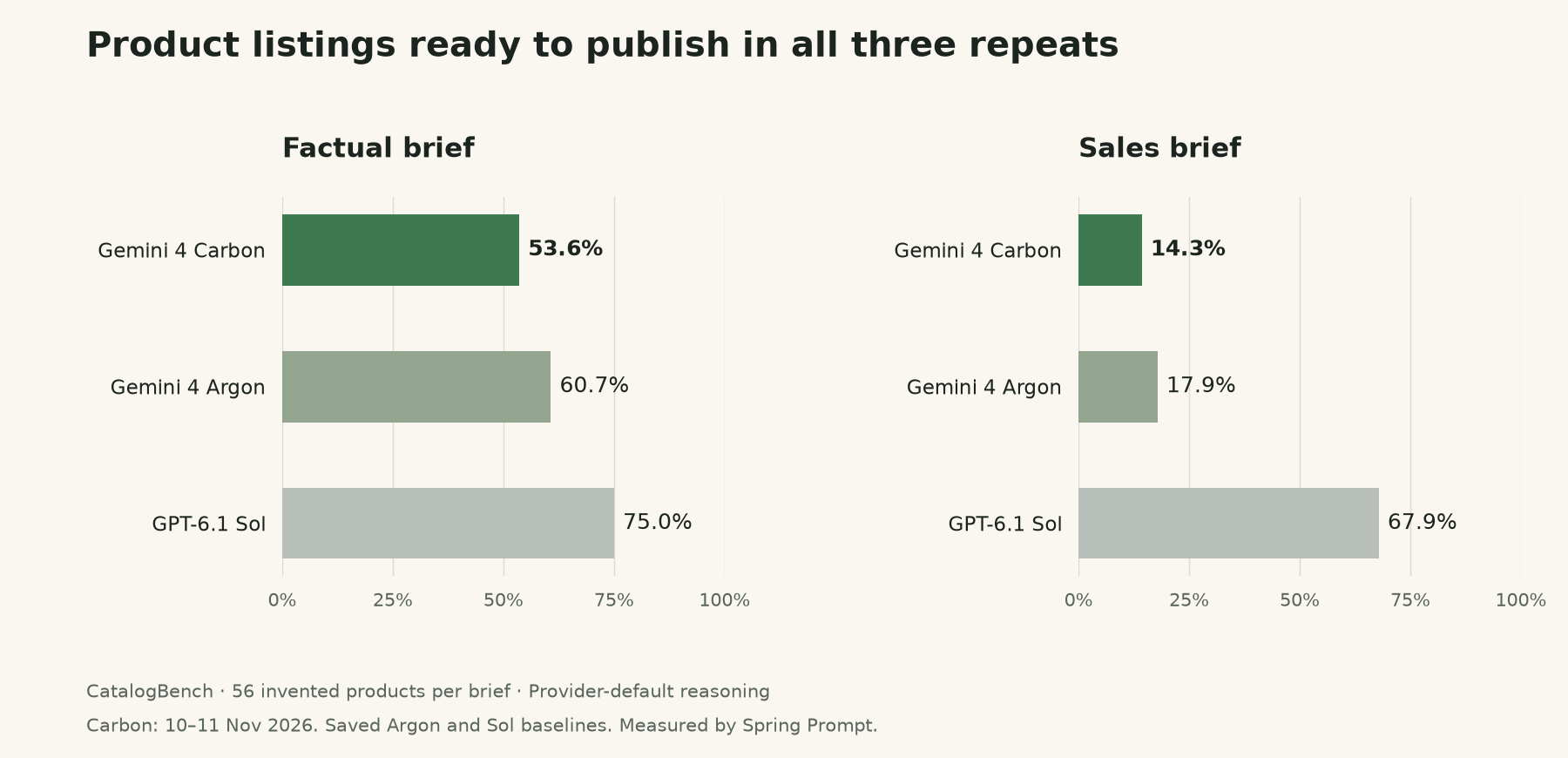
The sales brief was harder: eight products passed all three repeats. Carbon added an average 2.10 unsupported claims per listing, against 0.36 on the factual brief. One running-cap description promised a fit that stays put in wind without evidence for that benefit. More persuasive copy needs equally firm limits on what it may claim.
Survey analysis: correct answers, unsupported findings
Carbon's 102/102 fixed numeric answers improved on Argon's 99/102. Its research score rose from 83.3 to 87.0. Its public arena rating was 1,076, with a 95% interval of 982–1,178, against Argon's 960 (900–1,013). Those intervals overlap; the point estimates favour Carbon without establishing a clear separation.
Seven of nine analyses still contained an unsupported finding. In one, Carbon converted stated willingness to pay into a forecast of 15–25% actual paid conversion without supplied calibration data. Correct answers to fixed questions do not validate extra claims in the prose. Only one of nine complete plans and analyses was sound under all critical checks.
Slide decks, ad budgets and the clock
Carbon produced all eight requested decks, but only one of the six public decks was presentable. Four failed critical layout checks. Its arena rating of 1,021 was close to Argon's 978, with wide, overlapping intervals. Both models had two public decks without a critical layout fault.
On the ad-budget simulation, Carbon's score improved to 51.2 from 47.0. It completed all 12 months without overspending or a repair request, and made a loss in two months. This is a simulated marketing business, not a forecast of advertising returns.
Timed chess exposed the wait for answers. Across six settings, every one of Carbon's 28 losses was on time, with no provider error or fallback move. At 180+2, low effort rated 848 and default 557 from eight games each; their wide intervals overlap. Both 10+1 settings were screened out. At 60 seconds only low effort reached a rated result, 358.
Gemini 4 Carbon price and measured task cost
The introductory token price matches Argon's, but Carbon used more money and time per task. These are author costs on the public task sets, excluding judging.
| Task | Carboncost · time | Argoncost · time |
|---|---|---|
| Factual product listing | $0.021 · 45 seconds | $0.011 · 7 seconds |
| Slide deck | $0.164 · 3.8 minutes | $0.115 · 1.1 minutes |
| Survey task | $0.309 · 6.5 minutes | $0.131 · 1.2 minutes |
Provider-default runs through OpenRouter, averaged over each public task set. Carbon measured 10–11 November 2026; Argon uses its saved runs. Costs and response times come from the retained run records. They exclude judging and can omit time or charges from internal client retries.
What other evaluations tell us
Artificial Analysis reports 60 on Intelligence Index v5.0.1 at high effort, as read on 11 November. That is a broader evaluation and a separately named reasoning setting. It has not been imported into this catalogue release, so Carbon has no intelligence or speed comparison group here yet.
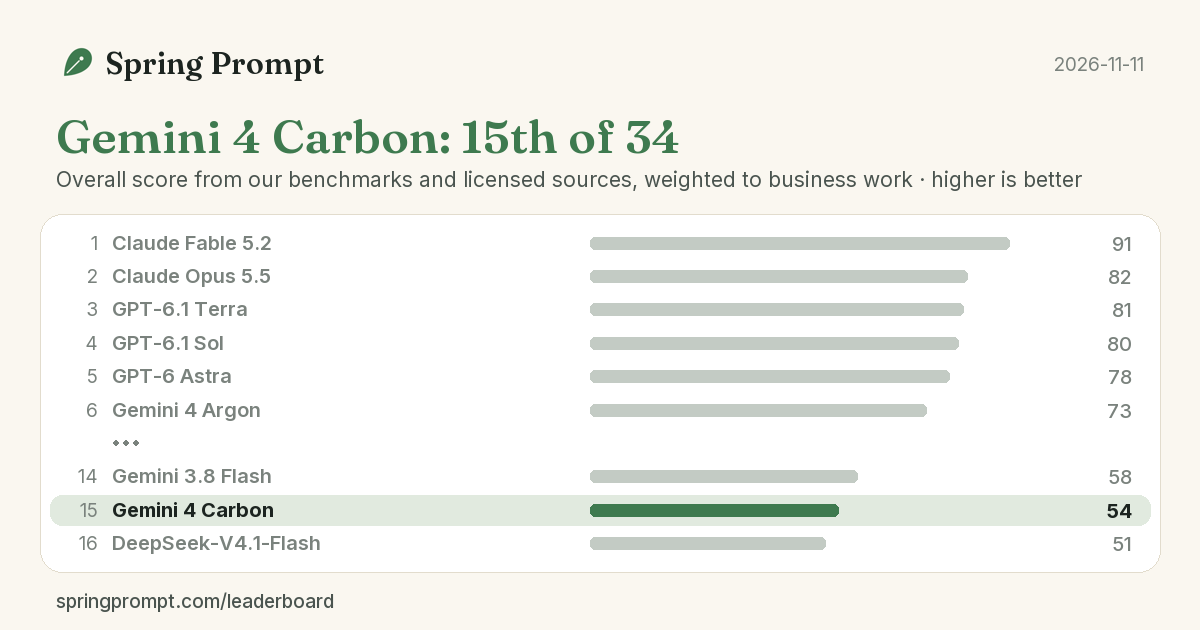
Carbon's overall leaderboard score here is 54, provisionally 15th of 34, using two of five groups: our own benchmarks and knowledge work. Both currently come from our measurements. Other models have broader coverage, so read the individual task results when making a choice.
Two things it made in the playground
For a lighter look, we selected stained glass and a pelican on a bicycle from recent visitor interest. These are illustrative outputs, separate from the benchmark verdict.


Gemini 4 Carbon vs Argon and GPT-6.1 Sol: who should use it?
For routine product copy, our evidence favours GPT-6.1 Sol: 75.0% reliable factual listings and about $0.008 per listing in its saved run. For teams already using Argon, these tests give no general reason to switch. Carbon improved some scores while increasing cost and wait time, and both need close checking of unsupported claims.
For survey drafting, Carbon is a candidate for a controlled comparison if you can audit the conclusions. Claude Fable 5.2 leads that benchmark in this release. We would not send Carbon's analyses or decks straight to a client, and these results do not establish how well it performs with an agent harness.
Test the models on your own prompts and source data before changing a workflow. The Carbon model page and its playground record collect the evidence. We will update this review as comparable third-party results enter the catalogue; the live box below shows the release currently being served.
Choosing or switching the model behind a product feature? Our custom evaluations test the models you are weighing on your own prompts and data, against your own definition of good. If AI writes your product content, the catalogue feed diagnostic measures how far you can trust it. Talk to us, or email hello@springprompt.com.
Cheapest model that passes
On our benchmarks that define a pass for each task: what one passing answer cost in our run, failed attempts included, and whether a cheaper model passed.
- CatalogBench · cost per 1,000 accepted listings
Gemini 4 Carbon passed 117 of 168 attempts, with no estimate: failed-call costs incomplete. Cheapest: GPT-6 Luna at $0.70 (114 of 168 attempts). - DeckBench · cost per presentable deck
Gemini 4 Carbon: $0.98 (1 of 6 tasks), 9 of 12. Cheapest: GPT-6.1 Terra at $0.13 (3 of 6 tasks). It passed at least as often. - SurveyBench · cost per sound survey task
Gemini 4 Carbon: $2.78 (1 of 9 tasks), 9 of 10. Cheapest: GPT-6 Luna at $0.03 (3 of 9 tasks). It passed at least as often.
Cost per attempt divided by the share that passed, at the run date's prices, excluding judging. Each model at its cheapest setting per passing answer. With a handful of tasks, a pass or two either way is within chance. No estimate where a run had missing outputs, because their cost may not have been recorded.
Quick answers
Is Gemini 4 Carbon better than Gemini 4 Argon?
On our business tests of 10–11 November 2026, the results were mixed. Carbon improved survey and ad-budget scores, but product listings reliably ready to publish fell from 60.7% to 53.6%. It took longer and cost more per listing, deck and survey task.
How much does Gemini 4 Carbon cost?
Google lists an introductory price of $2 per million input tokens and $10 per million output tokens through 30 November 2026. From 1 December, those prices become $4 and $20. Output pricing includes thinking tokens.
Does Gemini 4 Carbon make things up?
Yes. In our tests it added unsupported product claims, and seven of nine public survey analyses contained an unsupported finding even though all 102 answers to fixed numeric questions were correct. These were invented products and survey datasets.
Gemini 4 Carbon or GPT-6.1 Sol for product listings?
GPT-6.1 Sol was more reliable in our saved default-setting runs: 75.0% of products passed all three factual-brief repeats, against Carbon's 53.6%. Author cost was about $0.008 per listing for Sol and $0.021 for Carbon, excluding judging.
What is Gemini 4 Carbon's context window?
Google documents a unified input-and-output limit of 1,048,576 tokens. It accepts text, images, audio, video and PDFs and returns text. We did not test long-context performance.
Did Spring Prompt test Carbon's coding agents or cybersecurity?
No. We tested product listings, survey work, slide decks, an ad-budget simulation and timed chess through OpenRouter, plus illustrative playground outputs. These runs do not measure Google's multi-agent workflows or specialised cybersecurity capabilities.