Claude Fable 5.2 review: first on our survey and ad budget tests, and one of the dearest models to run
Anthropic released Claude Fable 5.2 on 9 November, at $8/$40 per million tokens, 20% below Fable 5.1. We ran it through all five of our business benchmarks the next morning.
It came first at survey analysis and at running an ad budget, and third at product listings and slide decks. Every one of those is a large step up from Fable 5.1. It was also slow, and one of the most expensive models per task that we have run: about ten times the cost of GPT-6.1 Sol, which still beats it narrowly on product listings.
Claude Fable 5.2 at a glance
- Use it for analysis where a wrong conclusion is expensive: it was first of 17 at survey analysis by a clear margin, and made the most profit of 28 models in our ad budget simulation.
- Don't pay for it on product listings. GPT-6.1 Sol was slightly more reliable at about a tenth of the cost per listing.
- Not for anything on a clock. It took about five minutes a deck or survey task and lost every game of 10-second chess on time.
- Price: $8/$40 per million input/output tokens, $0.20 cached. In our runs that came to $0.09 a listing, $1.40 a deck and $1.51 a survey task.
- Watch the thinking budget. Thinking can't be turned off, and on eight creative coding prompts it spent the full 128,000-token limit thinking and returned nothing until we lowered the effort.
Claude Fable 5.2 benchmark results in one table
Independent results, measured by Spring Prompt on 10 November 2026 at the API default setting. All of it is free to reuse with a link (CC BY 4.0), and the full rows are in our open data.
| Taskbenchmark | Claude Fable 5.2 | Claude Fable 5.1 | Best other model | Rankmodels on sale today |
|---|---|---|---|---|
| Survey analysisSurveyBench rating | 1,683 | not run | Muse Wonder, 1,485 | 1st of 17 |
| Ad budget, 12 simulated monthsROASBench score | 61.3 | 51.5 | GPT-6.1 Terra, 58.4 | 1st of 28 |
| Product listings, factual briefCatalogBench, publish-ready in all three runs | 71.4% | 26.8% | GPT-6.1 Sol and GPT-6 Astra, 75.0% | 3rd of 28 |
| Product listings, sales briefCatalogBench, publish-ready in all three runs | 44.6% | 5.4% | GPT-6 Astra, 69.6% | 7th of 28 |
| Slide decksDeckBench rating | 1,425 | 1,291 | GPT-6 Astra, 1,593 | 3rd of 28 |
| Chess, three minutes a sideBulletBench 180+2 rating | 1,100 | 358 | Gemini 4 Argon, 1,147 | 3rd of 17 |
Products, companies and survey data are invented, and each benchmark except CatalogBench ran once. Ratings are head-to-head scores, where a higher number wins more comparisons.
What Anthropic says
Anthropic's launch post does not pitch Fable 5.2 as the model for everyday work. It says "Fable and Mythos are best for the most ambitious, open-ended technical work" and recommends Claude Opus 5.5 as the place to start "for most coding and knowledge tasks". It says the new model writes more clearly than earlier Fables and produces output up to 30% faster than Fable 5.1.
Its headline numbers are for coding and agents. On FrontierCode 2.0 it reports 49.1% at extra-high effort, against 45.5% for Opus 5.5 and 42.8% for GPT-6 Astra. On the Remote Labor Index it reports 41.3%, against 21.3% for Opus 5.5, and on Humanity's Last Exam with tools 74.2%. Its own table has Gemini 4 Carbon ahead on AutomationBench (53.9% to 51.4%) and Opus 5.5 ahead on the AA-Briefcase head-to-head rating (1,800 to 1,785).
The model page lists a 1 million token context, 128,000 tokens of output, text and image input and a June 2026 knowledge cutoff. Thinking is always on: you choose an effort level from low to max, and the API default is high. It is on Anthropic's API, Amazon Bedrock, Google Cloud and Microsoft Foundry, and in paid Claude plans. These are the developer's claims. We have not measured coding, agents or computer use.
Claude Fable 5.2 benchmarks, measured by Spring Prompt
The model page has every result. How to read this table: each row is one benchmark, with Fable 5.2's score and setting, its rank among models we have tested that are on sale today, and its rank among models priced at $10 or more per million tokens. There is no intelligence or speed group yet, because the Artificial Analysis data in this release predates the launch.
| Benchmarkwhat it measures | Claude Fable 5.2its score | Rank among all modelsavailable today | Rank at its price$10 or more per million tokens, blended |
|---|---|---|---|
| SurveyBenchhead-to-head rating of survey plans and analyses | 1,683default setting | 1st of 17Next: Muse Wonder, 1,485 | Not rankedno other model at this price measured |
| ROASBenchscore in a 12-month ad budget simulation | 61.3default setting | 1st of 28Next: GPT-6.1 Terra, 58.4 | 1st of 3Best: Claude Fable 5.2, 61.3 |
| CatalogBench, factual brieflistings publish-ready in all three repeats | 71.4%default setting | 3rd of 28Best: GPT-6.1 Sol and GPT-6 Astra, 75.0% | 2nd of 3Best: GPT-6 Astra, 75.0% |
| DeckBenchhead-to-head rating of slide decks | 1,425default setting | 3rd of 28Best: GPT-6 Astra, 1,593 | 2nd of 3Best: GPT-6 Astra, 1,593 |
| CatalogBench, sales brieflistings publish-ready in all three repeats | 44.6%default setting | 7th of 28Best: GPT-6 Astra, 69.6% | 2nd of 3Best: GPT-6 Astra, 69.6% |
| BulletBench, one minutechess rating against a 60-second clock | 491default and low effort | 10th of 29Best: Gemini 3.8 Flash, 1,068 | Not ranked2 models measured |
Ranked on the release of 10 November 2026. A group only counts models that benchmark has measured. Ranks are provisional and can move as models are added. Blended price is three parts input to one part output: $16.00 for Fable 5.2.
What 1st overall does and doesn't mean
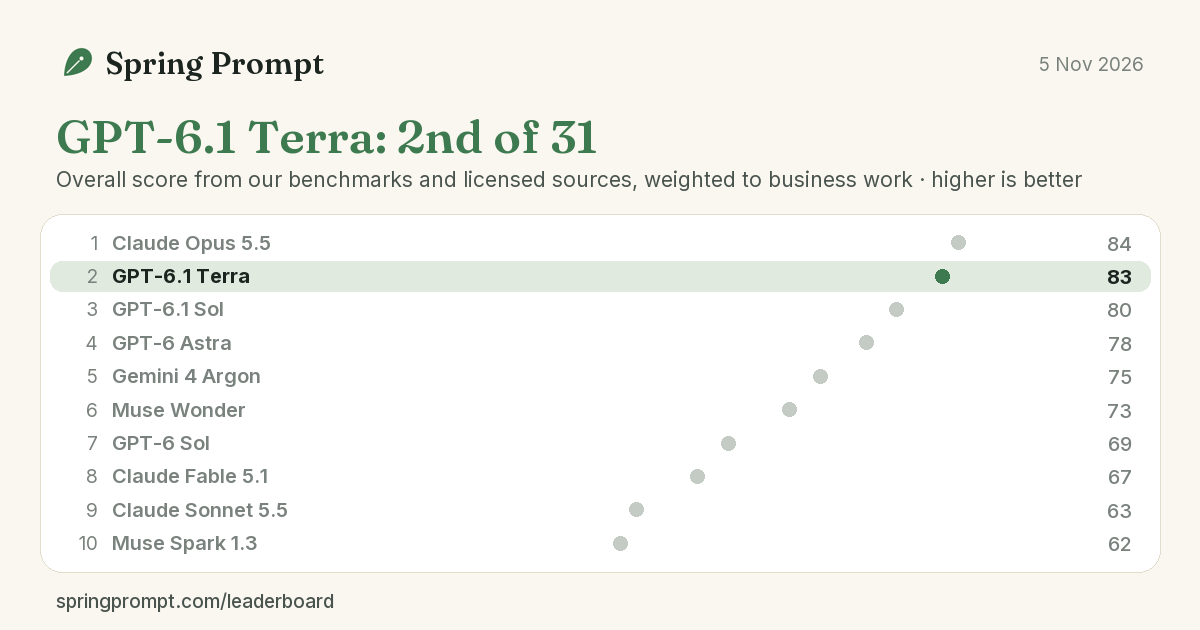
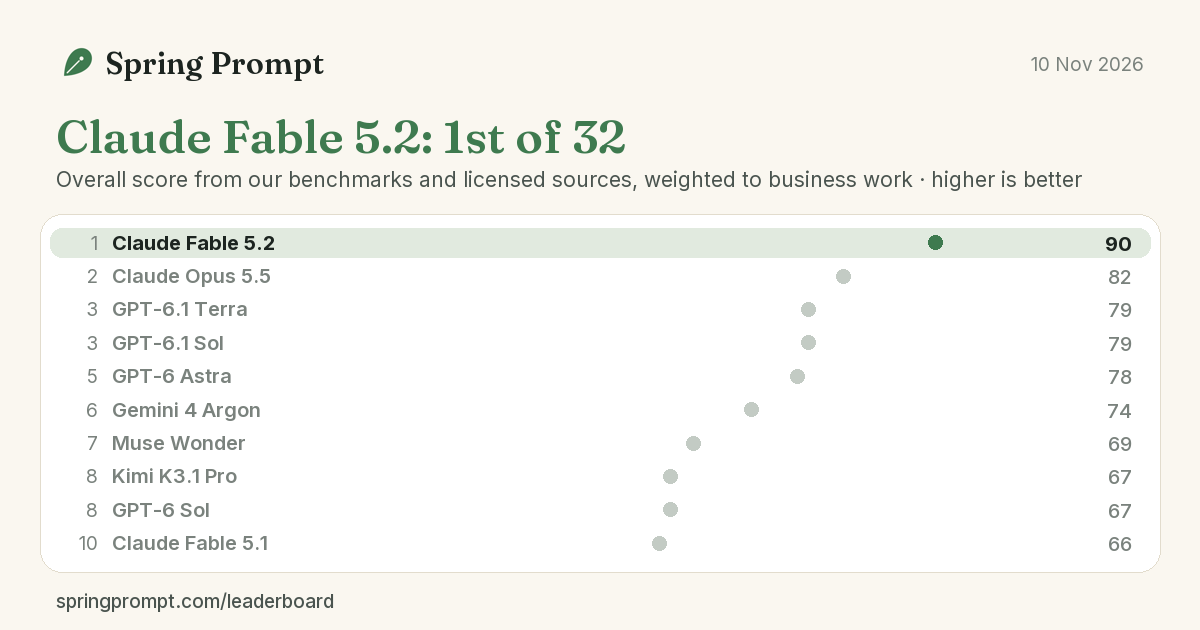
Fable 5.2 scores 90 on our overall leaderboard, eight points ahead of Claude Opus 5.5. Our score leaves out groups a model has no results in, and Fable 5.2 has results in 2 of 5: our own benchmarks (87) and knowledge work (96), both run by us. Agents, writing and factuality have nothing yet. Opus 5.5 and GPT-6.1 Sol have all five, and on our own benchmarks alone Sol still scores higher, 94 to 87. So the rank says Fable 5.2 did very well on what we have measured. It could move once third-party results arrive.
Survey analysis: a clear first
SurveyBench asks a model to plan a survey, then analyse the responses, with traps in the data. Fable 5.2 rated 1,683 (range 1,591 to 1,841). The next three, Muse Wonder, Claude Opus 5.5 and GPT-6.1 Sol, sit between 1,456 and 1,485, and none of their ranges reaches Fable's, so this lead is not a rounding matter. Its analyses scored 98 of 100, the highest we have recorded, every figure it quoted was right, and it handled 99% of the traps.
The best rating is not the same as faultless work. Four of its nine public tasks came through with no fault at all, against six for GPT-6.1 Sol and five for Opus 5.5; its slips were mostly in the survey questions it drafted. It took 337 seconds and $1.51 a task, the most expensive of 18 results. Sol took 222 seconds and $0.14.
Ad budgets: the best score and the most profit
In ROASBench, a 12-month simulation of a skincare brand's ad budget, Fable 5.2 scored 61.3, ahead of GPT-6.1 Terra's 58.4. It never overspent, made a loss in one month and finished with $1,032,894 of simulated profit, the most of any model. Fable 5.1 scored 51.5. The run cost $1.76. This is one simulated year per model, not evidence of real advertising returns, and GPT-6.1 Sol has not been run on it.
Product listings: far better than Fable 5.1, still behind GPT-6.1 Sol
CatalogBench asks a model to turn sparse feeds and photos for 56 invented products into listings that could go live. On the factual brief, 81.0% of Fable 5.2's listings were publish-ready across three repeats, the highest average of 29 models. Our headline number is stricter: listings that passed in all three repeats. There it scored 71.4%, or 40 of 56 products, two products short of GPT-6.1 Sol and GPT-6 Astra on 75.0%.
The change from Fable 5.1 is the story. Reliable listings rose from 26.8% to 71.4%, mostly because it stopped adding things: unsupported claims fell from 1.23 per product to 0.23. With a sales brief it loosened up again, at 0.46 unsupported claims per product and 44.6% reliably ready, 7th of 28, where the four GPT-6 models sit between 67.9% and 69.6%. If your listings need persuasive copy, that gap matters more than the factual result.
Each listing took 17.5 seconds and $0.088. GPT-6.1 Sol took 10 seconds and $0.008. These are invented products, so your own catalogue may behave differently. Our guide to the best AI for product descriptions has the full table.
Slide decks: third, and the costliest
On DeckBench it rated 1,425 (range 1,319 to 1,572), 3rd of 28 behind GPT-6 Astra and GPT-6 Sol. That range overlaps GPT-6.1 Sol and Claude Opus 5.5, so don't read much into the order among them. Seven of eight decks arrived; the eighth failed our file check with zero-size shapes. Of the six public tasks, all five decks that arrived could be presented as they were, the best rate of 30 results, and all five got the numbers right.
A deck took 285 seconds and $1.40, the most expensive of 30 results and nearly twice Fable 5.1's $0.81. Opus 5.5 took 99 seconds and $0.26. These are invented companies, with one deck per model per task.
Speed chess: fine with three minutes, hopeless with ten seconds
BulletBench plays speed chess against a ladder of engines, so slow thinking loses on time. With three minutes a side Fable 5.2 rated 1,100 (range 789 to 1,450), 3rd of 17 and far above Fable 5.1's 358: four wins from eight, every loss on time, no invalid moves. At one minute it rated 491 at both default and low effort, losing five of eight on time. At ten seconds it lost its first four games on time at both settings and was screened out. A median move took 3 to 5 seconds whatever the setting. BulletBench measures decisions against a clock, not general intelligence.
In the playground
Fable 5.2 also answered all 29 of our playground prompts, one-off creative coding tasks such as a stained glass window or a working chess board. All 29 answers run, with no errors. Twenty-one finished at the first try, in a median of 5.7 minutes. On the other eight, six of them animated craft scenes, the default setting spent the entire 128,000-token output limit thinking and returned no answer; each finished at low effort in 4 to 16 minutes. If you call it through the API with open-ended prompts, set a lower effort or expect some empty, fully billed replies.

We have since tried every answer by hand. It passed 116.5 of our 118 checks and is now our pick on three of the 29 pages: the piped birthday cake, the latte art and the oil painting. On most of the rest it is level with the current pick and costs several times as much. These are one-off prompts, not a benchmark, so read them as examples of what it makes. All 29 answers are here.
Third-party results
None count towards Fable 5.2's rank yet, because the third-party data in our 10 November release predates the launch. Five have published, all read on 10 November. Artificial Analysis gives Fable 5.2 at maximum effort 65 on its Intelligence Index, the highest on its board, at 98 tokens a second, 46.4 minutes and $26.54 per index task. Data sourced from Artificial Analysis. Epoch AI's data file puts it at 174 on the Epoch Capabilities Index (range 170 to 179), ahead of GPT-6 Astra on 169 with overlapping ranges.
Vals AI reports 71.31% on its Vals Index at high effort, first of 36 models. LiveBench shows it at 84.9 overall at extra-high effort, and notes that its maximum-effort run scored lower, 84.2. BenchLM gives 91.19 of 100, first of 214, a score it labels as estimated because it combines 35 results published elsewhere and is not its own testing.
All five agree with the shape of our results: top of the table, at a cost per task well above everything near it. METR's time-horizon page and Vectara's hallucination leaderboard had no Fable 5.2 entry on 10 November.
What people are saying
How it read on Hacker News: 37% positive, 26% mixed, 37% negative of the 27 comments that took a side
NegativeMixedPositive
On 10 November we read every top-level comment on the main Hacker News thread, posted in the day after launch, and labelled each one positive, mixed, negative, neutral or off-topic. Neutral and off-topic comments are left out; the loudest off-topic theme was a claim that Claude Opus 5.5 had got worse before the launch, which we have not tested. Labels are by Claude Fable 5.2 against a written rubric and checked by hand. This is one forum, not a sample of users, and most comments came before people had used it for long. Every labelled item.
A selection, with how we read each one:
It was able to work with an esoteric 600k line fortran codebase to speed up some computational material science work for us by 36 times (!).
Always happy to see improvements offered at lower costs.
Fable is good, but you really have to push the ambition of your prompt in order to see proper separation from Opus 5.5.
Fable 5.2 doesn't look materially different (if anything, the graphics look worse), but it added more depth to all three games.
It's an awesome model spec wise, but I pushed the button, and 10 mins later my whole weekly quota is gone.
resulting in 100% of 5hr usage being drained in less than 20min (on $100).
This is the first frontier model release by them that I am not that moved or eager to go use it, will likely stay on Opus 5.5 or other frontier models.
max is in there too, but it ran out of reasoning tokens (128,000 limit) before it got to the actual SVG.
Beyond the forum, Ethan Mollick wrote on 9 November that "on many individual tasks, I think it met the bar I set at the start: as good as most human experts", and also that when it made mistakes, "the AI did not notice these problems itself". Simon Willison hit the same wall we did: at maximum effort it "failed to return an image at all, running out of tokens after spending 128,000 thinking about them".
Claude Fable 5.2 vs Fable 5.1, Claude Opus 5.5 and GPT-6.1 Sol
Prices are blended per million tokens (three input to one output) at list price. All scores were measured by Spring Prompt at each model's best configuration, and a dash means we have no result.
| Modelwhy it's here | Priceblended, list | Overallprovisional where marked | CatalogBenchfactual, reliably ready | DeckBenchrating | SurveyBenchrating | ROASBenchscore | Compare |
|---|---|---|---|---|---|---|---|
| Claude Fable 5.2this review | $16.00 | 90, provisional | 71.4% | 1,425 | 1,683 | 61.3 | – |
| Claude Fable 5.1the model it replaces | $20.00 | 66 | 26.8% | 1,291 | – | 51.5 | Side by side |
| Claude Opus 5.5Anthropic's recommended starting point | $8.00 | 82 | 55.4% | 1,377 | 1,477 | 51.7 | Side by side |
| GPT-6.1 Solbest on listings, a quarter of the price | $4.00 | 79 | 75.0% | 1,420 | 1,456 | – | Side by side |
| GPT-6 AstraOpenAI's largest model, same price band | $20.00 | 78 | 75.0% | 1,593 | – | 56.6 | Side by side |
| GPT-6.1 Terrathe cheap option | $2.00 | 80, provisional | 64.3% | 1,332 | 1,251 | 58.4 | Side by side |
| Muse Wonderprevious best at surveys | $8.00 | 69, provisional | 66.1% | 1,238 | 1,485 | 38.9 | Side by side |
Against Fable 5.1 there is no reason to stay: better on everything we ran, and cheaper per token, though its decks took longer and cost more each. Against Opus 5.5, Fable 5.2 was ahead on all four business benchmarks, clearly on surveys and listings, while Opus cost a third to a fifth as much per task. That fits Anthropic's own advice to start with Opus and move up when it isn't enough. Against GPT-6.1 Sol it depends on the job: Sol for listings, Fable for survey analysis, either for decks, with Sol about ten times cheaper per task throughout. GPT-6 Astra, at a similar price, still makes the best decks we have rated.
Is Claude Fable 5.2 good? Who should use it
- Survey and research analysis, where it was clearly the best we have tested. Still have someone read the survey questions it drafts.
- Budget and planning work, where it did best of all, keeping in mind that this is one simulated year.
- Slide decks you need to present as they come, if $1.40 and five minutes a deck is acceptable. Check the file opens: one of eight didn't pass our check.
- Not for product listings at volume. GPT-6.1 Sol and GPT-6.1 Terra were as good or better for a twentieth to a tenth of the cost.
- Not for sales copy left unchecked. It added an unsupported claim to roughly every other listing on the sales brief.
- Not for real-time decisions, at any effort setting we tried.
These benchmarks aren't your data. We haven't measured coding or long agent sessions, which is what Anthropic is selling it on.
What we'll update
We'll add Artificial Analysis and the other third-party sources as they enter the catalogue, and Fable 5.2's rank may change when they do. Until then, the Claude Fable 5.2 model page has our results as they stand, and Anthropic's release timeline shows where it sits among recent launches.
Is Fable 5.2 worth the price for your prompt? Paste it and we'll draft the cases and checks, run it on Fable 5.2 and cheaper models, and show you the cheapest one that passes. Test your prompt →
Cheapest model that passes
On our benchmarks that define a pass for each task: what one passing answer cost in our run, failed attempts included, and whether a cheaper model passed.
- CatalogBench · cost per 1,000 accepted listings
Claude Fable 5.2: $108 (136 of 168 attempts), 23 of 24. Cheapest: GPT-6 Luna at $0.70 (114 of 168 attempts). Every cheaper model passed less often. - DeckBench · cost per presentable deck
Claude Fable 5.2 passed 5 of 6 tasks, with no estimate: failed-call costs incomplete. Cheapest: GPT-6.1 Terra at $0.13 (3 of 6 tasks). - SurveyBench · cost per sound survey task
Claude Fable 5.2: $3.40 (4 of 9 tasks), 8 of 8. Cheapest: Particle-1 at $0.06 (2 of 9 tasks). Cheaper and passed at least as often: GPT-6.1 Sol at $0.21 (6 of 9 tasks).
Cost per attempt divided by the share that passed, at the run date's prices, excluding judging. Each model at its cheapest setting per passing answer. With a handful of tasks, a pass or two either way is within chance. No estimate where a run had missing outputs, because their cost may not have been recorded.
Quick answers
How much does Claude Fable 5.2 cost?
Anthropic lists it at $8 per million input tokens and $40 per million output, 20% less than Claude Fable 5.1 and twice the price of Claude Opus 5.5. Cached input is $0.20 per million and the batch API is half price. There is no extra charge for long prompts.
Is Claude Fable 5.2 good?
On our business tests of 10 November 2026, yes. It came first of 17 models at survey analysis and first of 28 on an ad budget simulation, and third of 28 on product listings and slide decks. It was also among the most expensive models we have run, at about $1.40 a slide deck.
Is Claude Fable 5.2 better than Claude Fable 5.1?
Yes, by a wide margin on our tests. Product listings that were publish-ready in all three runs rose from 26.8% to 71.4%, unsupported claims per listing fell from 1.23 to 0.23, and its slide deck rating rose from 1,291 to 1,425, at a 20% lower price.
Claude Fable 5.2 or Claude Opus 5.5?
Fable 5.2 scored higher than Opus 5.5 on all four of our business benchmarks, clearly so on surveys and product listings. Opus 5.5 costs half as much per token and was three to five times cheaper per task in our runs, and Anthropic itself recommends starting with Opus.
Claude Fable 5.2 or GPT-6.1 Sol?
For product listings, GPT-6.1 Sol: it was slightly more reliable (75.0% against 71.4%) at about a tenth of the cost per listing. For survey analysis Fable 5.2 was clearly ahead. On slide decks the two were level.
Does Claude Fable 5.2 make things up?
Less than Fable 5.1, more than the best. On our product listing test it added 0.23 unsupported claims per product with a factual brief and 0.46 with a sales brief, on invented products, on 10 November 2026. GPT-6.1 Sol added none on the factual brief.
What is Claude Fable 5.2's context window?
Anthropic lists 1 million tokens of context and up to 128,000 tokens of output. It takes text and images and returns text. Its knowledge cutoff is June 2026.
Can you turn off thinking on Claude Fable 5.2?
No. Anthropic says thinking is always on; you set its depth with an effort level from low to max, and the API default is high. In our runs, eight creative coding prompts used the whole 128,000-token output limit on thinking at the default and only finished at low effort.