GPT-6.2 review: Sol writes the better listings and decks, Astra the better analysis, at four times the price
Test GPT-6.2 Sol on your prompt → It runs beside the models you could use instead, with every answer checked and costed.
OpenAI released GPT-6.2 Astra and GPT-6.2 Sol on 17 November, two and a half months after GPT-6 Astra. Sol keeps GPT-6.1 Sol's price of $2/$10 per million tokens; Astra, the flagship, is $8/$40, 20% below GPT-6 Astra. We ran both through our five business benchmarks on 18 November.
They are good at different things. Sol wrote the most reliable product listings of the 34 models we have measured and decks that won more comparisons than Astra's, and it is a clear step on GPT-6.1 Sol at the same price. Astra was second only to Claude Fable 5.2 on survey analysis and third on our ad budget simulation, where Sol was mid-table. For most writing work, Sol does as well or better for a quarter of the price.
GPT-6.2 Sol and Astra at a glance
- Sol writes the best product listings we have measured. 75.0% were publish-ready in all three runs on both the factual and the sales brief. No other model reaches 75% on both. Astra was close (73.2% and 69.6%) and made no unsupported claims at all.
- Astra is the better analyst. Its survey analysis rated 1,467, second of 25 behind Claude Fable 5.2; Sol's rated 1,354, seventh. On twelve simulated months of ad budgets Astra scored 57.6, third of 34, to Sol's 51.8.
- Astra's decks are accurate but plain. All 6 of its public decks could be presented as they came, but they lean on tables and text where GPT-6 Astra drew charts, and they lost more head-to-head comparisons than they won against the stronger decks: 17th of 34, against Sol's 6th.
- Both are fast. Sol took half GPT-6.1 Sol's time per deck and survey task. Astra made a deck in 45 seconds, against more than 5 minutes for GPT-6 Astra.
- Price: Sol $2/$10 per million input/output tokens, unchanged. Astra $8/$40, down from $10/$50. In our runs Astra cost two and a half to four times as much per task.
GPT-6.2 benchmark results in one table
Independent results, measured by Spring Prompt on 18 November 2026 at the default setting (medium reasoning on OpenRouter). Ranks are among the models on sale today that we have measured. All of it is free to reuse with a link (CC BY 4.0), and the full rows are in our open data.
| Taskbenchmark | GPT-6.2 Sol$2 / $10 | GPT-6.2 Astra$8 / $40 | Best other model |
|---|---|---|---|
| Product listings, factual briefCatalogBench, publish-ready in all three runs | 75.0% joint 1st of 34 | 73.2% 4th of 34 | GPT-6.1 Sol and GPT-6 Astra, 75.0% |
| Product listings, sales briefCatalogBench, publish-ready in all three runs | 75.0% 1st of 34 | 69.6% joint 2nd of 34 | GPT-6 Astra, 69.6% |
| Slide decksDeckBench rating | 1,370 6th of 34 | 1,183 17th of 34 | Qwen4-Max, 1,563 |
| Survey analysisSurveyBench rating | 1,354 7th of 25 | 1,467 2nd of 25 | Claude Fable 5.2, 1,662 |
| Ad budget, 12 simulated monthsROASBench score | 51.8 9th of 34 | 57.6 3rd of 34 | Claude Fable 5.2, 61.3 |
| Chess, three minutes a sideBulletBench 180+2 rating | 977 6th of 22 | 1,000 5th of 22 | Gemini 4 Argon, 1,147 |
Products, companies and survey data are invented, and each benchmark except CatalogBench ran once. Ratings are head-to-head scores, where a higher number wins more comparisons; adding Astra to the boards moved some other models' ratings slightly.
What OpenAI says
OpenAI calls GPT-6.2 Sol "our go-to model for everyday work": smarter and more efficient than GPT-6.1 Sol, and the default for many of its own staff. Its headline claims are about doing more with fewer output tokens. It says Sol comes within half a point of GPT-6.2 Astra on Cognition's FrontierCode 2.0 at about a fifth of the cost, and improves 5.3 points on GPT-6.1 Sol on its internal GDPval v2.
Astra is the flagship, priced 20% below GPT-6 Astra at $8/$40, with cached input down from $1.00 to $0.40. OpenAI's launch post leans on professional documents: slides that follow templates, spreadsheets and memos, plus new highs on Agents' Last Exam and two science benchmarks. Both models meet OpenAI's Critical threshold for cybersecurity and launch with tighter safeguards on security work.
GPT-6.2 Sol and Astra benchmarks, measured by Spring Prompt
What 2nd and 3rd overall do and don't mean
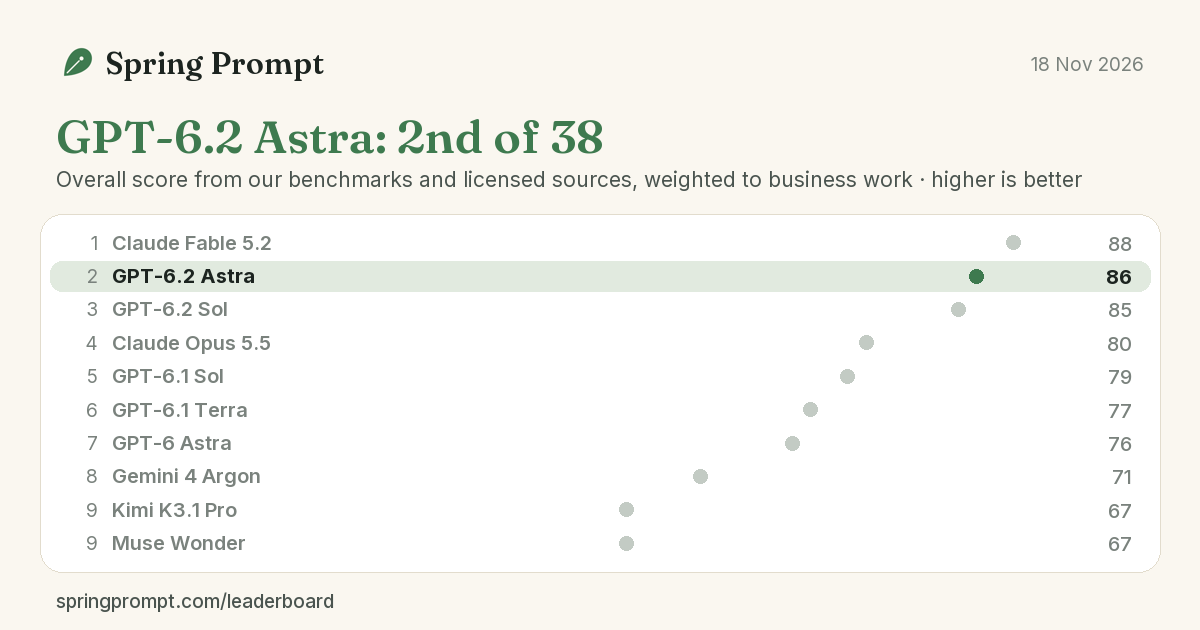
GPT-6.2 Astra is 2nd of 38 on our overall leaderboard and GPT-6.2 Sol 3rd, behind Claude Fable 5.2 and ahead of Claude Opus 5.5 and GPT-6.1 Sol. Both ranks are provisional. Each model has results in only two of the five groups, both from our own benchmarks, and models with missing groups can rank higher than they will once the third-party data arrives. GPT-6.1 Sol, with all five groups, is 5th.
Product listings: Sol is the best we have measured
On CatalogBench, 75.0% of GPT-6.2 Sol's product listings were ready to publish in all three runs, on both briefs. On the factual brief that ties GPT-6.1 Sol and GPT-6 Astra. On the sales brief, where models are asked for persuasive copy and usually start inventing benefits, it is first outright, and it made fewer than one unsupported claim per 100 products, against 46 per 100 for Claude Fable 5.2. Each listing took 6.5 seconds and cost $0.008.
GPT-6.2 Astra was just behind: 73.2% on the factual brief, fourth, and 69.6% on the sales brief, level with GPT-6 Astra in second. It made no unsupported claims on either brief; on the factual brief only Kimi K3.1 Pro and GPT-6.1 Sol can say the same. Each listing took 9.7 seconds and cost $0.035, four times Sol's price.
Slide decks: Sol rated higher, Astra made them in 45 seconds
On DeckBench GPT-6.2 Sol's head-to-head rating, 1,370, is level with GPT-6.1 Sol's 1,375 and sixth of 34. The change is in what comes out: 5 of its 6 public decks could be presented as they came, against 3 of 6 for GPT-6.1 Sol, and each took 1.4 minutes and $0.077, half 6.1 Sol's time and cost. One of the six had a figure that did not match the brief.
GPT-6.2 Astra is the surprise. All 6 of its public decks were presentable, with every figure matching the brief, and each took 45 seconds and $0.20, where GPT-6 Astra took over 5 minutes and $1.09. But its rating is 1,183, 17th of 34 and last of the four models we have measured at $10 or more per million tokens. The judges' reasons explain it: its decks set out the numbers in tables and short text, while the decks it lost to made the point with charts. Across its eight decks it drew 4 charts; GPT-6 Astra drew 20. It won two in three of its comparisons, but mostly against weaker decks, and lost to Kimi K3.1 Pro 7 times out of 12. If you need slides you can use as they come, it is reliable and quick; if you want slides that persuade, GPT-6 Astra, Qwen4-Max and Sol did better. You can compare them in the deck gallery.
Survey analysis: Astra second, Sol seventh
On SurveyBench GPT-6.2 Astra rated 1,467, second of 25 and the closest any model has come to Claude Fable 5.2 (1,662). Its analyses scored 96, it handled 97% of the traps in the data and it took 1.5 minutes and $0.37 a task. GPT-6.2 Sol rated 1,354, seventh, a little behind GPT-6.1 Sol's 1,421 with overlapping ranges; it caught slightly more traps (98%) but its analyses scored lower (85 against Astra's 96). Both had a finding the data did not support in a third of their tasks, the same share as GPT-6.1 Sol, so check the conclusions whichever you use.
Ad budgets: Astra third, Sol mid-table
In ROASBench, twelve simulated months of ad budget decisions, GPT-6.2 Astra scored 57.6, third of 34, just above GPT-6 Astra's 56.6 and behind Claude Fable 5.2 (61.3) and GPT-6.1 Terra (58.4). GPT-6.2 Sol scored 51.8, ninth. Neither overspent a month. A run cost $0.77 on Astra and $0.23 on Sol.
Speed chess: fine with time, short of it on the clock
On BulletBench with three minutes a side, Astra rated 1,000 and Sol 977, fifth and sixth of 22; neither lost a game on time, where GPT-6.1 Sol and GPT-6 Astra each lost three in eight that way. With 60 seconds a game both lost five of eight on time (Astra 557, Sol 491), and at 10 seconds plus one a move both lost every game on time. For fast turn-based work, OpenAI's Ultrafast tier is the option we have not yet run on 6.2.
In the playground
We also ran both models on two of our playground prompts. On the stained glass window both made some of the best finished windows on the page. Astra's "Nectar Window" cuts the glass over a faint outline of the design, leads the joins and lets the light in, finishing in about 10 seconds on an emerald hummingbird at coral flowers; the pointer moves a coloured glow on the wall behind more than the light on the glass. Sol's is a similar arched window, with the light following the pointer more closely. Neither draws the cartoon as its own step. On the pelican on a bicycle, Astra's is one of the most convincing riders: wing to the handlebars, both feet on the pedals, scarf blowing back. Sol's pelican sits on the top tube with one foot near the crank. These are one-off prompts, not a benchmark.
Third-party results
None count towards either model's rank yet, because the third-party data in our release predates the launch. Artificial Analysis published on launch day that GPT-6.2 Astra is second on its Intelligence Index, behind Claude Fable 5.2, and that the two 6.2 models take most of its cost-per-task frontier. On its AA-3D arena, where people vote between blinded 3D builds, Astra leads at 1,318 and Sol is third at 1,259, according to OpenAI's launch post. Data sourced from Artificial Analysis.
What people are saying
The launch post passed a million views within hours. OpenAI's Thibault Sottiaux said Ultrafast now reaches the Pro 200 plan for GPT-6.2 Sol. Not everyone was won over: Matt Shumer said he would not write a full review after "a terrible experience testing" the models. We'll add a fuller summary of reactions as the first week's testing comes in.
GPT-6.2 vs GPT-6.1 Sol, GPT-6 Astra, Claude Fable 5.2 and Gemini 4 Argon
| Modelwhy it's here | Priceper million, in/out | Listingssales brief, reliable | Decksrating | Surveysrating | Ad budgetsscore |
|---|---|---|---|---|---|
| GPT-6.2 Solnew | $2 / $10 | 75.0% | 1,370 | 1,354 | 51.8 |
| GPT-6.2 Astranew | $8 / $40 | 69.6% | 1,183 | 1,467 | 57.6 |
| GPT-6.1 SolSol's predecessor, same price | $2 / $10 | 67.9% | 1,375 | 1,421 | not run |
| GPT-6 AstraAstra's predecessor | $10 / $50 | 69.6% | 1,551 | not run | 56.6 |
| GPT-6.1 TerraOpenAI's cheaper tier | $1 / $5 | 67.9% | 1,280 | 1,209 | 58.4 |
| Claude Fable 5.2top of our overall board, Astra's price | $8 / $40 | 44.6% | 1,403 | 1,662 | 61.3 |
| Gemini 4 ArgonSol's price, Google | $2 / $10 | 17.9% | 947 | 918 | 47.0 |
At Astra's price, Claude Fable 5.2 is ahead on survey analysis, ad budgets and decks, and well behind on listings, where it invents more. At Sol's price, Gemini 4 Argon is behind on every one of these benchmarks.
Is GPT-6.2 good? Which one to use
- Product listings and sales copy: Sol. The most reliable model we have measured, with almost nothing made up, at a quarter of Astra's price. If you are on GPT-6.1 Sol, it is the same price and faster.
- Slide decks: Sol, unless speed matters most. Sol's decks won more comparisons; Astra's were all usable as they came and took 45 seconds, but they are plain. For the most persuasive decks, Qwen4-Max and GPT-6 Astra rated higher.
- Survey and research analysis: Astra, or Claude Fable 5.2 at the same price, which is still clearly ahead. Check the conclusions with either.
- Budget and planning decisions: Astra did better than Sol in our simulation, but GPT-6.1 Terra scored slightly higher at an eighth of Astra's price.
- Not for anything on a tight clock at the default setting.
These benchmarks aren't your data. We haven't measured coding or long agent sessions, which is where much of OpenAI's launch post is aimed.
What we'll update
We'll add Artificial Analysis, Arena and the other third-party sources as they enter the catalogue, and both ranks may change when they do. Until then, the GPT-6.2 Sol and GPT-6.2 Astra model pages have our results as they stand, and OpenAI's release timeline shows where they sit among recent launches.
Sol or Astra for your prompt? Paste it and we'll draft the cases and checks, run it on both and the alternatives, and show you the cheapest one that passes. Test your prompt →
Cheapest model that passes
On our benchmarks that define a pass for each task: what one passing answer cost in our run, failed attempts included, and whether a cheaper model passed.
- CatalogBench · cost per 1,000 accepted listings
GPT-6.2 Sol: $10.44 (133 of 168 attempts), 7 of 27. Cheapest: GPT-6 Luna at $0.70 (114 of 168 attempts). Every cheaper model passed less often. - DeckBench · cost per presentable deck
GPT-6.2 Sol is the cheapest of the 14 models we could cost this way: $0.09 (5 of 6 tasks). - SurveyBench · cost per sound survey task
GPT-6.2 Sol passed 6 of 9 tasks, with no estimate: failed-call costs incomplete. Cheapest: GPT-6 Luna at $0.03 (3 of 9 tasks).
Cost per attempt divided by the share that passed, at the run date's prices, excluding judging. Each model at its cheapest setting per passing answer. With a handful of tasks, a pass or two either way is within chance. No estimate where a run had missing outputs, because their cost may not have been recorded.
Quick answers
How much do GPT-6.2 Sol and GPT-6.2 Astra cost?
Sol costs $2 per million input tokens and $10 per million output, the same as GPT-6.1 Sol. Astra costs $8 and $40, 20% less than GPT-6 Astra. In our runs a product listing cost $0.008 on Sol and $0.035 on Astra, and a slide deck $0.077 and $0.20.
GPT-6.2 Sol or GPT-6.2 Astra?
For writing work, Sol. On our tests of 18 November it wrote more reliable product listings (75.0% publish-ready on both briefs, against 73.2% and 69.6%) and won more deck comparisons, for a quarter of the price. Astra was clearly ahead on survey analysis (2nd of 25 against 7th) and our ad budget simulation (57.6 against 51.8).
Is GPT-6.2 Sol better than GPT-6.1 Sol?
Mostly, yes. Its sales-brief listings rose from 67.9% to 75.0% reliably publish-ready, 5 of 6 public decks were presentable against 3 of 6, and it took about half as long per deck and per survey task. Its survey analysis rating was a little lower, 1,354 against 1,421, with overlapping ranges.
Is GPT-6.2 Astra better than GPT-6 Astra?
It is far cheaper and faster, not clearly better. A deck took 45 seconds and $0.20 against 5 minutes and $1.09, but GPT-6 Astra's chart-heavy decks won far more head-to-head comparisons (1,551 against 1,183). Listings were level or close, and Astra 6.2 scored slightly higher on ad budgets (57.6 against 56.6).
Is GPT-6.2 good for product listings?
Sol is the best we have measured: 75.0% of its listings were publish-ready in all three runs on both our factual and our sales brief, with almost no unsupported claims. Astra made no unsupported claims at all but was slightly less reliable, at 73.2% and 69.6%.
What reasoning setting does GPT-6.2 use?
Reasoning is always on. OpenRouter offers low, medium, high, xhigh and max for both models, and defaults to medium, which is what we ran. Some of OpenAI's own comparisons use max.
What is GPT-6.2's context window?
1,050,000 tokens for both on OpenRouter. Sol prompts over 272,000 tokens are charged at a higher rate: $4 input and $15 output per million.
Release dates: every OpenAI model release · new AI models released this week
Will GPT-6.2 Sol work for your product?
Benchmarks aren't your task. Paste the prompt your product uses and run it beside the models you could use instead, with every answer checked and costed.
New here? Your email starts a free trial. No credit card needed.