Qwen4-Max review: top of our slide deck ratings, weak on product listings
Test Qwen4-Max on your prompt → It runs beside the models you could use instead, with every answer checked and costed.
Alibaba released Qwen4-Max on 16 November, five days after a preview that only ran on Alibaba's own services. It costs $1.50/$4.50 per million tokens, and it went straight through our five business benchmarks the same morning.
It is the most uneven result we have had in a while. Our judges rated its slide decks the best of 32 models and its survey analysis fifth. But it was 19th of 32 on product listings, made up claims freely when asked for sales copy, and lost nearly every game of speed chess on time. It is a large step up from Qwen3.8 Max on everything we ran.
Qwen4-Max at a glance
- Best rated slide decks we have measured, narrowly ahead of GPT-6 Astra at about a sixth of the cost per deck. But none of its public decks could be presented as they came, mostly because the body text was too small.
- Strong on survey analysis: fifth of 23, and it handled 99% of the traps in the data.
- Not for product listings. 39.3% were reliably ready to publish, against 64.3% for GPT-6.1 Terra at a similar price, and it added 2.6 unsupported claims per product with a sales brief.
- Slow at default settings: about 8 minutes a deck and 11.5 minutes a survey task, and 8.6 seconds a move at chess.
- Price: $1.50/$4.50 per million input/output tokens, $0.075 cached, no long-context premium. In our runs: $0.007 a listing, $0.18 a deck, $0.20 a survey task.
Qwen4-Max benchmark results in one table
Independent results, measured by Spring Prompt on 16 November 2026 at the default setting (high reasoning on both Alibaba's API and OpenRouter). All of it is free to reuse with a link (CC BY 4.0), and the full rows are in our open data.
| Taskbenchmark | Qwen4-Max | Qwen3.8 Max | Best other model | Rankmodels on sale today |
|---|---|---|---|---|
| Slide decksDeckBench rating | 1,585 | 1,035 | GPT-6 Astra, 1,566 | 1st of 32 |
| Survey analysisSurveyBench rating | 1,395 | not run | Claude Fable 5.2, 1,641 | 5th of 23 |
| Ad budget, 12 simulated monthsROASBench score | 45.8 | 25.4 | Claude Fable 5.2, 61.3 | 15th of 32 |
| Product listings, factual briefCatalogBench, publish-ready in all three runs | 39.3% | 28.6% | GPT-6.1 Sol and GPT-6 Astra, 75.0% | 19th of 32 |
| Product listings, sales briefCatalogBench, publish-ready in all three runs | 8.9% | GPT-6 Astra, 69.6% | 21st of 32 | |
| Chess, three minutes a sideBulletBench 180+2 rating | 147 | not run | Gemini 4 Argon, 1,147 | 20th of 20 (last) |
Products, companies and survey data are invented, and each benchmark except CatalogBench ran once. Ratings are head-to-head scores, where a higher number wins more comparisons.
What Alibaba says
Alibaba's launch post calls Qwen4-Max "your new AI teammate for work, creativity, and discovery", built on a new architecture with a 2.4-trillion-parameter backbone, 71 billion parameters active per token, native vision and a one-million-token context. Its showcase is work deliverables: 3D scenes, factory line planning, finance research and legal due diligence. It says Qwen4-Max uses up to about half the tokens of Qwen3.8 Max and cuts the average cost per task by 62% on its own Work360 test.
Its benchmark chart compares Qwen4-Max with Qwen3.8 Max, Claude Opus 5.5, GPT-6.1 Sol, GPT-6 Astra and Kimi K3.1, and leaves out Google and Anthropic's newest models. Qwen4-Max leads 4 of its 16 panels, including the DeepSWE coding test and Vals's HLAB; Opus 5.5 leads 7. Where we could check the leaderboards Alibaba cites, its own figures match exactly, but the comparison set flatters it. On Vals's HLAB, for example, it beats every model in Alibaba's chart but is 7th of 39 overall. Its APEX-Agents score is cited to Mercor's leaderboard, which had no Qwen4-Max entry on 16 November. The chart does not state its settings; its Work360 and Terminal-Bench figures match the xhigh points on Alibaba's own effort chart, not the default.
The model page lists 1 million tokens of context, up to 262,144 tokens of thinking plus answer per request, and text and image input. Thinking is on by default at high, with low and xhigh available and an option to turn it off. The weights are not public; Alibaba says smaller Qwen4 models will be. These are the developer's claims. We have not measured coding or agents.
Qwen4-Max benchmarks, measured by Spring Prompt
The model page has every result. How to read this table: each row is one benchmark, with Qwen4-Max's score and setting, its rank among models we have tested that are on sale today, and its rank among models priced at $1 to $3 per million tokens. There is no intelligence or speed group yet, because the Artificial Analysis data in this release predates the launch.
| Benchmarkwhat it measures | Qwen4-Maxits score | Rank among all modelsavailable today | Rank at its price$1–3 per million tokens, blended |
|---|---|---|---|
| DeckBenchhead-to-head rating of slide decks | 1,585default (high) | 1st of 32Next: GPT-6 Astra, 1,566 | 1st of 6Best: Qwen4-Max, 1,585 |
| SurveyBenchhead-to-head rating of survey plans and analyses | 1,395default (high) | 5th of 23Best: Claude Fable 5.2, 1,641 | 1st of 4Best: Qwen4-Max, 1,395 |
| ROASBenchscore in a 12-month ad budget simulation | 45.8default (high) | 15th of 32Best: Claude Fable 5.2, 61.3 | 2nd of 7Best: GPT-6.1 Terra, 58.4 |
| CatalogBench, factual brieflistings publish-ready in all three repeats | 39.3%default (high) | 19th of 32Best: GPT-6.1 Sol and GPT-6 Astra, 75.0% | 3rd of 6Best: GPT-6.1 Terra, 64.3% |
| CatalogBench, sales brieflistings publish-ready in all three repeats | 8.9%default (high) | 21st of 32Best: GPT-6 Astra, 69.6% | 3rd of 6Best: GPT-6.1 Terra, 67.9% |
| BulletBench, one minutechess rating against a 60-second clock | 147low effort | 25th of 33Best: Gemini 3.8 Flash, 1,068 | 4th of 6Best: Claude Haiku 4.5, 445 |
Ranked on the release of 16 November 2026. A group only counts models that benchmark has measured. Ranks are provisional and can move as models are added. Blended price is three parts input to one part output: $2.25 for Qwen4-Max.
What 16th overall does and doesn't mean
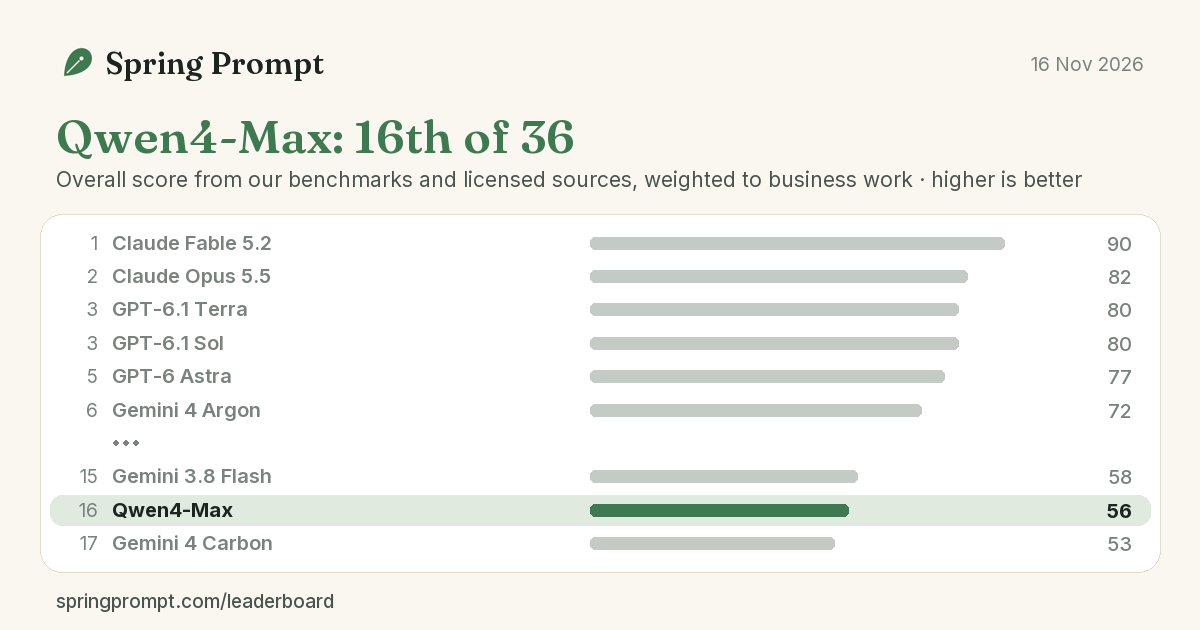
Qwen4-Max scores 56 on our overall leaderboard, 16th of 36, up from 44 (21st) for Qwen3.8 Max. Our score leaves out groups a model has no results in, and Qwen4-Max has results in 2 of 5: our own benchmarks (41) and knowledge work (91), both run by us. Decks and surveys count towards knowledge work, which is why that score is high; the product listings and chess results pull our own-benchmark group down. Agents, writing and factuality have nothing yet, so the rank could move a long way once third-party results arrive.
Slide decks: the best rated, but not ready to present
On DeckBench Qwen4-Max rated 1,585 (range 1,497 to 1,708), first of 32 and just ahead of GPT-6 Astra on 1,566. Their ranges overlap, so call it level with the best. Its design scored 83 of 100 from our judges, behind Astra (89) and level with Kimi K3.1 Pro (84). The catch is that none of its six public decks could be presented as they came: five failed our layout check, mostly for body text under 12 point (57 cases across its decks), and two made claims the data did not support. GPT-6 Astra had four of its six public decks ready to present. A Qwen4-Max deck took about 8 minutes and $0.18; Astra's cost $1.09. These are invented companies, with one deck per model per task.
Survey analysis: fifth, and careful with traps
SurveyBench asks a model to plan a survey, then analyse the responses, with traps in the data. Qwen4-Max rated 1,395 (range 1,320 to 1,482), fifth of 23 and first among models at its price. Its survey plans scored 95 of 100, its analyses 89, and it handled 99% of the traps. Three of its nine public tasks were fault-free; on five, its analysis made at least one claim the data did not support. A task took about 11.5 minutes and $0.20. GPT-6.1 Sol rated 1,432 at $0.14 and 3.7 minutes.
Product listings: better than Qwen3.8 Max, still well behind
CatalogBench asks a model to turn sparse feeds and photos for 56 invented products into listings that could go live. On the factual brief 39.3% of Qwen4-Max's listings, 22 of 56, were publish-ready in all three repeats, 19th of 32 and up from 28.6% for Qwen3.8 Max. It added 0.70 unsupported claims per product. With a sales brief it added 2.56 per product and only 8.9% of its listings were reliably ready. GPT-6.1 Terra, at a slightly lower list price, managed 64.3% and 67.9%.
It was quick and cheap per listing: 21 seconds and $0.007, against 78 seconds and $0.026 for Qwen3.8 Max. These are invented products, so your own catalogue may behave differently. Our guide to the best AI for product descriptions has the full table.
Ad budgets: a big jump on Qwen3.8 Max
In ROASBench, a 12-month simulation of a skincare brand's ad budget, Qwen4-Max scored 45.8, 15th of 32 and up from 25.4 for Qwen3.8 Max. It never overspent, where its predecessor overspent in two months, and finished with $775,520 of simulated profit against $99,775. GPT-6.1 Terra scored 58.4. This is one simulated year per model, not evidence of real advertising returns.
Speed chess: out of time
BulletBench plays speed chess against a ladder of engines, so slow thinking loses on time. Even with three minutes a side, Qwen4-Max rated 147, last of 20, losing seven of its eight games on time; a median move took 8.6 seconds. At one minute it lost its first four games on time at the default and was screened out; at low effort it rated 147, again losing seven of eight on time. At ten seconds it lost its first four games on time at both settings. BulletBench measures decisions against a clock, not general intelligence.
In the playground
We also ran two of our playground prompts. Its pelican on a bicycle passed all three checks, in 1.7 minutes for $0.030: a clean drawing of a crested pelican with a wing on the handlebar, its feet on the pedals and a chain on the bicycle. Its stained glass window drew the cartoon and then stopped: its script calls the canvas scale function with one number where it needs two, the browser throws an error, and the glass is never cut or lit. These are one-off prompts, not a benchmark.
Third-party results
None count towards Qwen4-Max's rank yet, because the third-party data in our 16 November release predates the launch. Several published within hours, all at xhigh. Artificial Analysis gives it 43 on its Intelligence Index, $3.27 per index task, nine points up on Qwen3.8 Max and three behind Kimi K3.1 Pro. Data sourced from Artificial Analysis. Vals AI reports 63.20% on its Vals Index, 11th of 38 and the highest-scoring Chinese model there, though it scored lower than Qwen3.8 Max on Vals's Legal Research Bench.
On Arena, all marked preliminary, it is 6th on Code Arena WebDev (1,750) and 14th on the Agent board. LiveBench, Arena's text board, Epoch AI, METR and Vectara had no entry on 16 November.
What people are saying
How the launch read on X and Hacker News: 53% positive, 23% mixed, 25% negative of the 53 posts and comments that took a side
NegativeMixedPositive
On 16 November, a few hours after the release, we read the first 150 posts X served under "Top" for the model's name and every top-level comment on the main Hacker News thread, and labelled each one positive, mixed, negative, neutral or off-topic. Posts from Alibaba, its staff, partners and hosts announcing access are left out, as are neutral and off-topic items. Labels are by Claude Opus 5.5 against a written rubric, in one pass. X's Top tab favours the loudest posts, and many of them are about the preview that opened on 11 November. Only 5 of the 14 Hacker News comments took a side, so that bar is thin. Every labelled item.
A selection, with how we read each one:
More of what i want and less of what i never asked, in a good way ! I'm seeing no failures so far, which is a huge improvement.
The continued focus on efficiency alongside quality is encouraging

Qwen 4 Max is now the top Chinese model on the Vals Index (at #11 overall).

strong on knowledge work, still behind on terminal coding.

not an opus killer but it wants to live in your claude code
they're mostly not as good as 4, but I prefer the 3.8 xhigh one.
Disappointing performance for a 2.4T model in the end of 2026.

First impressions of Qwen4 Max - UNUSABLE🗑️ Getting these failures constantly when trying to do any code generation
Qwen4-Max vs Qwen3.8 Max, Kimi K3.1 Pro, GPT-6.1 Terra, Sol and GPT-6 Astra
Prices are blended per million tokens (three input to one output) at list price. All scores were measured by Spring Prompt at each model's best configuration, and a dash means we have no result.
| Modelwhy it's here | Priceblended, list | Overallprovisional where marked | DeckBenchrating | SurveyBenchrating | CatalogBenchfactual, reliably ready | ROASBenchscore | Compare |
|---|---|---|---|---|---|---|---|
| Qwen4-Maxthis review | $2.25 | 56, provisional | 1,585 | 1,395 | 39.3% | 45.8 | – |
| Qwen3.8 Maxthe model it replaces | $3.00 | 44 | 1,035 | – | 28.6% | 25.4 | Side by side |
| Kimi K3.1 Proin Alibaba's comparison | $3.81 | 68, provisional | 1,204 | 609 | – | 55.1 | Side by side |
| GPT-6.1 Terrasimilar price | $2.00 | 80, provisional | 1,305 | 1,234 | 64.3% | 58.4 | Side by side |
| GPT-6.1 Solin Alibaba's comparison | $4.00 | 80 | 1,391 | 1,432 | 75.0% | – | Side by side |
| GPT-6 Astralevel on decks | $20.00 | 77 | 1,566 | – | 75.0% | 56.6 | Side by side |
Against Qwen3.8 Max there is no reason to stay: better on everything we ran, at a lower price, and nearly four times faster per listing. Against Kimi K3.1 Pro, the other Chinese flagship Alibaba compared it with, Qwen4-Max made far better decks and surveys, while Kimi did better in the ad budget simulation. Against GPT-6.1 Terra at a similar price, Qwen4-Max is the pick for decks and surveys; Terra is well ahead on listings and the ad simulation. Against GPT-6.1 Sol, Sol is ahead on surveys and well ahead on listings, while Qwen4-Max rated higher on decks. Against GPT-6 Astra the two are level on deck ratings, and Qwen4-Max costs about a sixth as much per deck, though Astra's decks were far more often ready to present.
Is Qwen4-Max good? Who should use it
- Slide decks and reports where someone will check the layout, for the best rated content we have measured at a low cost per deck. Expect to fix small text before presenting.
- Survey and research analysis, where it was fifth of 23 and first at its price. Check its conclusions against the data; it reached for unsupported claims on five of nine tasks.
- Not for product listings or sales copy. GPT-6.1 Terra did much better for less.
- Not for anything on a clock at its default setting.
- Set the effort yourself. Alibaba's headline numbers appear to use xhigh; the default is high, which is what we ran.
These benchmarks aren't your data. We haven't measured coding or long agent sessions, which is where Alibaba makes most of its claims.
What we'll update
We'll add Artificial Analysis, Arena and the other third-party sources as they enter the catalogue, and Qwen4-Max's rank may change when they do. Until then, the Qwen4-Max model page has our results as they stand, and Alibaba's release timeline shows where it sits among recent launches.
Is Qwen4-Max the right model for your prompt? Paste it and we'll draft the cases and checks, run it on Qwen4-Max and the alternatives, and show you the cheapest one that passes. Test your prompt →
Cheapest model that passes
On our benchmarks that define a pass for each task: what one passing answer cost in our run, failed attempts included, and whether a cheaper model passed.
- CatalogBench · cost per 1,000 accepted listings
Qwen4-Max: $12.12 (95 of 168 attempts), 9 of 25. Cheapest: GPT-6 Luna at $0.70 (114 of 168 attempts). It passed at least as often. - DeckBench · cost per presentable deck
Qwen4-Max: no presentable decks (0 of 6 tasks). Cheapest: GPT-6.1 Terra at $0.13 (3 of 6 tasks). - SurveyBench · cost per sound survey task
Qwen4-Max: $0.61 (3 of 9 tasks), 7 of 12. Cheapest: GPT-6 Luna at $0.03 (3 of 9 tasks). It passed at least as often.
Cost per attempt divided by the share that passed, at the run date's prices, excluding judging. Each model at its cheapest setting per passing answer. With a handful of tasks, a pass or two either way is within chance. No estimate where a run had missing outputs, because their cost may not have been recorded.
Quick answers
How much does Qwen4-Max cost?
Alibaba lists it at $1.50 per million input tokens and $4.50 per million output on its international (Singapore) endpoint, the same as OpenRouter, with no extra charge for long prompts. Cached input is $0.075. That is 25% below Qwen3.8 Max. Alibaba's other regions charge about 6% less.
Is Qwen4-Max good?
On our business tests of 16 November 2026 it was uneven. It rated first of 32 models on slide decks and fifth of 23 on survey analysis, but 19th of 32 on product listings and 15th of 32 in our ad budget simulation.
Is Qwen4-Max better than Qwen3.8 Max?
Yes, on everything we ran. Reliable product listings rose from 28.6% to 39.3%, its deck rating from 1,035 to 1,585, and its ad budget score from 25.4 to 45.8, while each listing took a quarter of the time and cost about a quarter as much.
Qwen4-Max or GPT-6.1 Terra?
For slide decks, Qwen4-Max rated higher (1,585 against 1,305). It was also ahead on survey analysis. For product listings and the ad budget simulation, GPT-6.1 Terra was ahead, at a slightly lower list price and less per task.
Is Qwen4-Max open source?
No. Alibaba has not released Qwen4-Max's weights. It says smaller Qwen4 models will be released with open weights, without a date.
Can you turn off thinking on Qwen4-Max?
Yes. Thinking is on by default at high effort; Alibaba also offers low and xhigh, and you can switch thinking off. OpenRouter calls that setting none. Alibaba's own benchmark chart appears to use xhigh.
What is Qwen4-Max's context window?
Alibaba lists 1 million tokens of context and up to 262,144 tokens of thinking plus answer per request (131,072 without thinking). It takes text and images and returns text.
Release dates: new AI models released this week
Will Qwen4-Max work for your product?
Benchmarks aren't your task. Paste the prompt your product uses and run it beside the models you could use instead, with every answer checked and costed.
New here? Your email starts a free trial. No credit card needed.