We Unpacked 95,789 Events of Theo's T3 Code Telemetry. Here Is How He Actually Uses It.
Theo published 95,789 of his own T3 Code telemetry events on Slopalytics (104MB, 4 September to 24 November 2026). We unpacked the log, matched it against public model launches and his tstack skills repo, and pulled out what normal teams can copy.
 Ellis CrosbyFounder, Spring Prompt
Following the debate around default-on telemetry in T3 Code, Theo Browne published a raw export of his own telemetry on Slopalytics: 95,789 PostHog events (104MB uncompressed) spanning 4 September to 24 November 2026. The file was released to show that no source code, prompts, or file paths were collected. It also happens to be one of the cleanest public datasets of how a heavy multi-agent developer actually works.
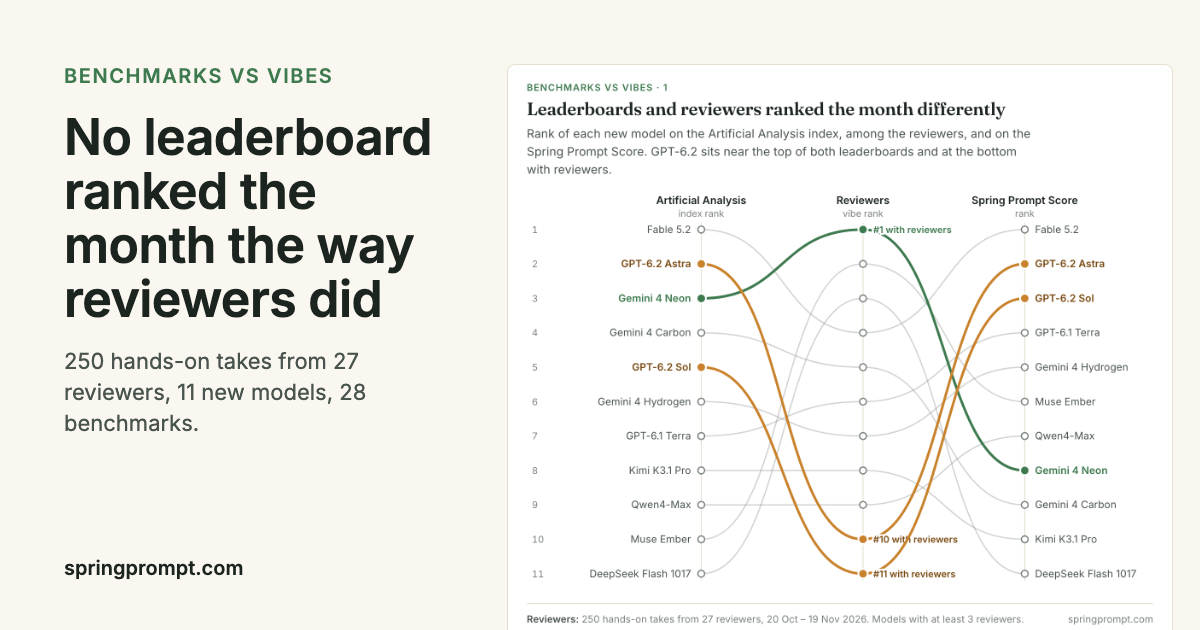
Last week we compared 28 benchmarks against 250 hands-on reviewer takes, and noted a split inside Theo's own GPT-6.2 review: Astra dominated his personal coding benches, yet he said he would not choose it over Opus 5.5 for daily work. This telemetry dump lets us check what he actually ran, day by day, across roughly 15 machines, and line it up with public model release dates and his open-source tstack skills repository.
mcp.tool.invoked, mcp.delegated_task.finished, feature.used) started logging on 20 October 2026, and provider.request.completed started on 2 November. Whenever we report daily rates or funnel ratios below, we restrict to those apples-to-apples windows rather than diluting across September. We also exclude Claude's otherInputTokens field from all token and cost sums: inspecting raw rows shows it logs a monotonically rising cumulative session counter (3.40B to 3.72B across consecutive turns, including zero-input turns) rather than incremental per-turn tokens.
What his setup looks like right now (last 7 days)
Aggregating all 82 days hides how fast his stack moved after Gemini 4 Neon (18 November) and GPT-6.2 (17 November) launched. Looking at just the final 7 days in the dump (18 to 24 November, 2,428 completed requests) gives a much clearer picture of his current setup.
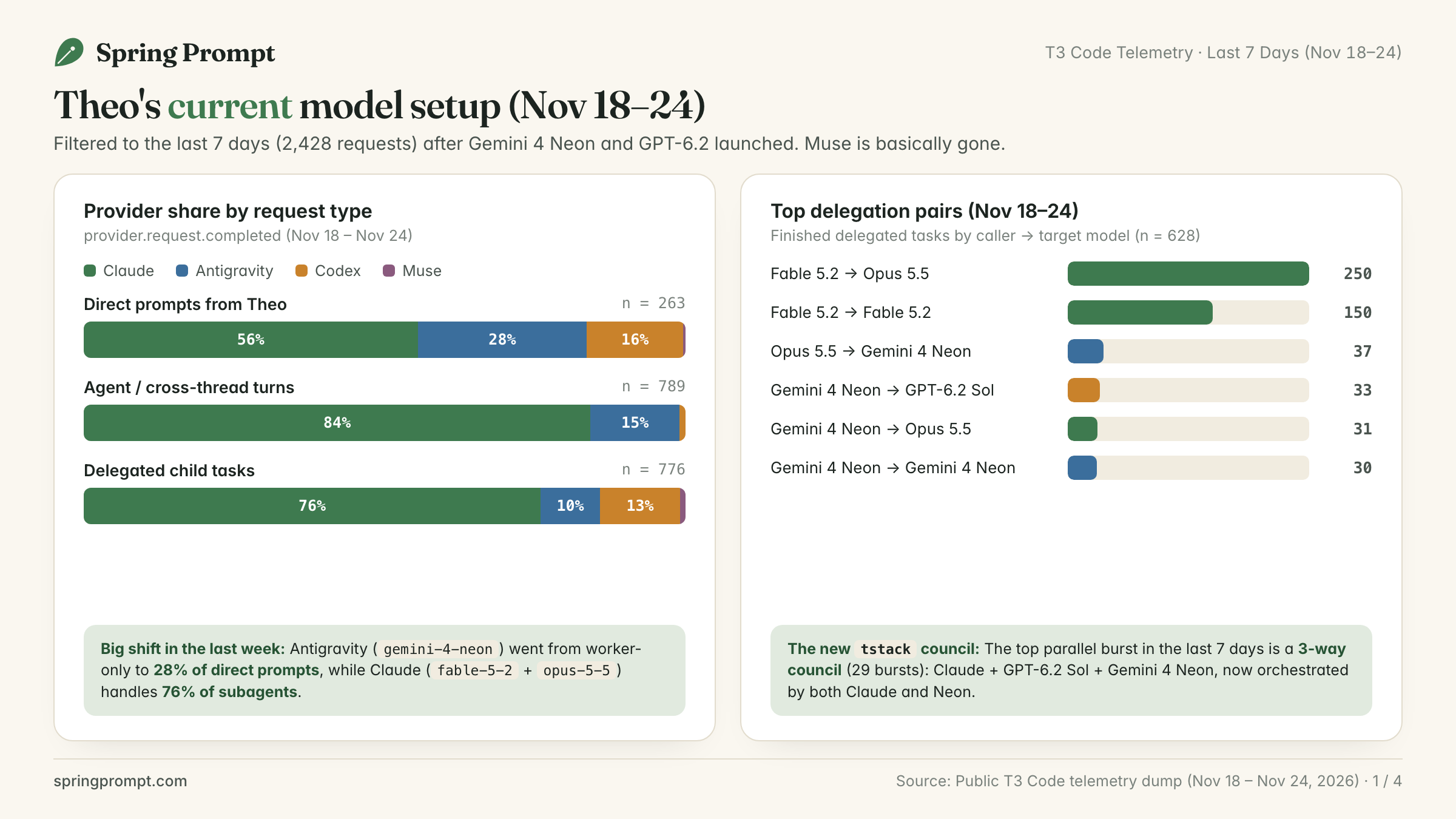
Almost 90% of requests in that week were not typed by Theo. Only 263 of 2,428 requests were direct human prompts; the rest were delegated child tasks (776), cross-thread agent messages (789), auto-continuations (470), and scheduled cron runs (130).
Two things stand out in the recent split:
- Gemini 4 Neon moved from reviewer to orchestrator. Earlier in the month, Antigravity (
gemini-4-argon) had zero caller events: it was only ever called as a delegated worker. Oncegemini-4-neonlaunched on 18 November PT, it immediately took 28.1% of Theo's direct prompts and began running its own balanced 3-way review councils: 33 delegations togpt-6.2-sol, 31 toclaude-opus-5-5, and 30 to itself. - Muse dropped out, and Claude reclaimed subagents. Earlier in October, Muse held roughly 12% of Claude's delegations and Codex carried heavy subagent bursts. By 18 to 24 November, Muse fell to 0.4% of direct prompts and 0.9% of children, while Claude (
claude-fable-5-2fanning out toclaude-opus-5-5andclaude-fable-5-2) ran 75.9% of child tasks. The live multi-lab council is now 3-way: Claude, GPT-6.2 Sol, and Gemini 4 Neon (29 parallel bursts in 7 days).
36 days of provider shifts and what pre-release access actually looks like
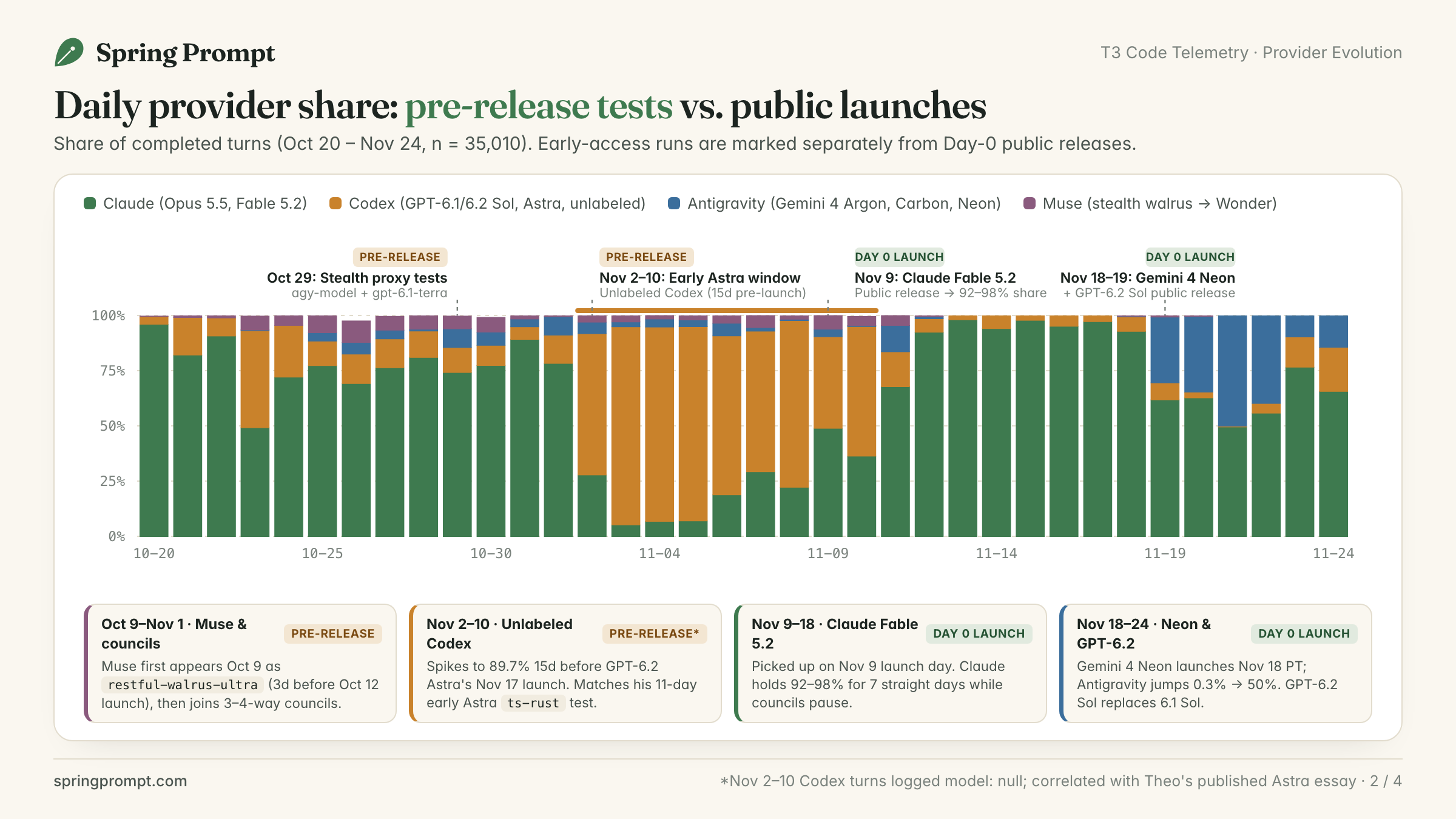
Zooming back out to 20 October to 24 November (35,010 completed turns, shown in the chart at the top) makes one habit obvious: there is zero provider loyalty. Whenever a stronger model arrives, daily turn share swings within hours.
Across the full log, 35 distinct model strings appear. Matching each model's first-seen timestamp against official 2026 release dates separates genuine pre-release testing from Day-0 public adoption:
| Model / log ID | Public launch | First in log | Delta | Observed behaviour |
|---|---|---|---|---|
| GPT-6.2 Astra (unlabelled Codex*) | 17 Nov | 2 Nov | -15 days* | Spikes to 89.7% share (101B tokens, 52.3h loops); matches his 11-day early Astra ts-rust essay |
Meta Muse Wonder (restful-walrus-ultra) | 12 Oct | 9 Oct | -3 days | Stealth codename to muse-proxy-wonder-full (21 Oct) to 1.0 (27 Oct) |
Gemini 4 Argon (gemini-4-argon-high) | 13 Oct | 13 Oct | Day 0 | 8.8% share on launch day; used strictly as a delegated council worker |
| Claude Fable 5.2 | 9 Nov | 9 Nov | Day 0 | 19.5h awake stretch; drives Claude to 92% to 98% share for 7 straight days |
| Gemini 4 Hydrogen | 12 Nov | 12 Nov | Day 0 | 8 test runs on launch day, then dropped |
| Gemini 4 Neon | 18 Nov | 18 Nov PT | Day 0 | 19.3h awake stretch; Antigravity jumps from 0.3% to 50% and becomes an orchestrator |
| Gemini 4 Carbon / Mythos 5.2 | 9 to 10 Nov | 11 Nov | +1 to 2d | Tested 10 minutes apart during a 19.2h awake stretch; neither sticks |
| Claude Opus 5.5 | 22 Sep | 24 Sep | +2d | 20,464 turns across 56 days; baseline daily coordinator |
The pre-release story is less glamorous than people assume. Most models in the dump first show up on public launch day, not weeks ahead. Where genuine pre-release access does show up, it looks like messy QA rather than a quiet advantage:
- The 2 to 10 November Codex marathon. Starting 2 November (15 days before GPT-6.2 Astra's 17 November launch), a non-catalogue Codex model logging
model: nullunderreportVersion: 2erupts from zero to 2,087 turns on 2 November and 2,458 turns on 3 November (89.7% of all turns), while namedgpt-6.1-solandgpt-6-astraturns continue logging their IDs on the exact same days. Over nine days it logs 9,157 turns, 101.1 billion input tokens, and continuous auto-continuation runs lasting 14.4 to 52.3 hours (up to 76 chained turns). That matches Theo's public essay "Why I hate GPT-6.2 Astra" almost to the day, where he described testing early-access Astra onts-rustfor 7 days of loops (making the compiler 56% slower) plus 4 days on performance. Whengpt-6.2-astraofficially lands in T3 Code on 19 November, he calls it 12 times and stops;gpt-6.2-soltakes the Codex slot instead. - Stealth Muse. Meta Muse appears on 9 October (3 days before launch) as
restful-walrus-ultra, transitions torestful-walruson 12 October, moves tomuse-proxy-wonder-fullon 21 October (800 turns across 21 days in multi-model councils), and drops to zero after 11 November once Claude Fable 5.2 takes over. - Ruthless Day-0 triage. His real edge is testing launches immediately on real repos and cutting weak fits within hours.
gemini-4-hydrogengets 8 runs,gemini-3.8-flashgets 5,grok-4.7fades out after 29, andclaude-sonnet-5-5plusclaude-haiku-5-5together make up barely 1% of his Claude volume. He defaults almost everything tohigh,xhigh, ormaxreasoning effort.
Message cadence, subagent runtimes, and prompt-cache economics
Across the 36-day active window (20 October to 24 November), the funnel from human input to agent output looks nothing like IDE-based coding:
- 820 human-started threads (68.3% in isolated git worktrees), plus 368 top-level threads launched by agents via
t3_thread_launch. - 4,467 human turn requests (5.45 messages per human thread), triggering 6,786 delegated child runs (8.28 per thread) and 35,010 total provider turns (42.7 per thread).
- 470 linked pull requests (57.3% of human threads link a PR) and 806 settled threads (22.4 settled/day against 22.8 started/day), plus 307 snoozes.
- 11 VS Code opens (
editor.open) and 1 checkpoint rollback across 36 days.
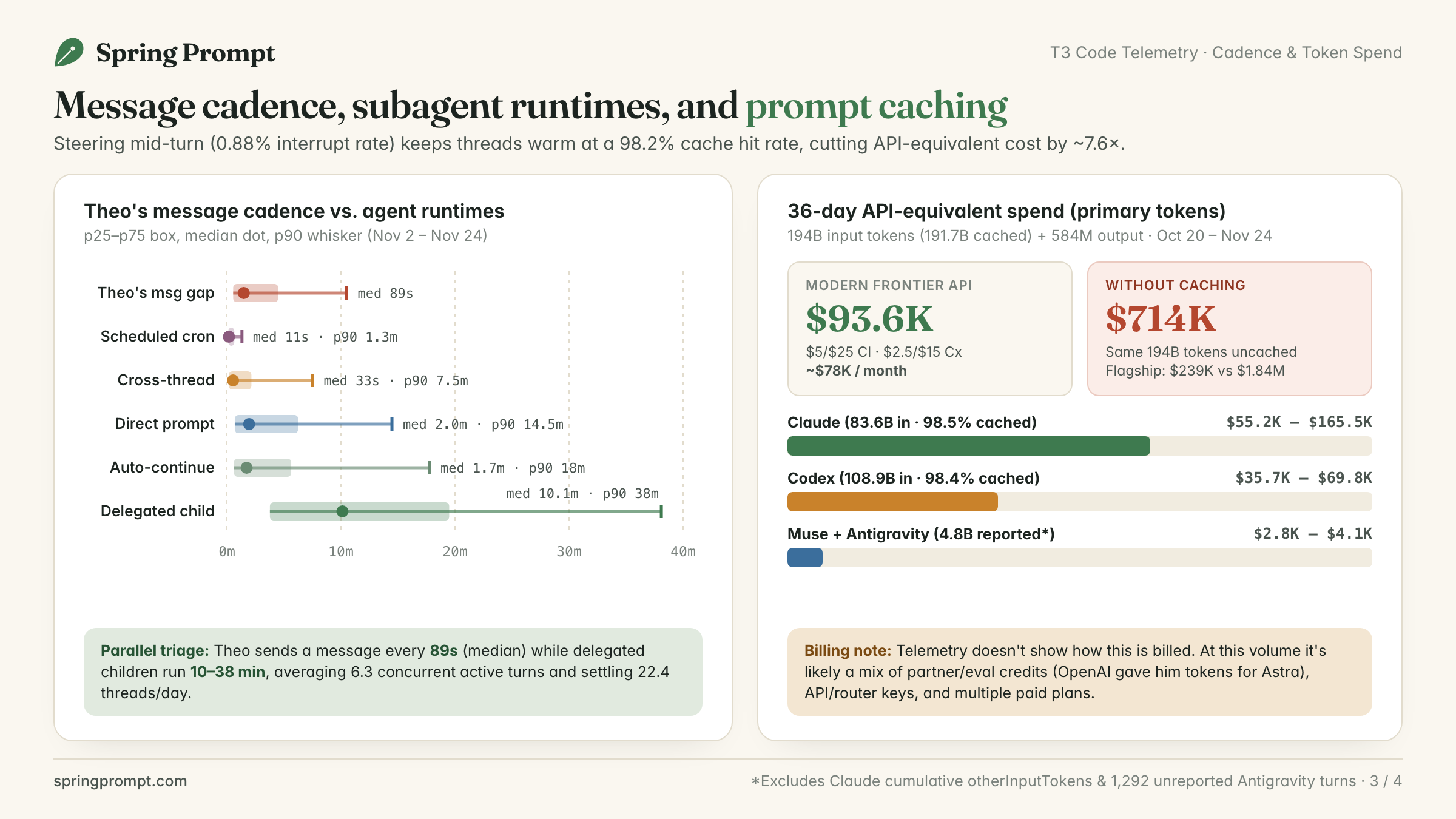
The gap between consecutive messages from Theo during active sessions is 89 seconds (median), while delegated children run for a median of 10.1 minutes (p90 of 38 minutes; 5.1% run over an hour). Reconstructing active turn intervals gives an average concurrency of 6.3 simultaneous turns whenever the fleet is active, peaking at 82 on 2 November. He is not watching one terminal finish; he is rotating through open worktrees, steering live runs, and clearing finished threads like an inbox.
That habit directly drives the token economics. His interrupt rate is 0.88% (357 of 40,460 turns). Rather than killing a turn and busting context, he steers live runs mid-flight (queue.steer: 46 times in the UI and 187 agent-to-agent steers via t3_thread_send). Across 194 billion primary input tokens in 36 days, 191.7 billion were cache hits (98.2%): 98.5% on Claude and 98.4% on Codex.
Pricing those primary tokens at modern frontier API rates ($5/$25 per million for Claude with $0.50 cache reads and $6.25 cache writes; $2.50/$15 for Codex with $0.25 cache reads) puts 36-day API-equivalent spend at roughly $93,600 (~$78,000/month), rising to $239,400 (~$200,000/month) at $15/$75 flagship Opus rates. Without prompt caching, those exact tokens would cost $714,000 to $1.84 million. Telemetry does not record billing, so at this volume it is almost certainly a combination of partner and early-access credits (OpenAI supplied tokens for the Astra test), API or router keys, and multiple paid plans.
When Theo sleeps, and the 24/7 fleet behind it
The fleet spans roughly 15 active machine installs: headless Linux x64 servers account for 74.3% of all events, macOS for 18.1% (his primary Mac has up to 55 projects registered), and three headless Windows x64 boxes for 7.6%. Roughly three-quarters of his client turns travel over T3 Connect Relay rather than localhost. Mobile accounts for 4.2% of human turns (peaking at 2 to 3 PM PT) and half of his UI PR merges (5 of 10).
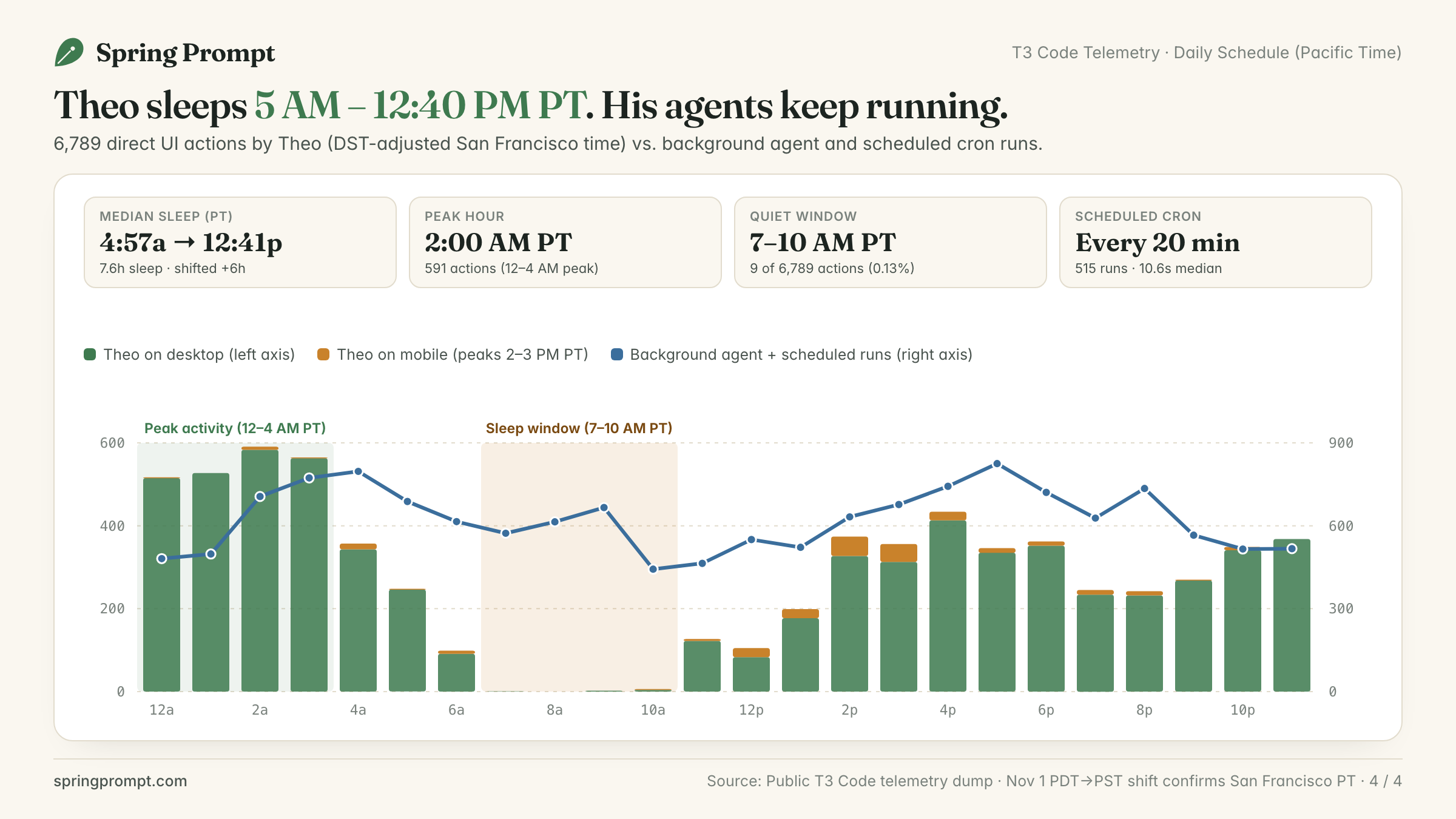
Filtering to strictly human UI actions (client.turn.requested, client.thread.started, and UI feature.used) answers a recurring side question cleanly. Converting UTC to San Francisco time (independently confirmed by the 1-hour shift in quiet hours after the 1 November US Daylight Saving Time change) shows a normal sleep duration shifted six hours later than office hours:
- Median sleep window: 4:57 AM to 12:41 PM PT (7.6 hours median across 29 tracked nights).
- Dead zone: 7:00 to 10:59 AM PT holds just 9 of 6,789 actions (0.13%), with zero actions in the 8 AM hour across all 36 days.
- Peak hour: 2:00 AM PT (591 actions), with midnight to 4 AM as his heaviest desk block.
- Model-drop streaks: his three longest continuous stretches without a 4-hour gap (19.5h on 9 to 10 November, 19.3h on 18 to 19 November, and 19.2h on 11 to 12 November) all fall on the exact nights Claude Fable 5.2, Gemini 4 Neon / GPT-6.2, and Claude Mythos 5.2 / Gemini 4 Carbon launched.
While he sleeps, a 20-minute scheduled cron on his main Linux server (515 runs, 10.6s median duration) and two daily crons on secondary boxes keep firing. On 15 November, during a 45.9-hour human break, he sent zero messages and the fleet still completed 142 turns and 29 delegated tasks.
How to apply this in T3 Code (without 15 servers)
The interesting part of this log is that almost all of the leverage comes from a small set of repeatable habits and markdown skills, not from hardware scale. Most of Theo's cross-provider bursts map directly to the open-source skills he published at github.com/t3dotgg/tstack.
git clone https://github.com/t3dotgg/tstack
cp -R tstack/skills/* ~/.claude/skills/
cp -R tstack/skills/* ~/.codex/skills/
Four skills from tstack do the heavy lifting. Skip full-send (autonomous merge) until your CI and test coverage are rock-solid:
full-stop: runs the full implementation, proof, review, PR creation, and CI-fix loop, then pauses right before merge for a human check.sol-loop: runs 3 to 5 iterative review passes with GPT Sol on your diff before you read a line. In Theo's logs, Codex child runs finish in a median of ~2.5 minutes and catch edge cases cheaply.council: spins up read-only reviewers from three different labs in parallel at high effort, looping until they reach consensus and appending a summary table to the PR. Reserve this for architecture changes, auth/security code, and UI polish (paired with before/after screenshots).babysit-prandfile-pr: keeps PR descriptions short and problem-focused, then useswatch_pull_requestso the thread stays quiet until CI fails, a reviewer comments, or checks go green. (takeoverandmodernizeare also worth keeping for stalled branches and stale PRs.)
Pair those skills with five day-to-day T3 Code habits:
- Default to worktrees, capped at 3 to 4 threads. Start every feature or fix in its own git worktree (68% of Theo's threads are worktrees). Three or four concurrent threads give most of the throughput gain without losing track of context.
- Steer instead of stopping. When an agent drifts mid-turn, send a mid-flight correction (
queue.steer) rather than hitting Stop. Preserving prompt cache is the single biggest lever on latency, API cost, and subscription rate limits. - Treat the sidebar like email. Settle completed threads immediately, snooze blocked ones, and fork instead of rolling back.
- Use a 2-model split day to day. Keep your preferred coordinator at depth 0 (Claude or Gemini 4 Neon) and delegate fast scoped reviews to a second lab (GPT-6.2 Sol). Save 3-way councils for high-stakes diffs.
- Move
t3off your laptop. Running T3 Code on one always-on Mac Mini or small Linux VPS over T3 Connect Relay letsbabysit-pr, overnight runs, and mobile PR merges keep working when you close your lid.
Limits
Telemetry shows volume and mechanics, not engineering quality. Four caveats matter before reading too much into the totals:
- No merge or defect rates. 470 linked PRs does not tell us how many merged cleanly, how many were reverted, or how many were throwaway benchmarks like
ts-rust. - Author dogfooding skew. Running ~48 nightly T3 Code builds per day means part of the fleet (notably the three Windows nodes and clusters of
html_previewanddevice_openerrors) is QA-ing T3 Code itself. - No visibility into prompts or repo guardrails. Running 99.7%
full-accessworks only because of repo tests, CI checks, and explicit skill checklists. On regulated production repositories, tighter runtime modes and branch protection still matter. - Unreported token rows and correlation limits. 1,292 of 1,639 Antigravity turns and all 29 Grok turns logged zero tokens, so their share of spend is understated. Linking the 2 to 10 November unlabelled Codex spike to early GPT-6.2 Astra is a high-confidence correlation with Theo's published essay rather than a cryptographically labelled model string.
Leaderboards vs. daily work
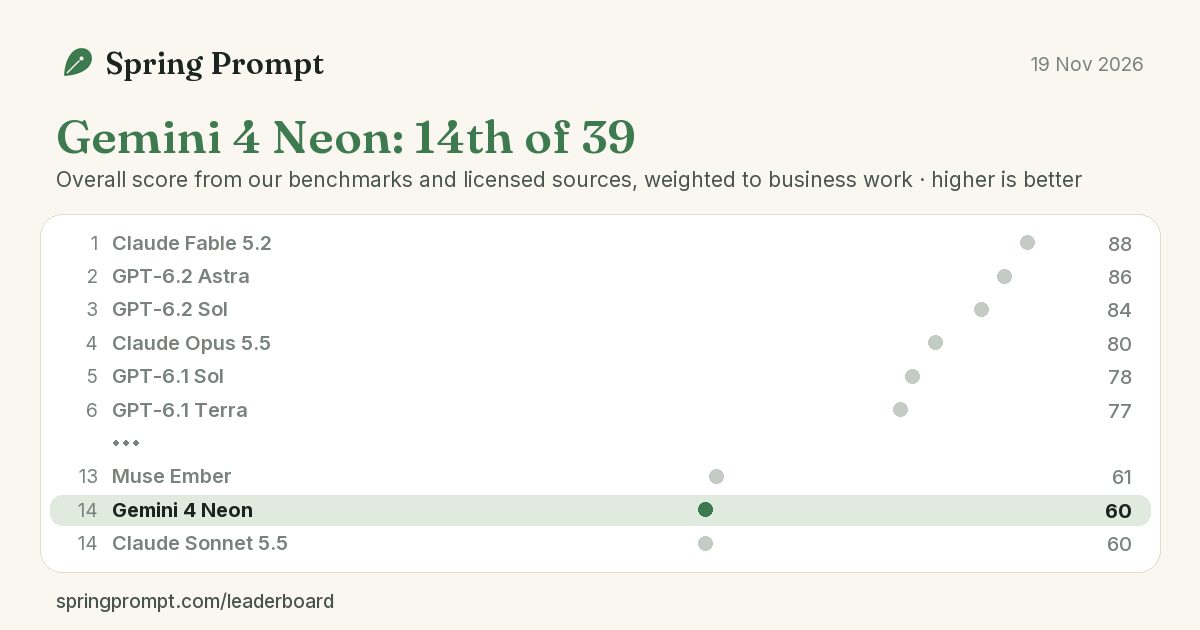
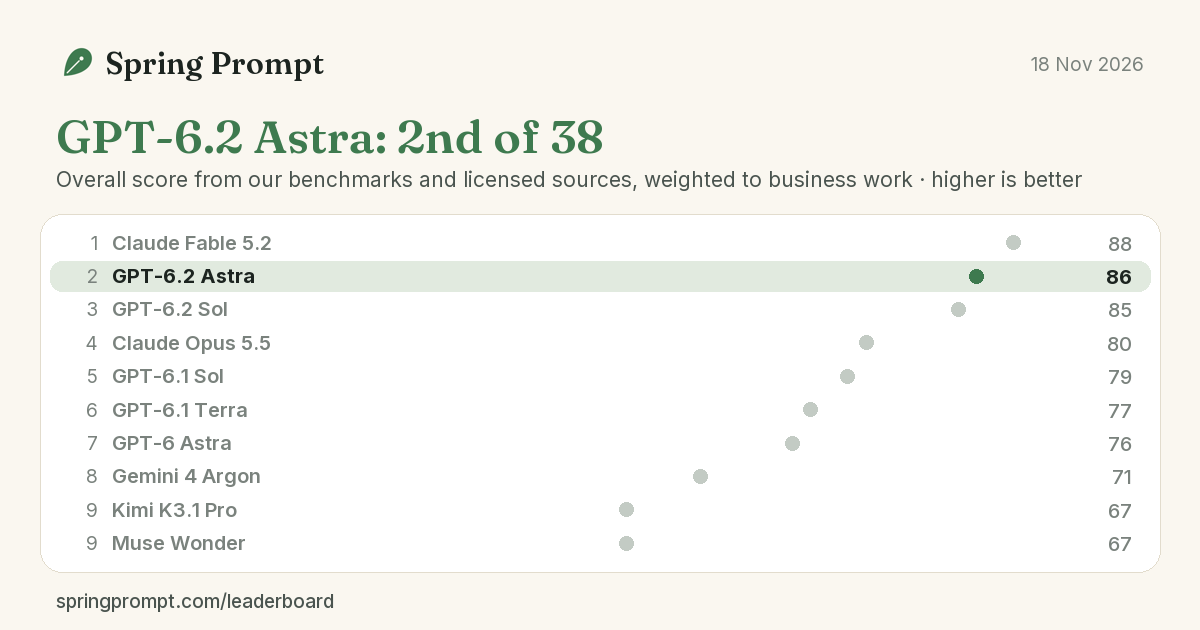
This data backs up what we saw last week in our benchmark vs. reviewer comparison. GPT-6.2 Astra sits 2nd on our Spring Prompt leaderboard right behind Claude Fable 5.2, yet in live multi-day agent runs Theo dropped Astra and kept Fable 5.2, GPT-6.2 Sol, and Gemini 4 Neon. Capability scores narrow the field; real workflows decide what stays.
If you want to check how models behave on your own tasks rather than someone else's, you can run your own prompt across models on Spring Prompt.
Method
- Source file:
t3code-telemetry-events-jsonl-a4896cdc.gz(95,789 JSONL rows, 104MB unpacked, 4 September to 24 November 2026), published by Theo Browne on Slopalytics. - Windows: full span for inventory and total turn counts (40,460
provider.turn.completedrows); 20 October to 24 November (36 days, 35,010 turns) for MCP tools, delegations, UI feature events, and token totals; 2 to 24 November (16,409 rows) forprovider.request.completedrole splits; 18 to 24 November (2,428 requests) for the current 7-day setup. - Token accounting: primary per-turn fields only (
inputTokens,cachedInputTokens,cacheCreationTokens,outputTokens). VerifiedinputTokens >= cachedInputTokens + cacheCreationTokensandoutputTokens >= reasoningTokenson 100% of non-zero rows; excludedotherInputTokensafter verifying it behaves as a cumulative session counter. - Sleep analysis: strictly human UI events (
client.turn.requested,client.thread.started, and desktop/mobile/webfeature.used) converted from UTC to US Pacific Time (PDT UTC-7 before 1 November 09:00 UTC; PST UTC-8 thereafter). Sleep gaps defined as 4.5 to 14 hour inactivity windows starting between 22:00 and 08:00 PT and ending between 06:00 and 16:00 PT (n = 29 nights). - Concurrency and bursts: parallel delegation bursts group
delegate_taskinvocations on the same machine within 30 seconds of the previous call. Concurrency reconstructed via sweep-line over[timestamp - durationMs, timestamp]intervals capped at 6 hours to exclude stalled outliers.
Quick answers
What is in Theo's public T3 Code telemetry dump?
The file contains 95,789 PostHog events (104MB uncompressed) spanning 4 September to 24 November 2026 across roughly 15 active machine installs. It records turn completions, durations, token counts, MCP tool invocations, delegated tasks, UI feature usage, and device metadata. It contains no source code, file paths, prompts, or responses.
Which AI models does Theo currently use in T3 Code?
In the most recent 7 days of the log (18 to 24 November 2026, 2,428 requests), direct prompts from Theo split 56% Claude, 28% Antigravity (Gemini 4 Neon), and 16% Codex (GPT-6.2 Sol), with Muse down to 0.4%. Delegated child tasks ran 76% Claude (mostly Fable 5.2 delegating to Opus 5.5 and Fable 5.2), 13% Codex, and 10% Antigravity.
Did the telemetry show early access to unreleased AI models?
Most models in the log first appear on their public release day (Gemini 4 Argon, Claude Fable 5.2, Gemini 4 Hydrogen, Gemini 4 Neon). Two periods stand out as genuine pre-release: Meta Muse appearing three days before its 12 October launch under the stealth name restful-walrus-ultra, and an unlabelled Codex surge from 2 to 10 November (15 days before GPT-6.2 Astra's 17 November release) that aligns closely with Theo's essay on testing early Astra on ts-rust.
How much compute does this workflow use?
In the active 36-day window (20 October to 24 November), primary per-turn counters log 194 billion input tokens (191.7 billion cached, a 98.2% cache hit rate) and 584 million output tokens. At modern frontier API rates that equals roughly $93,600 over 36 days (~$78,000/month), or ~$239,400 at flagship Opus pricing. Without prompt caching, the same tokens would cost $714,000 to $1.84 million. Telemetry does not show how this is billed.
How can normal developers adopt this T3 Code workflow?
Install Theo's open-source tstack skills (github.com/t3dotgg/tstack) into ~/.claude/skills/ and ~/.codex/skills/, start with full-stop (not full-send), sol-loop, council, and babysit-pr, default new threads to git worktrees (capped at 3 to 4 concurrent threads), steer live runs instead of interrupting them, and run t3 on an always-on Mac Mini or small Linux VPS.
Model pages: Claude Fable 5.2 · Claude Opus 5.5 · GPT-6.2 Sol · GPT-6.2 Astra · GPT-6.1 Sol · Gemini 4 Neon · Gemini 4 Argon · Gemini 4 Carbon · Gemini 4 Hydrogen · Muse Wonder