Gemini 4 Neon review: the most reliable product listings we've measured
Test Gemini 4 Neon on your prompt → It runs beside the models you could use instead, with every answer checked and costed.
Google released Gemini 4 Neon on 18 November, a week after Gemini 4 Hydrogen, and placed it between Hydrogen and Carbon. It costs $3/$15 per million tokens, twice Hydrogen's price, and it went through our five business benchmarks overnight.
It set a new best on product listings, the job our first benchmark was built for. 78.6% of Neon's product listings were ready to publish in every one of our three runs, more than any of the 35 models we have measured, including GPT-6.2 Sol, GPT-6 Astra and Claude Fable 5.2. It reads specs off packaging and fills in the fields other models leave empty or get slightly wrong. It was weaker on sales copy, slide decks and survey analysis, so it is a specialist rather than an all-rounder.
Gemini 4 Neon at a glance
- The most reliable product listings we have measured. 78.6% publish-ready in all three runs on our factual brief, first of 35 models and 16 points ahead of Hydrogen.
- It reads the packaging. On products where the facts are only in the photos, it filled in blanks other leading models missed (example below).
- Between Hydrogen and Carbon on listing speed, as Google says: 36 seconds a listing, against 20 for Hydrogen and 45 for Carbon.
- Not an all-rounder. Sales copy (32.1% publish-ready), slide decks and survey analysis were well behind GPT-6.2 Sol.
- Price: $3/$15 per million input/output tokens, $0.15 cached.
Gemini 4 Neon benchmark results in one table
Independent results, measured by Spring Prompt on 19 November 2026 at the default setting on OpenRouter (medium; Google's own API defaults to high). All of it is free to reuse with a link (CC BY 4.0), and the full rows are in our open data.
| Taskbenchmark | Gemini 4 Neon | Gemini 4 Hydrogen | Best other model | Rankmodels on sale today |
|---|---|---|---|---|
| Product listings, factual briefCatalogBench, publish-ready in all three runs | 78.6% | 62.5% | GPT-6.2 Sol, GPT-6.1 Sol and GPT-6 Astra, 75.0% | 1st of 35 |
| Product listings, sales briefCatalogBench, publish-ready in all three runs | 32.1% | 23.2% | GPT-6.2 Sol, 75.0% | 13th of 35 |
| Ad budget, 12 simulated monthsROASBench score | 47.0 | 45.4 | Claude Fable 5.2, 61.3 | 16th of 35 |
| Chess, 60 seconds a gameBulletBench rating, best setting (low) | 766 | 889 | Gemini 3.8 Flash, 1,068 | 7th of 36 |
| Slide decksDeckBench rating | 1,013 | 1,079 | Qwen4-Max, 1,563 | 24th of 35 |
| Survey analysisSurveyBench rating | 629 | 1,096 | Claude Fable 5.2, 1,670 | 22nd of 26 |
Products, companies and survey data are invented, and each benchmark except CatalogBench ran once. Ratings are head-to-head scores, where a higher number wins more comparisons.
Product listings: the new best
CatalogBench gives each model a product's supplier data with some fields blanked out, plus its photos, and asks for a listing that is ready to publish: every blank filled correctly from the images, nothing made up, nothing overwritten. A listing only counts as reliable if it passes in all three runs. 44 of Neon's 56 did, 78.6%. That puts it first of 35 models, ahead of GPT-6.2 Sol, GPT-6.1 Sol and GPT-6 Astra (75.0%) and Claude Fable 5.2 (71.4%), and a big step on Hydrogen (62.5%), Argon (60.7%) and Carbon (53.6%).
Where it pulled ahead was reading the photos. Take one of the public test products, a front and rear bike light set where the lumens, water resistance, charging port and number of lights are blank in the supplier data and only printed on the box:
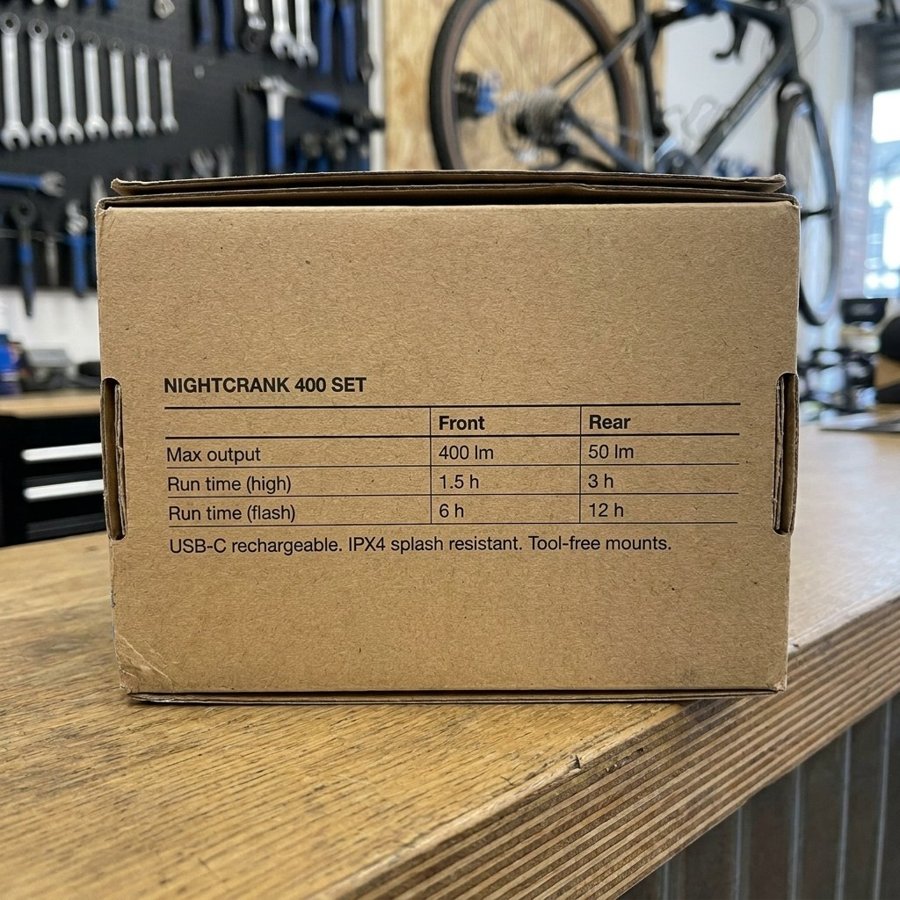
| Model | Lumens | Water resistance | Charging | Lights in the set | Publish-readyruns out of 3 |
|---|---|---|---|---|---|
| Gemini 4 Neon | 400 | IPX4 | USB-C | 2 | 3 of 3 |
| GPT-6.2 Sol | 400 | "IPX4 splash resistant" | USB-C | 2 | 0 of 3 |
| Gemini 4 Hydrogen | 400 | IPX4 | left blank | left blank | 0 of 3 |
Each model's first run. GPT-6.2 Sol put the marketing phrase into a field that takes a rating, which our checks count as wrong; Hydrogen left two fields empty.
Each listing took 36 seconds and cost $0.065. That is slower than Hydrogen (20 seconds) and faster than Carbon (45 seconds), which fits where Google places it, but it costs about three times as much per listing as either.
The sales brief is a different story. Asked for persuasive copy for the same products, only 32.1% of Neon's listings were publish-ready, 13th of 35, and it added about one unsupported claim per product. GPT-6.2 Sol held 75.0% on both briefs. If you use Neon for catalogue content, give it the factual brief.
What Google says
Google's Gemini API changelog lists gemini-4-neon as generally available from 18 November, on the paid tier only, bringing "frontier-level intelligence with fast end-to-end task completion" to software engineering, knowledge work and science. Google DeepMind's launch post places it between Carbon and Hydrogen. It has a 1,048,576-token context window and, Google says, output up to a million tokens. Thinking defaults to high, with low, medium and xhigh also available.
The rest of our benchmarks
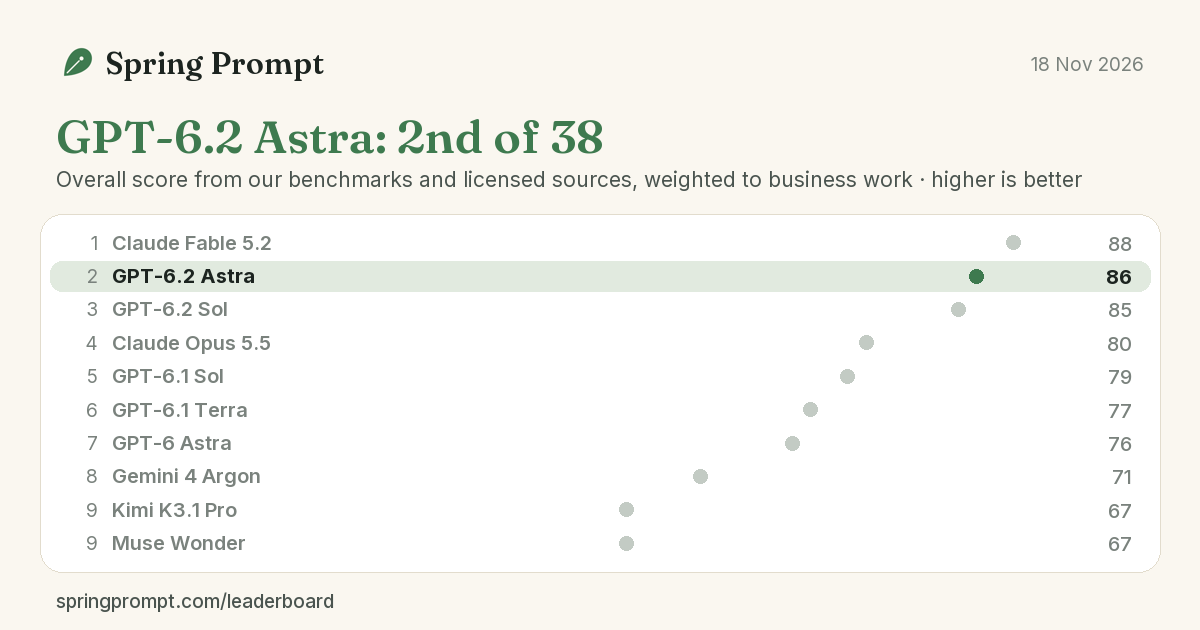
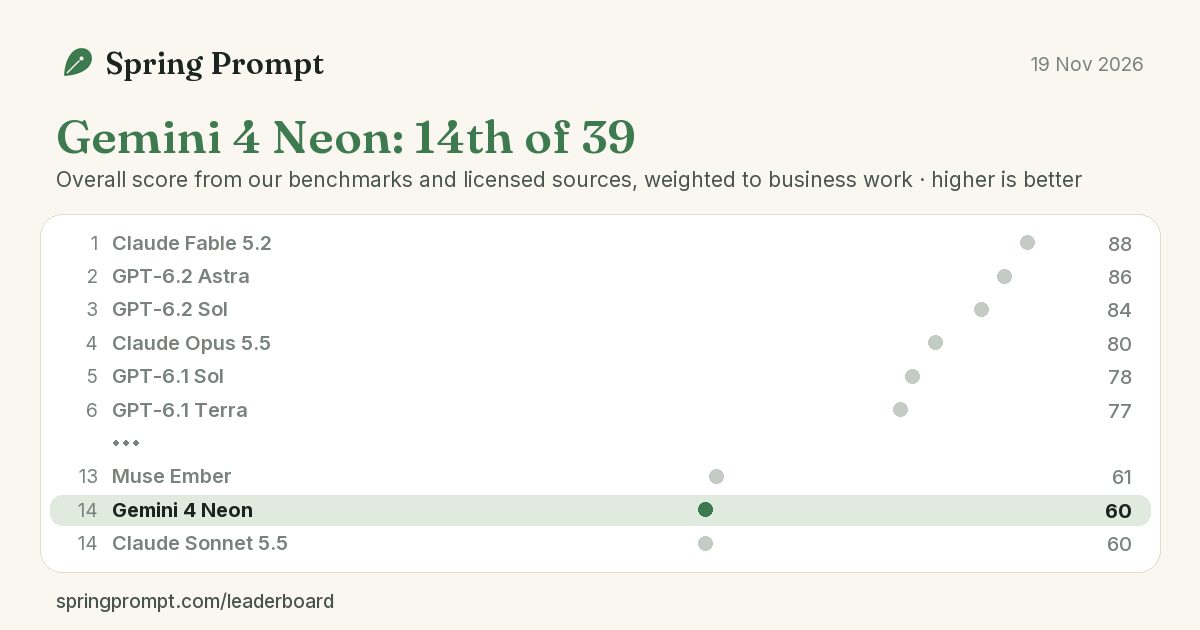
Joint 14th overall
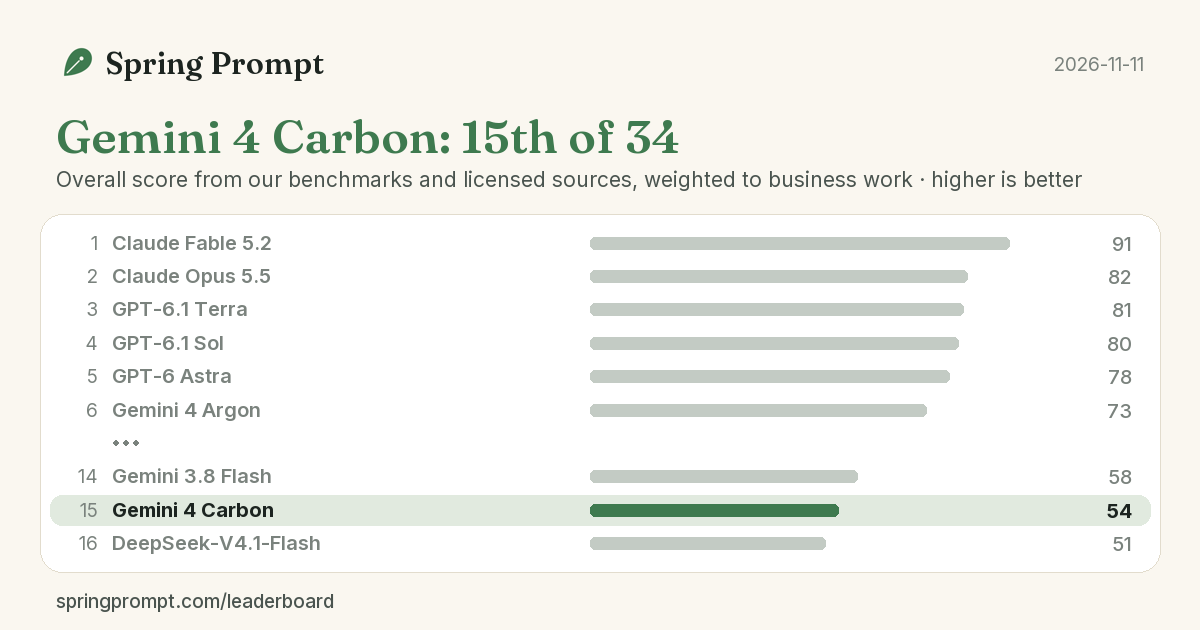
Neon is joint 14th of 39 on our overall leaderboard, level with Claude Sonnet 5.5 and Gemini 4 Hydrogen, and ahead of Gemini 4 Carbon (20th). Like every new model this month, it has results in only two of the five groups, both from our own benchmarks, so the rank is provisional until third-party data arrives.
Ad budgets: mid-table
In ROASBench, twelve simulated months of ad budget decisions, it scored 47.0, 16th of 35, just ahead of Hydrogen (45.4) and behind Carbon (51.2). It never overspent a month.
Speed chess: better at low effort
On BulletBench with 60 seconds a game it rated 766 at low effort, 7th of 36, against 491 at the default, where it lost five of eight games on time. With three minutes a side it rated 946, and its moves came quicker than Hydrogen's or Carbon's.
Slide decks: not ready to present
On DeckBench it rated 1,013, 24th of 35 and just behind Hydrogen. Two of its eight decks failed outright: one placed shapes with zero height and the other's file was cut off mid-way, so neither could be built. None of its six public decks could be presented as they came, mostly because of layout problems. Each took about 7 minutes and $0.77, longer than Hydrogen or Carbon.
Survey analysis: out of room on most tasks
On SurveyBench it rated 629, 22nd of 26. That rating mostly reflects one problem: on 8 of 12 tasks Neon used its whole output budget, presumably on reasoning, and returned no analysis. Every model gets the same budget, and Hydrogen and Carbon finished every task within it. Where it did answer, its survey plans were good (92 of 100) and it caught every trap in the data. If you use it for long analysis, set a generous output limit.
In the playground

Neon did well on both of our playground prompts. Its stained glass window is one of the best on the page and one of the few to show every step: a pencil cartoon first, then the glass cut and dropped in piece by piece, the leading darkened and the window lit, with the light following the pointer. Its pelican on a bicycle wears a scarf, has a fish in the front basket, and has a wing on the grip and a foot on a pedal.
Third-party results
None count towards Neon's rank yet, because the third-party data in our release predates the launch. On launch day Vals AI put it second on its Vals Index (70.9%), 0.4 points behind Claude Fable 5.2, Arena placed Neon at high effort second on its Agent Arena index, and Cursor reported 63.7% on CursorBench at its default effort, up from Hydrogen's 57.3%. Those results are mostly coding and agent work, which our benchmarks don't measure.
Gemini 4 Neon vs Hydrogen, Carbon, Argon, GPT-6.2 Sol and Claude Fable 5.2
| Modelwhy it's here | Priceper million, in/out | Listingsfactual / sales, reliable | Decksrating | Surveysrating | Ad budgetsscore |
|---|---|---|---|---|---|
| Gemini 4 Neonthe new model | $3 / $15 | 78.6% / 32.1% | 1,013 | 629 | 47.0 |
| Gemini 4 HydrogenGoogle's faster, cheaper model | $1.50 / $7.50 | 62.5% / 23.2% | 1,079 | 1,096 | 45.4 |
| Gemini 4 CarbonGoogle's long-task model | $2 / $10 until 30 Nov | 53.6% / 14.3% | 992 | 1,054 | 51.2 |
| Gemini 4 ArgonGoogle's general model | $2 / $10 | 60.7% / 17.9% | 951 | 928 | 47.0 |
| GPT-6.2 Solthe all-rounder at a lower price | $2 / $10 | 75.0% / 75.0% | 1,370 | 1,362 | 51.8 |
| Claude Fable 5.2top of our overall board | $8 / $40 | 71.4% / 44.6% | 1,403 | 1,670 | 61.3 |
Is Gemini 4 Neon good? Who should use it
- Factual product content, especially from photos and packaging: the most reliable model we have measured. Worth testing first if your catalogue relies on specs that are only in the images.
- Use a factual brief. Asked for sales copy, it dropped to 32.1% and added unsupported claims.
- Look elsewhere for decks and long analysis, where GPT-6.2 Sol did better for less. If you do use it for analysis, set a generous output limit.
- Try the setting yourself. We ran OpenRouter's medium; Google defaults to high, and low was better at fast chess.
These benchmarks aren't your data. Google pitches Neon at coding, agent work and science, which we haven't measured.
What we'll update
We'll add Artificial Analysis, Arena and the other third-party sources as they enter the catalogue, and Neon's rank may change when they do. Until then, the Gemini 4 Neon model page has our results as they stand, and Google's release timeline shows where it sits among this month's Gemini 4 launches.
Is Gemini 4 Neon the right model for your product listings? Paste your prompt and we'll draft the cases and checks, run it on Neon and the alternatives, and show you the cheapest one that passes. Test your prompt →
Cheapest model that passes
On our benchmarks that define a pass for each task: what one passing answer cost in our run, failed attempts included, and whether a cheaper model passed.
- CatalogBench · cost per 1,000 accepted listings
Gemini 4 Neon passed 137 of 168 attempts, with no estimate: failed-call costs incomplete. Cheapest: GPT-6 Luna at $0.70 (114 of 168 attempts). - DeckBench · cost per presentable deck
Gemini 4 Neon: no presentable decks (0 of 6 tasks). Cheapest: GPT-6.2 Sol at $0.09 (5 of 6 tasks). - SurveyBench · cost per sound survey task
Gemini 4 Neon: no sound survey tasks (0 of 9 tasks). Cheapest: GPT-6 Luna at $0.03 (3 of 9 tasks).
Cost per attempt divided by the share that passed, at the run date's prices, excluding judging. Each model at its cheapest setting per passing answer. With a handful of tasks, a pass or two either way is within chance. No estimate where a run had missing outputs, because their cost may not have been recorded.
Quick answers
Is Gemini 4 Neon good for product listings?
It is the best we have measured. On our tests of 19 November, 78.6% of its listings from a factual brief were ready to publish in all three runs, first of 35 models, ahead of GPT-6.2 Sol, GPT-6.1 Sol and GPT-6 Astra on 75.0% and well ahead of Gemini 4 Hydrogen on 62.5%.
How much does Gemini 4 Neon cost?
Google charges $3 per million input tokens and $15 per million output, with cached input at $0.15, on the paid tier of the Gemini API; OpenRouter charges the same. That is twice Gemini 4 Hydrogen's price. In our runs it came to $0.065 a product listing, $0.77 a slide deck and $0.79 a survey task.
Is Gemini 4 Neon faster than Gemini 4 Carbon?
For product listings, yes: 36 seconds a listing against Carbon's 45 and Hydrogen's 20, which matches Google placing it between the two. On our longer tasks it was slower than both at the default setting: about 7 minutes a slide deck and 7.3 minutes a survey task.
Gemini 4 Neon or GPT-6.2 Sol?
For factual catalogue content, Neon wrote more reliable listings (78.6% against 75.0%). For sales copy, slide decks and survey analysis, GPT-6.2 Sol was well ahead, at two-thirds of Neon's token price and less time per task.
What reasoning setting does Gemini 4 Neon use?
Thinking is always on. Google's API defaults to high; OpenRouter defaults to medium, which is what we ran. Google also offers low and xhigh.
What is Gemini 4 Neon's context window?
1,048,576 tokens, with output up to 1 million tokens according to Google. It takes text, images, audio, video and documents and returns text.
Release dates: every Google model release · new AI models released this week
Will Gemini 4 Neon work for your product?
Benchmarks aren't your task. Paste the prompt your product uses and run it beside the models you could use instead, with every answer checked and costed.
New here? Your email starts a free trial. No credit card needed.