Claude Opus 5.5 vs Muse Wonder Full: Eight Crafts, and Opus Still Wins Most
This week someone on X (@kaolti) asked Opus 5.5 and Muse Wonder Full to embroider the Apple logo in code. We liked it enough to try more crafts: throw a bowl, carve an ice swan, lead a stained-glass window, pipe a cake, pour latte art.
We picked them as best against new: Claude Opus 5.5 against Meta's Muse Wonder. Standard Wonder on one try wasn't close. Wonder Full, run as an agent, finished every piece and showed every step. Opus still made the more real object in most of the eight.
The test
Each prompt names a craft and asks for the same thing:
Make it a single self-contained HTML file (inline CSS and JavaScript, no external libraries, fonts or images) that fills the window. Show the piece being made from start to finish, then hold on the finished result. Moving the pointer moves the light, so the surface catches it the way the real material would. Click to start again.
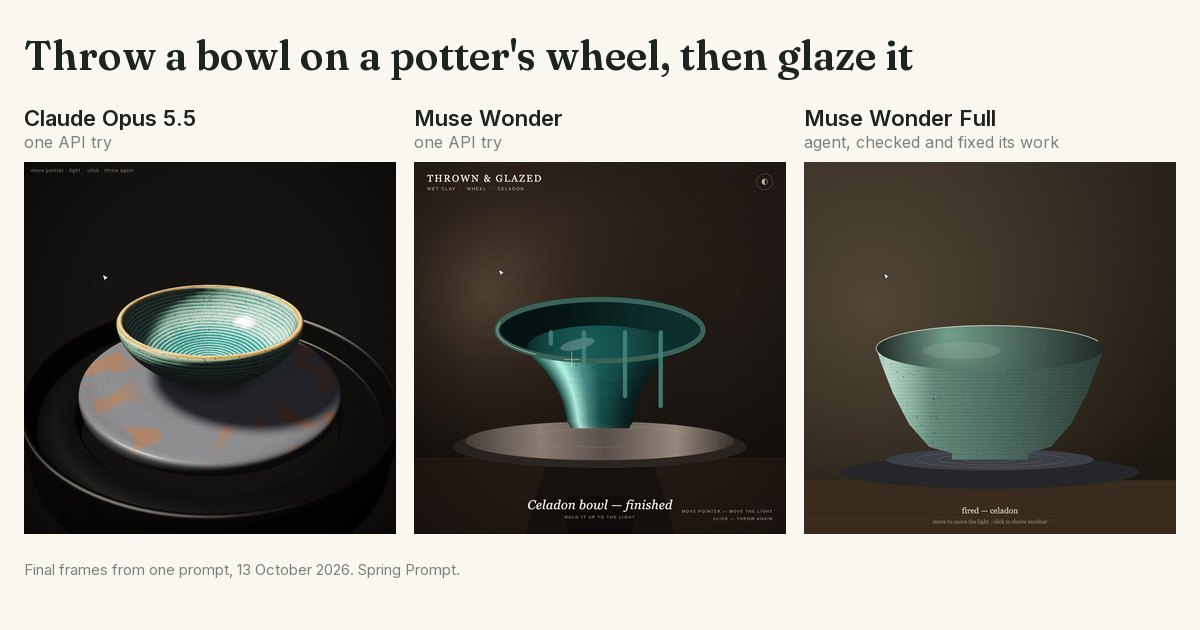
Nothing says how real it should look, so it shows how much care a model takes unprompted. Each test's playground page, linked below, runs all three answers live, so you can move the light yourself. The images here are each recording's last frame.
| Craft | Our call | Opus 5.5 | Wonder |
|---|---|---|---|
| Pottery | Opus, by a long way | 7.4 min, $0.90 | 2.7 min, $0.30 |
| Ice swan | Opus, by a long way | 9.5 min, $1.15 | 1.4 min, $0.20 |
| Stained glass | Opus, by a long way | 15.4 min, $1.88 (second try) | 1.3 min, $0.16 |
| Cake | Opus, by a long way | 4.4 min, $0.52 | 1.4 min, $0.21 |
| Oil painting | Opus | 7.2 min, $0.90 | 2.6 min, $0.30 |
| Neon sign | Near draw, slight Opus | 5.4 min, $0.66 | 1.6 min, $0.27 |
| Embroidery | Split: Opus for realism, Full for charm | 6.6 min, $0.79 | 1.0 min, $0.20 |
| Latte art | Full | 6.6 min, $0.78 | 1.1 min, $0.18 |
"Our call" compares all three. Times are how long each API answer took to write; costs are what OpenRouter charged for it. Full has no comparable figure: it ran in a subscription app, and wrote, checked, fixed and was recorded on all eight in one 45-minute session.
Where Opus was far ahead
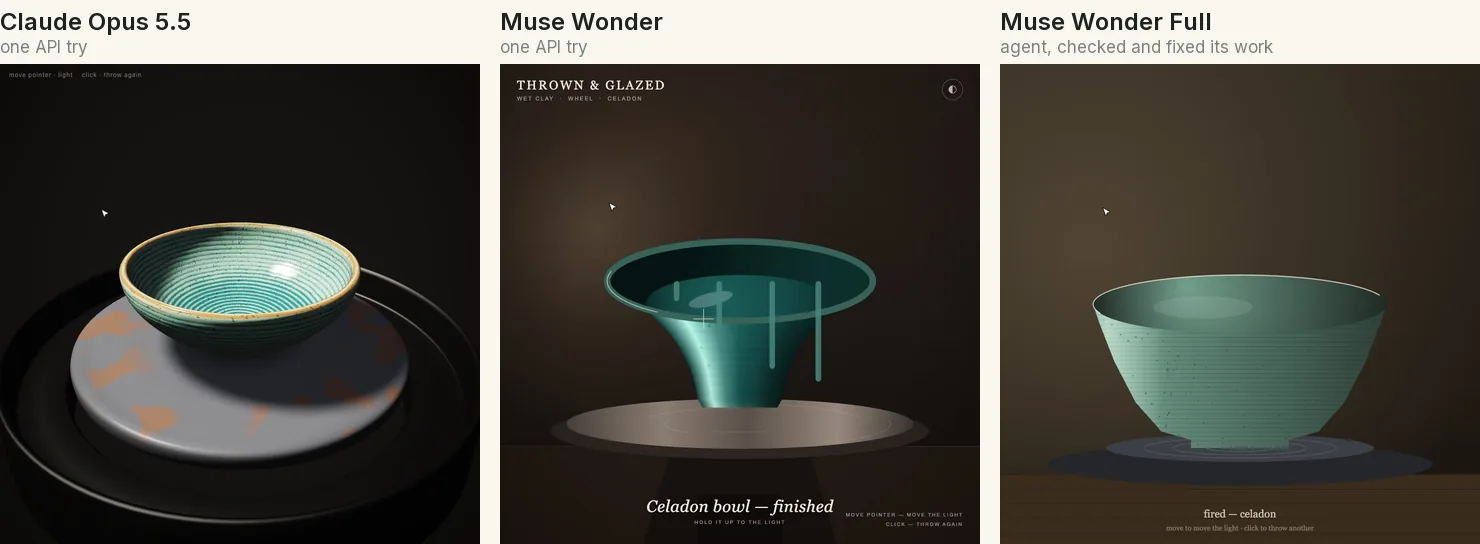
Pottery. Opus builds the bowl in 3D. It centres the clay, pulls up the walls, lets it dry to leather-hard and glazes it a speckled celadon, with throwing rings and a highlight that follows the pointer. Standard Wonder gave the potter cartoon arms and made a funnel. Full fixed most of that. It goes through every real step, from centring to trimming the foot to firing. The bowl is believable, but a flat side view, where Opus's is an object you could pick up.
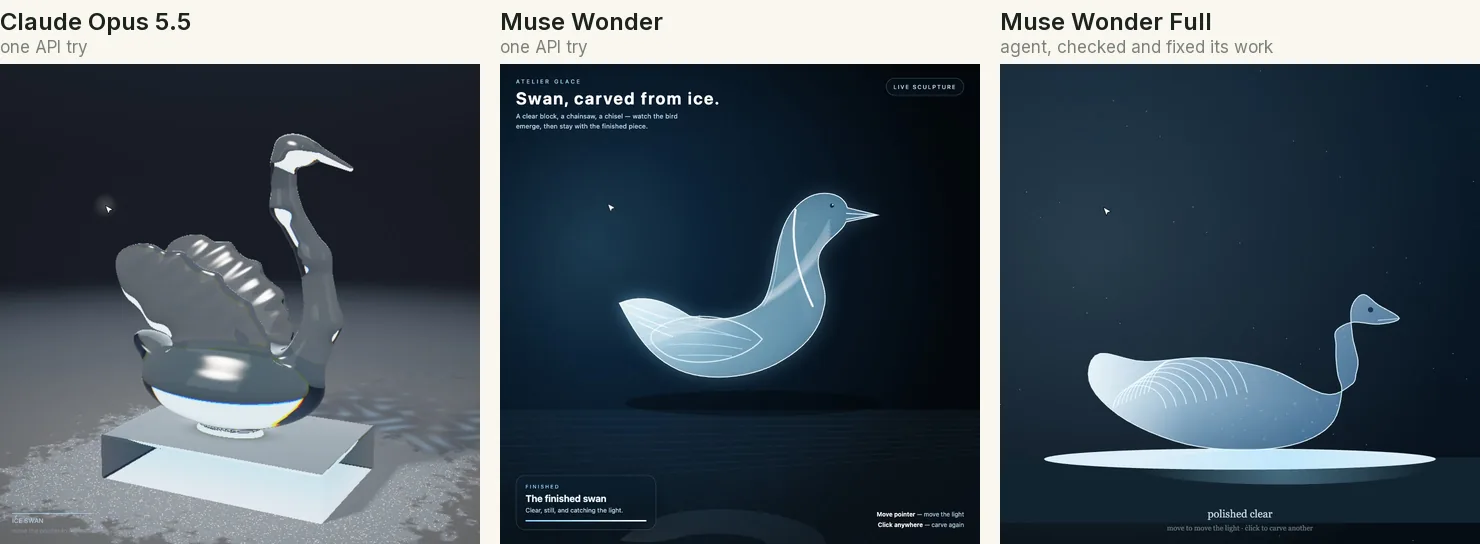
Ice swan. Opus carves a swan out of a block in 3D, with a chainsaw, then chisels, then a torch to polish it clear. Standard Wonder drew a glowing outline of something closer to a duck. Full has the best process of the three: chainsaw, chisel, feather detail and torch, with chips flying. The finished swan is a flat profile, and looks rather like a goose.
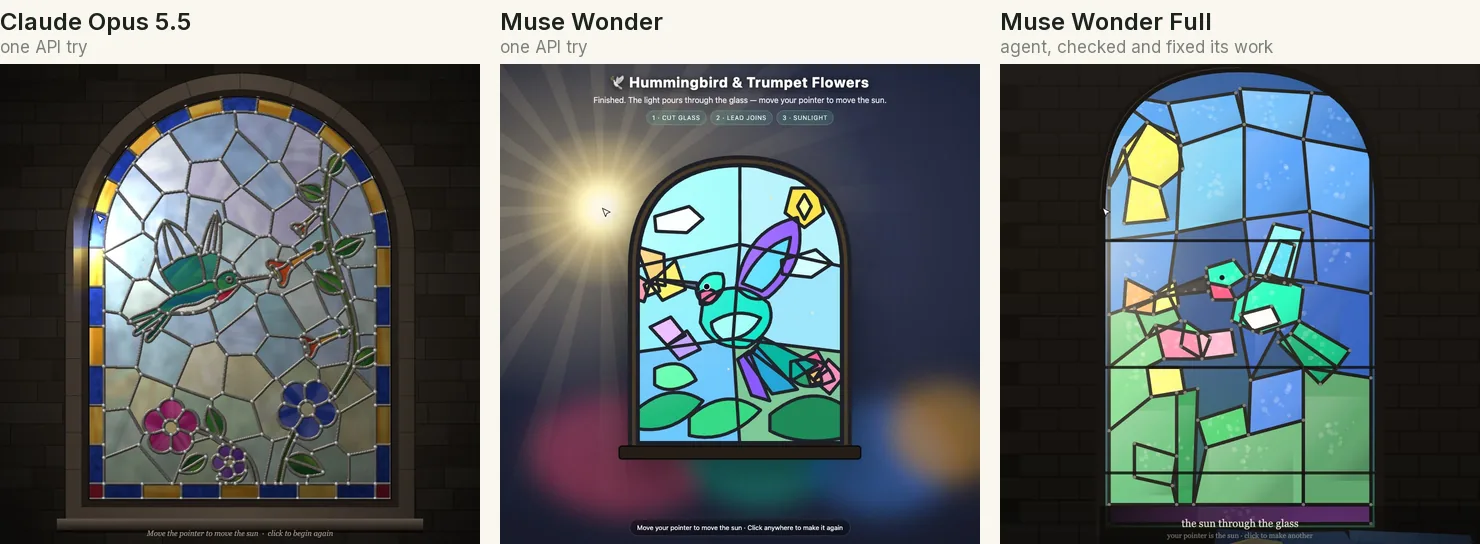
Stained glass. Opus draws the design first, as a glazier would, then cuts and leads textured glass around a hummingbird at a trumpet flower. This was Opus's second try: the first, after 12 minutes and $1.49, had a syntax error and showed a blank page. Standard Wonder's hummingbird is a pile of shapes. Full's is legible, with a ruby throat and its beak in the flower, but blocky, and the glass is flat colour. One detail Full got that Opus didn't: the coloured light spilling on to the floor follows the sun.
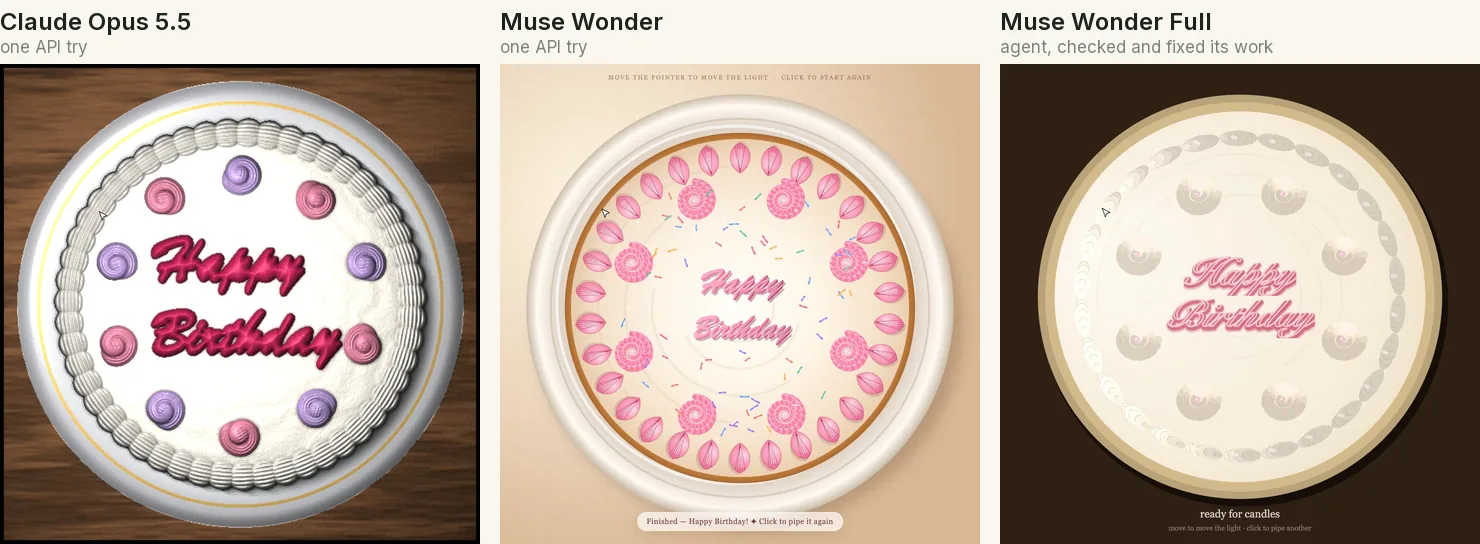
Cake. Opus's buttercream looks piped: a shell border, pink and lilac rosettes with some body, and raised lettering. Standard Wonder went pink with sprinkles, which is fun but flat. Full's cake is tasteful and very pale, white shells and rosettes on white icing, with all the colour in the writing.
Closer
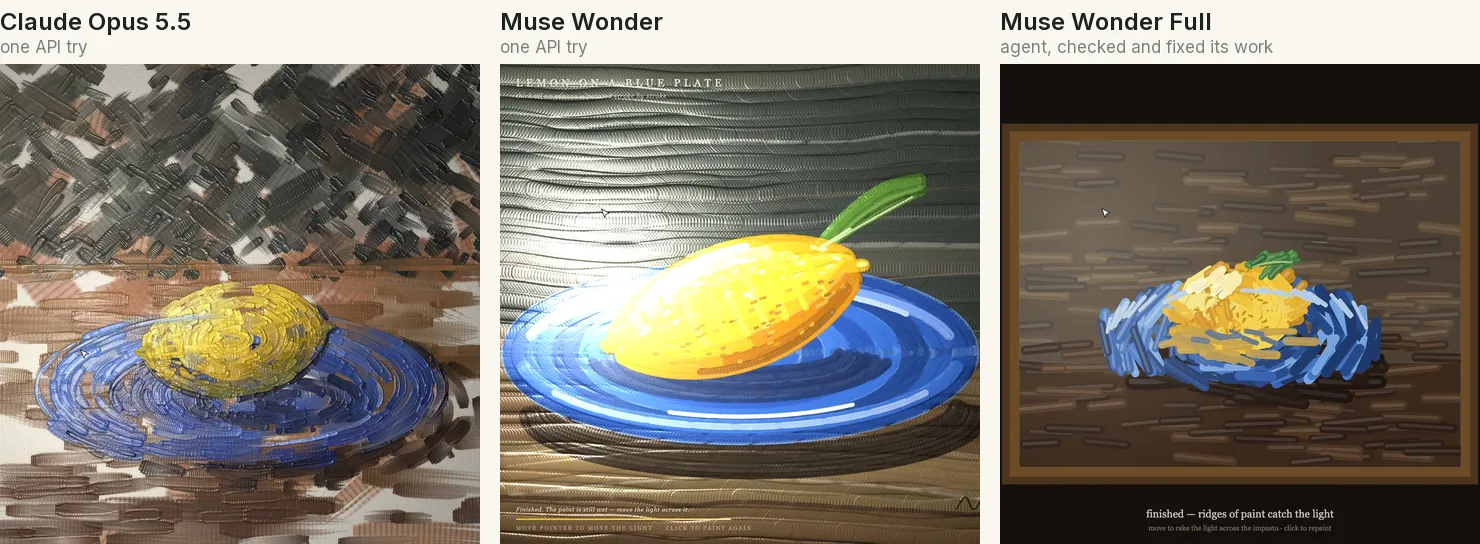
Oil painting. Asked for a lemon on a blue plate, Opus paints the background first, then the plate, then the lemon, and the ridges of paint catch the light. Standard Wonder's lemon is shiny and 3D, with a large leaf. Full blocks in flat colour and then adds short strokes that catch the light the way paint does, but its lemon is small and hard to read.
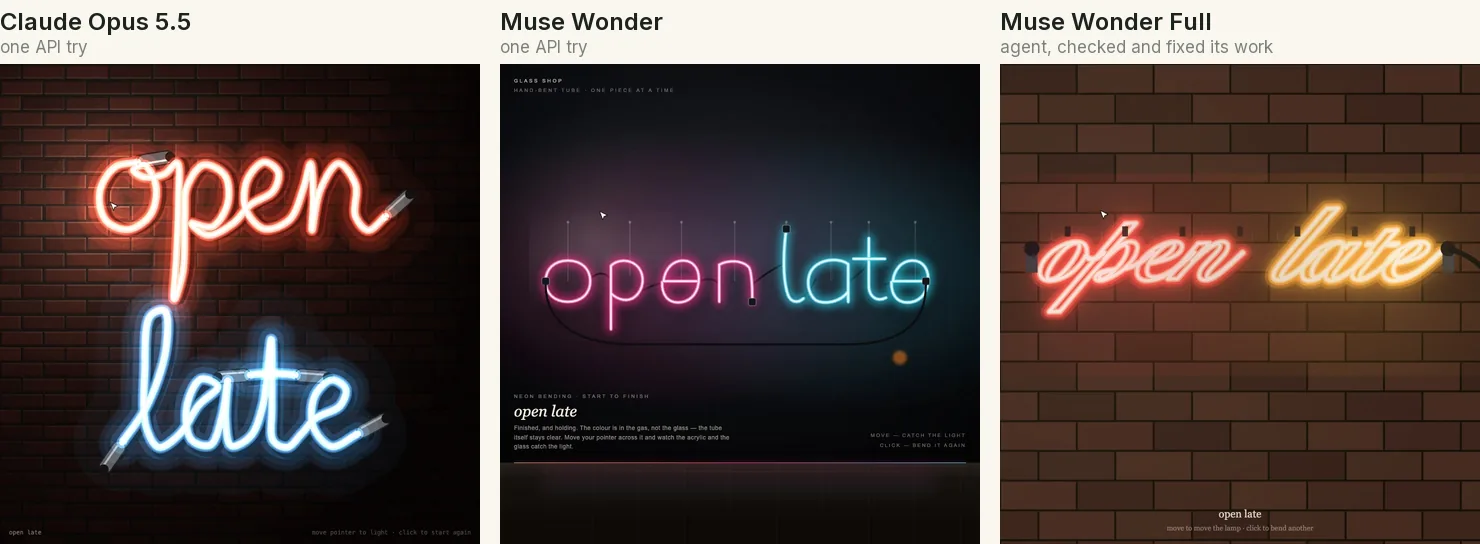
Neon sign. The closest of the eight. Opus bends "open late" over a flame letter by letter, red above blue, with the electrodes and the gaps between letters in shot, as real signs have. Full bends a single coral-and-amber line, mounts it and flickers it on like a sign starting up. We'd give Opus the edge, narrowly.
Where Full won
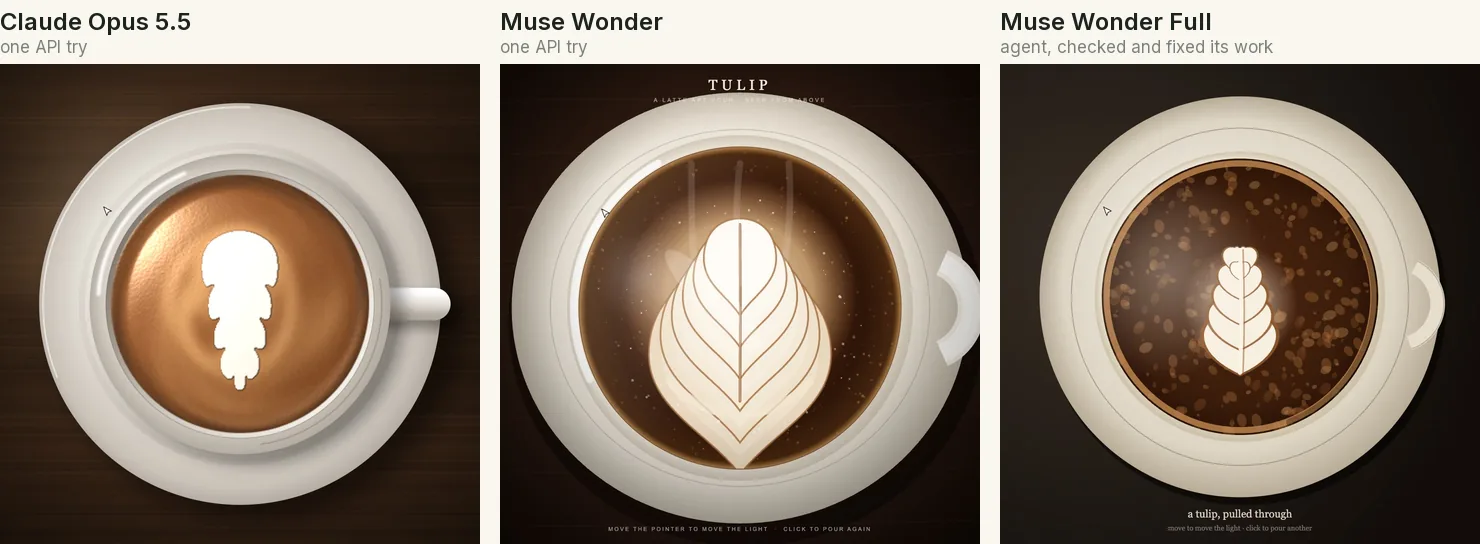
Latte art. We asked for a tulip. Opus's cup and crema are the most realistic of the three, and then the milk lands as a lumpy white blob. Standard Wonder poured a neat leaf instead. Full stacked hearts and pulled through them. If you are strict it still leans towards a leaf, but it is the only one of the three you would call a tulip.
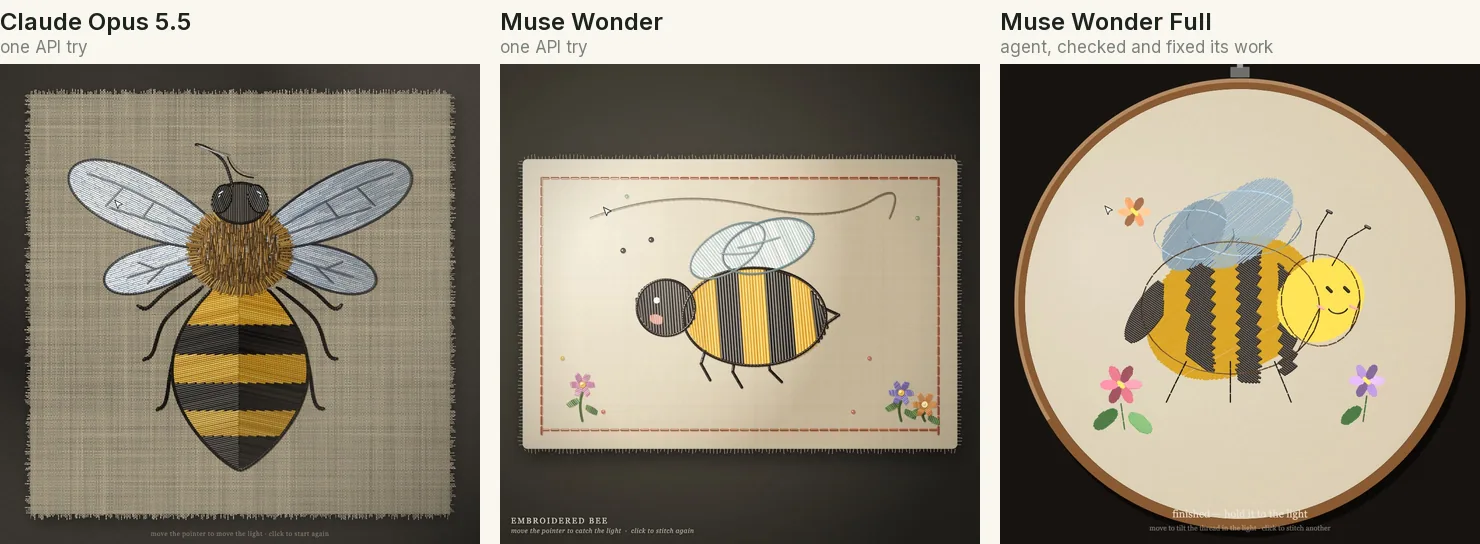
Embroidery. Opus stitches a bee on linen from above, and the thread looks real enough to touch. It works in an odd order, though: legs and wings first, the head last. Both Muse versions went for a cartoon bee with a face. Full's sits in a hoop with flowers, and each stitch flashes as you move the light. Opus's is the better embroidery; Full's is the one you'd sew on a child's jacket.
Time and cost
Opus 5.5 and Muse Wonder cost the same per token on OpenRouter: $4 per million in and $20 per million out. Wonder was cheaper per answer only because it wrote less. Across the eight answers, Opus produced 379,000 output tokens and Wonder 90,000. Most of the difference is thinking: 71% of Opus's tokens were reasoning, against 38% of Wonder's.
The eight Opus answers cost $7.59 and took just over an hour to write; with the failed stained-glass try, $9.08. The eight Wonder answers cost $1.81 and took 13 minutes. Both ran at their API defaults.
What it means if you're choosing a model
If you want a visual page or front-end piece in one shot, Opus 5.5 made the better object in most of these tests, and the gap was large on the hardest ones. It is slow, cost about four times as much in total, and it isn't infallible: one of its eight first tries didn't run.
Standard Muse Wonder is cheap and quick, and on one try it wasn't close. Full is better, but it needed an agent and a few rounds of looking at its own work to finish everything. That loop is worth copying whichever model you use: render the page, screenshot it, and let the model fix what it sees. Opus didn't get that chance here.
Choosing the model behind a product workflow? Our custom evaluations test the alternatives on your prompts and data.
Quick answers
Is Muse Wonder Full better than Claude Opus 5.5 at visual generation?
Not in our eight craft tests on 13 October 2026. Opus 5.5 made the more convincing object in six of the eight, with neon a near draw. Full won latte art (the only tulip-shaped pour) and, for charm, the embroidery. Full also had the easier setup: it ran as an agent that could screenshot and fix its work, while Opus had one API try per prompt.
How did you run Muse Wonder Full?
In Muse Code, Meta's agent app, on 13 October 2026. Full was not available through the API we use. It wrote each file, screenshot-checked it and fixed what it saw, over a few rounds on the hardest pieces. Muse Code is a subscription, so we have no per-answer cost for Full.
Is Muse Wonder cheaper than Claude Opus 5.5?
Per token, no: OpenRouter listed both at $4 per million input tokens and $20 per million output tokens on 13 October 2026. Per answer, standard Wonder cost $0.16 to $0.30 on these tests and Opus $0.52 to $1.88, because Wonder wrote about a quarter as many tokens, with far less thinking.