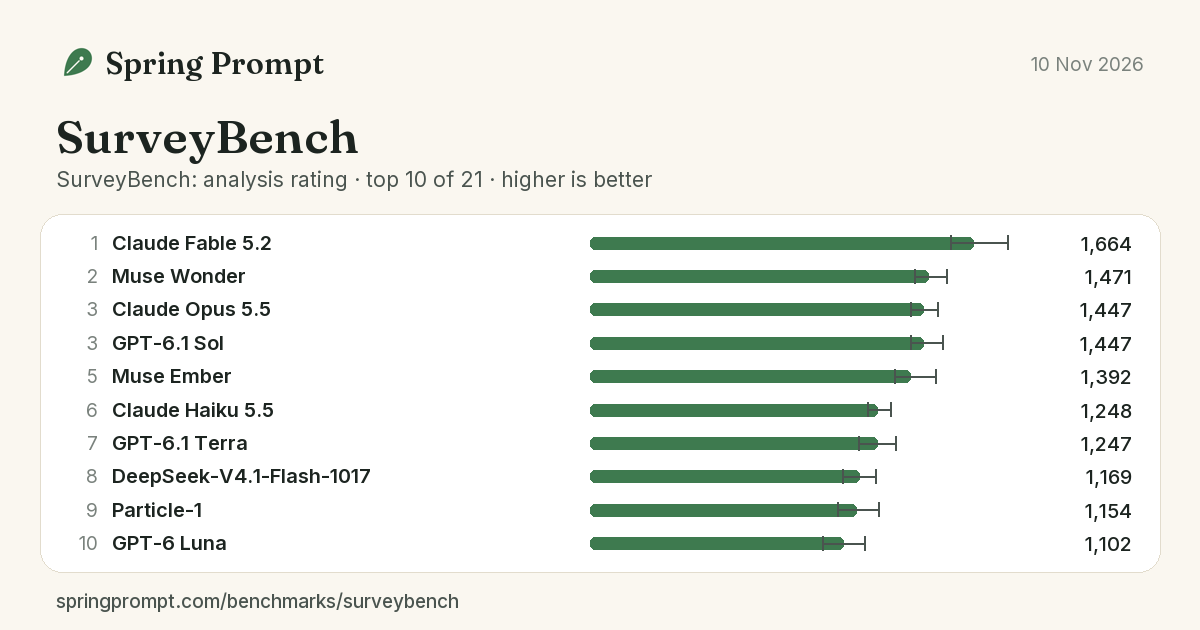
SurveyBench: cost per sound survey task, US dollars, lower is better
| # | Model | Cost per sound survey task
US dollars, lower is better | Analysis rating
rating | Research score
points of 100 | Sound research
% of tasks | Traps handled
% of traps | Cost per task
US dollars |
|---|
| 1 |
GPT-6 LunaOpenAI |
$0.0264
|
1,102 | 91.7 | 33.3%
3 of 9 | 94.2% | $0.0088 |
| 2 |
Particle-1Particle AI |
$0.0629
|
1,154 | 89.7 | 22.2%
2 of 9 | 95.7% | $0.0140 |
| 3 |
DeepSeek-V4.1-Flash-1017DeepSeek |
$0.11
|
1,169 | 90.9 | 33.3%
3 of 9 | 91.3% | $0.0373 |
| 4 |
Claude Haiku 5.5Anthropic |
$0.17
|
1,248 | 90.2 | 11.1%
1 of 9 | 94.2% | $0.0185 |
| 4 |
GPT-6.1 TerraOpenAI |
$0.17
|
1,247 | 92.2 | 33.3%
3 of 9 | 94.2% | $0.0569 |
| 6 |
GPT-6.1 SolOpenAI |
$0.21
|
1,447 | 97.0 | 66.7%
6 of 9 | 95.7% | $0.14 |
| 7 |
Claude Opus 5.5Anthropic |
$0.82
|
1,447 | 96.1 | 55.6%
5 of 9 | 95.7% | $0.46 |
| 8 |
Muse WonderMeta |
$1.06
|
1,471 | 93.6 | 33.3%
3 of 9 | 100.0% | $0.35 |
| 9 |
Claude Fable 5.2Anthropic |
$3.40
|
1,664 | 97.6 | 44.4%
4 of 9 | 98.6% | $1.51 |
Swipe the table sideways for more columns.
Source: Spring Prompt, springprompt.com/benchmarks/surveybench. Test your own prompt on these models →
Ranks follow the score as shown, so equal numbers share a rank. Generation cost per task with both a sound survey plan and a sound analysis: cost per task divided by the share of tasks that were sound. Cost is recorded at each run's prices and excludes judging and human review. This is the cost of passing answers in our run, the same way the Prompt test counts cost per usable answer: failed attempts are paid for too. No estimate for 13 configurations: failed-call costs incomplete for Muse Ember, GLM-5.3 FlashX Legal; no sound survey tasks for Claude Haiku 4.5, Gemini 3.1 Pro Preview, Gemini 3.5 Flash-Lite, Gemini 3.8 Flash, Gemini 4 Argon, Kimi K3.1 Pro, Mercury 3, MiniMax M3.1 Flash, MiniMax M3.1 Flash, Mistral Large 4, Mistral Medium 3.5. Each model runs at its provider's default reasoning setting, once per task. The rating comes from head-to-head comparisons of the analyses, so it keeps separating models after several pass the checks; ranges are 95% intervals from resampling the comparisons. Models whose ranges overlap are not reliably different.