Given a research brief, which models plan a sound user survey, and then draw only the conclusions its responses support?
Last updated 16 Nov 2026
Results dated
8 Oct 2026 to 16 Nov 2026
Results
25 configurations of 24 models
Unit
% of tasks
Licence
Spring Prompt original
Judge
GPT-6.1 Sol, Claude Opus 5.5 and Gemini 3.1 Pro, by majority · bias check
Runs
1 per task
SurveyBench in brief
What it measures. SurveyBench is a Spring Prompt benchmark. Can a model plan a user survey and read its results without being misled? It scores: Survey questions: leading, double-barrelled, assumptive or ambiguous; Whether the survey can answer the brief within its limits; Numbers read from crosstabs, weighted, and tested for significance; Whether the analysis is misled by weaknesses planted in the data; Next steps, and what would change the recommendation.
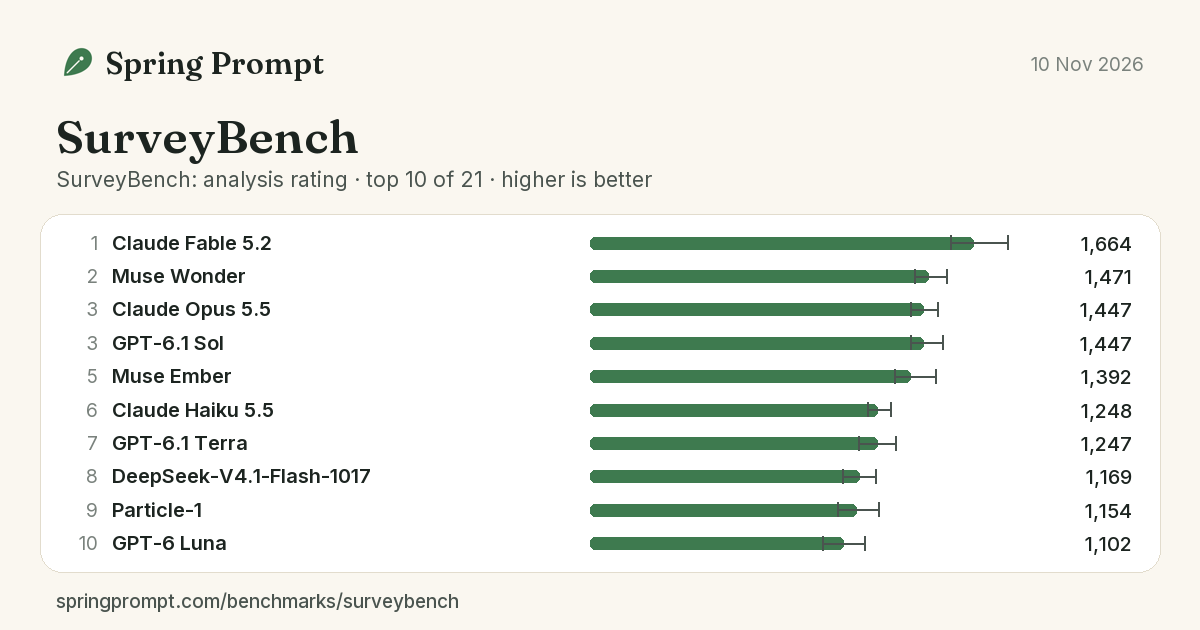
Latest results. , 24 models ranked.
Top 3 on Leading or double-barrelled questions (% of tasks, lower is better, each model at its best setting):
Ranks follow the score as shown, so equal numbers share a rank. Each model is shown at its best setting; show every setting. Each model runs at its provider's default reasoning setting, once per task. The rating comes from head-to-head comparisons of the analyses, so it keeps separating models after several pass the checks; ranges are 95% intervals from resampling the comparisons. Models whose ranges overlap are not reliably different.
Progress over time
Leading or double-barrelled questions, plotted at each model's release date, lower is better. Each model counts once, at its best setting. Scores are today's, not launch day's; 3 models without a known release date are left off. Hover or tap a mark for its model.
Best score so far
Every model at its release date. The line moves each time a new release beats every earlier one, and each new best is named where there is room.
Best score by lab
Each lab's best so far, stepping whenever one of its releases beats its own earlier models. The 6 labs with the best scores today; 4 others not drawn.
AnthropicOpenAIDeepSeekMoonshot AIMistral AIMeta
See the surveys and analyses
Every model's survey and analysis for every public task. Open a task to see the brief and the data every model analysed, or a model to read what it wrote, each number against the true value and what the judges flagged.
Why Fernway customers cancel· 2 of 23 sound
Whether to build one-tap skipping of any week (about four months of product work) or cut the price of the plans by 20%, to win back and keep customers. The brief and the data →
Where to put next quarter's product and sales effort to lift trial-to-paid conversion: a new accounting integration, assisted setup, a cheaper plan, or a shorter trial. The brief and the data →
Why Pennywell customers don't use savings pots· 5 of 23 sound
Whether to run an awareness and onboarding push for savings pots (in-app prompts and a set-up nudge on payday), to raise the pots rate to 3.85% AER, or both. The brief and the data →
Whether to reverse the per-shipment fee and bring back the subscription, invest in shipment tracking and proactive delay alerts, or add account managers for mid-sized customers. The brief and the data →
What Hollinbrook residents think of three-weekly bin collections· 4 of 23 sound
Whether to move general waste collection to every three weeks across the whole district, to do so with extra support for households that need it (a larger bin, or extra collections of nappies and hygiene waste), to pilot it in some areas first, or to drop the proposal. The brief and the data →
What Ledgerline's accountancy practices want built next· 5 of 23 sound
Which one improvement to build next half-year: AI categorisation of bank transactions, more reliable bank feeds (fewer broken connections), a client portal for requesting documents, or bulk Making Tax Digital submissions. The brief and the data →
How Ashgrove patients find online-first booking· 3 of 23 sound
Whether to keep online-first booking as it is, restore a morning phone booking line for every patient, or add a dedicated phone line and in-person help at reception only for patients who need them (over-75s, patients with a disability, and patients with limited English). The brief and the data →
Should Corefit gyms stop opening 24 hours?· 2 of 23 sound
Whether to close all 14 gyms between 11pm and 5am, close overnight only at the quietest gyms, or keep every gym open 24 hours. The brief and the data →
Why Riverside Food Network is losing volunteers· 3 of 23 sound
How to spend next year's £45,000 for volunteer support: reimburse volunteers' travel costs, fund a part-time volunteer coordinator with online shift booking, or do both at a smaller scale. The brief and the data →
Share of the set numeric questions answered correctly, against the share of planted traps in the data the analysis handled. Several models get the arithmetic right and still miss what the data cannot show.
Numbers rightTraps handled
Claude Fable 5.2
100.0% · 98.6%
Claude Haiku 5.5
100.0% · 94.2%
Claude Opus 5.5
100.0% · 95.7%
DeepSeek-V4.1-Flash-1017
100.0% · 91.3%
Gemini 3.1 Pro Preview
100.0% · 71.0%
Gemini 3.8 Flash
100.0% · 78.3%
Gemini 4 Carbon
100.0% · 92.8%
Gemini 4 Hydrogen
100.0% · 89.9%
Muse Ember
100.0% · 98.4%
Muse Wonder
100.0% · 100.0%
MiniMax M3.1 Flash
100.0% · 75.0%
Kimi K3.1 Pro
100.0% · 93.3%
GPT-6.1 Sol
100.0% · 95.7%
GPT-6.1 Terra
100.0% · 94.2%
Particle-1
100.0% · 95.7%
Qwen4-Max
99.0% · 98.6%
Mistral Large 4
98.9% · 78.7%
GPT-6 Luna
98.0% · 94.2%
Gemini 4 Argon
97.1% · 84.1%
GLM-5.3 FlashX Legal
94.9% · 83.0%
MiniMax M3.1 Flash
90.9% · 66.7%
Gemini 3.5 Flash-Lite
75.5% · 56.5%
Mistral Medium 3.5
75.5% · 59.4%
Claude Haiku 4.5
63.7% · 62.3%
Mercury 3
63.3% · 60.7%
0%25%50%75%100%
Why the research is not sound
Share of tasks failing each check. A task can fail several at once; any one means the survey or the analysis needs fixing before it is used.
Model
Traps missed
Wrong numbers
Unsupported findings
Mistaken next steps
Wrong recommendation
Leading or double-barrelled
Survey structure
Objectives unanswerable
Stakeholder's view presumed
Precision ignored
Claude Fable 5.2Anthropic
11.1%
0.0%
11.1%
0.0%
0.0%
22.2%
11.1%
0.0%
0.0%
0.0%
Muse WonderMeta
0.0%
0.0%
11.1%
0.0%
0.0%
44.4%
33.3%
11.1%
11.1%
22.2%
GPT-6.1 SolOpenAI
33.3%
0.0%
0.0%
11.1%
11.1%
0.0%
11.1%
0.0%
0.0%
0.0%
Claude Opus 5.5Anthropic
33.3%
0.0%
22.2%
0.0%
0.0%
0.0%
11.1%
0.0%
0.0%
0.0%
Qwen4-MaxAlibaba
11.1%
11.1%
55.6%
11.1%
22.2%
11.1%
22.2%
0.0%
0.0%
0.0%
Muse EmberMeta
22.2%
11.1%
22.2%
22.2%
22.2%
33.3%
22.2%
0.0%
0.0%
11.1%
Claude Haiku 5.5Anthropic
22.2%
0.0%
77.8%
22.2%
11.1%
33.3%
22.2%
0.0%
0.0%
0.0%
GPT-6.1 TerraOpenAI
33.3%
0.0%
0.0%
11.1%
11.1%
11.1%
22.2%
11.1%
11.1%
0.0%
Particle-1Particle AI
33.3%
0.0%
55.6%
22.2%
11.1%
11.1%
33.3%
11.1%
0.0%
0.0%
DeepSeek-V4.1-Flash-1017DeepSeek
44.4%
0.0%
44.4%
0.0%
11.1%
11.1%
33.3%
11.1%
0.0%
0.0%
Gemini 4 HydrogenGoogle
66.7%
0.0%
33.3%
11.1%
33.3%
44.4%
11.1%
0.0%
22.2%
0.0%
GPT-6 LunaOpenAI
33.3%
11.1%
22.2%
11.1%
11.1%
11.1%
22.2%
0.0%
11.1%
0.0%
Gemini 4 CarbonGoogle
44.4%
0.0%
77.8%
22.2%
22.2%
55.6%
11.1%
0.0%
11.1%
11.1%
GLM-5.3 FlashX LegalZ.ai
66.7%
33.3%
77.8%
44.4%
55.6%
44.4%
44.4%
22.2%
22.2%
22.2%
Gemini 4 ArgonGoogle
77.8%
33.3%
88.9%
33.3%
11.1%
66.7%
0.0%
0.0%
11.1%
11.1%
Gemini 3.8 FlashGoogle
88.9%
0.0%
77.8%
11.1%
0.0%
66.7%
22.2%
0.0%
22.2%
44.4%
Mistral Large 4Mistral AI
100.0%
22.2%
100.0%
66.7%
44.4%
33.3%
11.1%
11.1%
22.2%
55.6%
Gemini 3.1 Pro PreviewGoogle
88.9%
0.0%
77.8%
33.3%
44.4%
44.4%
22.2%
0.0%
22.2%
55.6%
Mercury 3Inception
88.9%
44.4%
44.4%
22.2%
77.8%
55.6%
22.2%
0.0%
22.2%
0.0%
Gemini 3.5 Flash-LiteGoogle
100.0%
100.0%
66.7%
44.4%
22.2%
77.8%
55.6%
33.3%
55.6%
100.0%
Kimi K3.1 ProMoonshot AI
88.9%
77.8%
77.8%
77.8%
100.0%
22.2%
11.1%
0.0%
0.0%
0.0%
Mistral Medium 3.5Mistral AI
100.0%
100.0%
100.0%
77.8%
44.4%
55.6%
11.1%
11.1%
33.3%
100.0%
Claude Haiku 4.5Anthropic
88.9%
100.0%
100.0%
55.6%
44.4%
66.7%
0.0%
22.2%
22.2%
100.0%
MiniMax M3.1 FlashMiniMax
88.9%
100.0%
88.9%
77.8%
88.9%
44.4%
44.4%
44.4%
33.3%
44.4%
MiniMax M3.1 FlashMiniMax
100.0%
88.9%
100.0%
100.0%
100.0%
77.8%
77.8%
66.7%
55.6%
66.7%
How SurveyBench works
1
The brief
An invented organisation's research brief: the decision, four objectives, who to survey, limits on length and sample, and a stakeholder's firm view.
2
The survey
The model writes the survey as it would be sent: screener, questions, display logic, sample plan and analysis plan.
3
The analysis
Every model then analyses the same fielded survey: crosstabs with bases, fielding notes and open-text answers from simulated respondents.
4
Head to head
On each task the judges compare analyses in pairs and pick the one they would rather send to the decision-makers. The votes become the rating.
The task
Survey data rarely says what it seems to at first glance. The risk is not an ugly chart: it is a confident finding from twelve respondents, a satisfaction score asked only of the people who got through, or a stakeholder's hunch written into the question.
Each task is an invented organisation (a meal-kit subscription, a bank, software firms, a council, a GP practice, gyms, a charity) with a brief written for the benchmark. The responses are simulated from respondent-level data with planted effects, so every true number, and every way of being misled, is known before any model sees it.
What makes the research sound
The survey
Within the brief's limits on questions and minutes; every objective answerable; no leading or double-barrelled question; the stakeholder's view tested neutrally; and a sample plan that says plainly when the precision asked for cannot be met.
The numbers
Ten to twelve set questions per task: shares, weighted figures, margins of error, significance tests, differences and counts of open-text answers, each checked against the true value.
The traps
Skewed samples, small bases, questions asked of only some respondents, averages pulled by a few extreme answers, trends broken by a change of method, stated intentions, organised campaigns and reversals within subgroups.
The advice
A recommendation that follows from the data, next steps that would settle what the survey cannot, and none of the mistakes a careless reading leads to.
Why a rating as well
Sound research is a bar: once the best models clear it on most tasks, it stops telling them apart. The head-to-head rating does not run out of room, because an analysis only has to be preferred to another one. Each analysis meets about six others per task; a 400-point gap means the higher-rated model's analysis is preferred about ten times out of eleven.
What it measures
Survey questions: leading, double-barrelled, assumptive or ambiguous
Whether the survey can answer the brief within its limits
Numbers read from crosstabs, weighted, and tested for significance
Whether the analysis is misled by weaknesses planted in the data
Next steps, and what would change the recommendation
What it does not measure
Your customers, your data or your survey tool
Interviews, usability tests or other qualitative research
Fielding the survey or cleaning raw response files
Method
Respondents are simulated, so every true number is known exactly
Numbers and survey structure are checked by code
Three judges from three vendors decide each judged check by majority
No judge compares analyses from its own vendor
Three tasks are held back so the set can be refreshed
Put SurveyBench's current top 10 in your article. Free to reuse under CC BY 4.0; the code includes the credit link. Add ?n=5 for fewer rows, ?models= with model slugs (as in our model page addresses) for your own comparison, or ?theme=dark.
Interactive chart
<iframe src="https://springprompt.com/embed/surveybench" title="SurveyBench results by Spring Prompt" width="100%" height="456" style="border:0;max-width:720px" loading="lazy"></iframe>
<p><a href="https://springprompt.com/benchmarks/surveybench">SurveyBench results by Spring Prompt</a></p>
Image, for sites that block iframes
<a href="https://springprompt.com/benchmarks/surveybench"><img src="https://springprompt.com/og/benchmarks/surveybench.png" alt="SurveyBench: the top 10 AI models by analysis rating" width="1200" height="630" style="max-width:100%;height:auto"></a>
<p><a href="https://springprompt.com/benchmarks/surveybench">SurveyBench results by Spring Prompt</a></p>
Every judged check is decided by a majority of three judges: GPT-6.1 Sol, Claude Opus 5.5 and Gemini 3.1 Pro. On 12 tasks and seven models, corrected for chance (Fleiss' kappa), they agreed most on next steps (0.81 to 0.85), traps (0.73) and whether a survey faces the precision it was asked for (0.93), and least on double-barrelled questions (0.38), whether every objective can be answered (0.39) and which findings are unsupported (0.49). No judge favoured its own vendor's model. In head-to-head comparisons a judge never votes on a pair that includes its own vendor's analysis. A sample of human ratings is still to come.